From your first lecture to your admission at the Supreme Court of NSW—here is your roadmap to a legal career

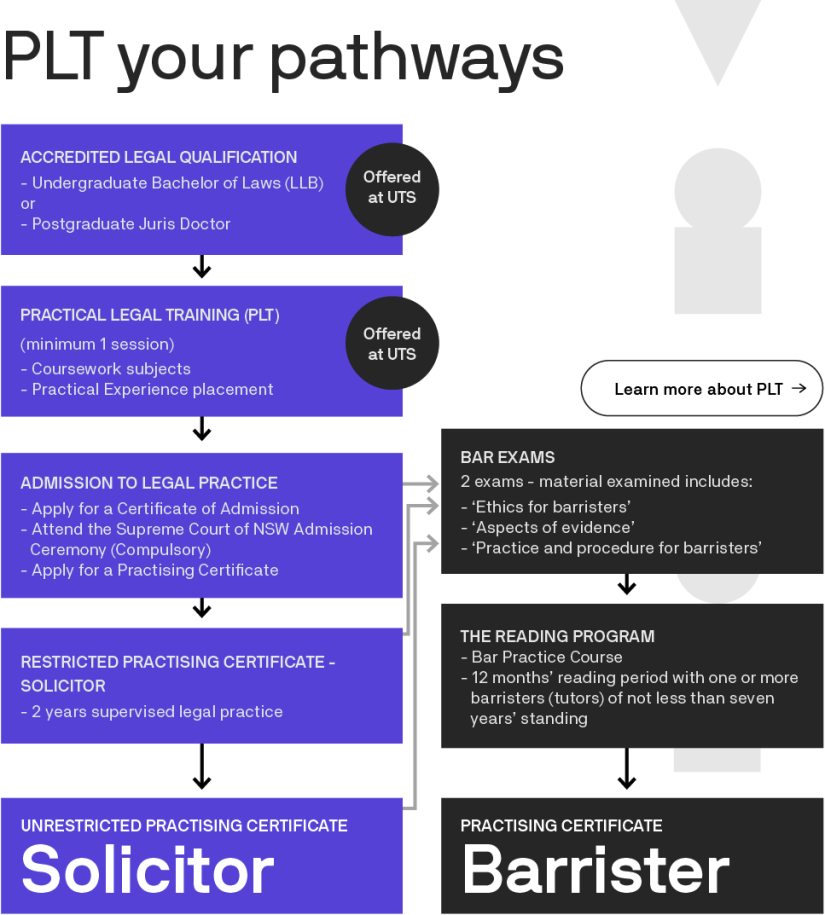
The law journey at a glance
Ready to pursue a career in law?
Becoming a lawyer is a rigorous but rewarding process. In New South Wales (NSW), there are four distinct steps to moving from a student to an admitted legal practitioner.
solicitor vs barrister: What's the difference?
Most law graduates start as solicitors, but it is important to know where each path leads.
| Feature | Solicitor | Barrister |
|---|---|---|
| Primary Role | The first point of contact for clients. They advise on and manage legal work including contracts, litigation, and case management. | Specialist advocates who represent clients in court and provide expert opinions on complex matters. They are engaged by solicitors on behalf of clients. |
| Work Environment | Law firms, government agencies, not-for-profits or in-house corporate teams. | Usually self-employed, working from ‘Chambers’. |
| How to get there | Your journey starts as a lawyer once you receive your Practising Certificate (see step 4) | Requires passing Bar Exams after gaining admission as a legal practitioner (see step 3). |
Step 1:
Complete an accredited legal qualification
Duration: 3–5 years
Your journey begins with an academic foundation. At UTS, we offer two primary pathways depending on your current education level.
Which degree is right for you?
- I am a high school leaver:
BACHELOR OF LAWS (LLB)- Duration: 4 years full-time
- The details: An undergraduate degree that combines legal theory with real-world practice. You can also combine this with degrees in Business, Science, IT, and more. LLB can include PLT.
- I already have a degree in another discipline:
JURIS DOCTOR (JD)- Duration: 3 years full-time
- The details: A postgraduate qualification designed for graduates from non-law backgrounds or those with an international legal qualification who want to pivot their career into law.
Step 2:
Practical Legal Training (PLT)
Duration: ~6 months
A law degree teaches you the law; PLT teaches you the skills needed to be a lawyer. This compulsory practical training covers the day-to-day skills you need, such as trust accounting, soft skills, ethics, and litigation practice.
The UTS Advantage:
Unlike many other institutions, UTS offers a one-stop shop. You can include PLT in your LLB or JDPLP, or you can complete your PLT directly with us immediately after finishing your degree.
Explore the Practical Legal Training (PLT) Program
Step 3:
Admission to Legal Practice
(The Ceremony)
Once you have your degree and your PLT certification, you are ready to make it official.
- Apply: Submit your admission application to the Legal Profession Admission Board (LPAB) for a Compliance Certificate.
- Attend: Once approved, you will attend an Admission Ceremony at the Supreme Court of NSW.
- Oath: You will take your oath of office and sign the Supreme Court Roll.
Congratulations! You are now an admitted legal practitioner.
Step 4:
Your practising certificate
(Start your career)
Admission makes you a lawyer on paper, but to work you need a Practising Certificate.
- The Solicitor route: Apply to the Law Society of NSW for a Restricted Practising Certificate. You will work under the supervision of a senior lawyer for two years. After that, you can apply for an Unrestricted Practising Certificate.
- The Barrister route: While some sit the Bar Exams immediately, many lawyers work as solicitors first to build a network and experience before specialising in courtroom advocacy.
Don't wait to kick-start the legal career of your dreams