


Awkar Ruel has creativity running through his veins. From a young age, he wanted to be an architect, working in a profession where he could bring the drawings that lived in his imagination into the real world.
But when he came across the Bachelor of Creative Intelligence and Innovation (BCII) at the University of Technology Sydney, Awkar realised he could do more than just a standalone architecture degree. Combining his love of design with creative intelligence would set him apart from others in his field.
“I’m passionate about design, drawn to creating and I love being able to innovate and push the boundaries, so I thought this degree combination made perfect sense,” he says.
Creative intelligence in the real world
Awkar admits that when he first started the BCII, he didn’t really know what he was getting himself into. At the time, the degree was still new and the concept of creative intelligence was yet to hit the mainstream.
But as he immersed himself in the BCII’s studio subjects, think tanks, hackathons and other unconventional learning opportunities, he was hooked.
“I was in love with it from the get-go,” he says. “I didn’t know what I was expecting. It was a beautiful surprise.”
The BCII introduces students from all different study areas to the concept of creative intelligence, equipping them with the skills to reframe challenges, sit with uncertainty, and consider unlikely solutions to complex problems. It can be paired with one of 26 UTS core degrees, from engineering and science to health and communication.
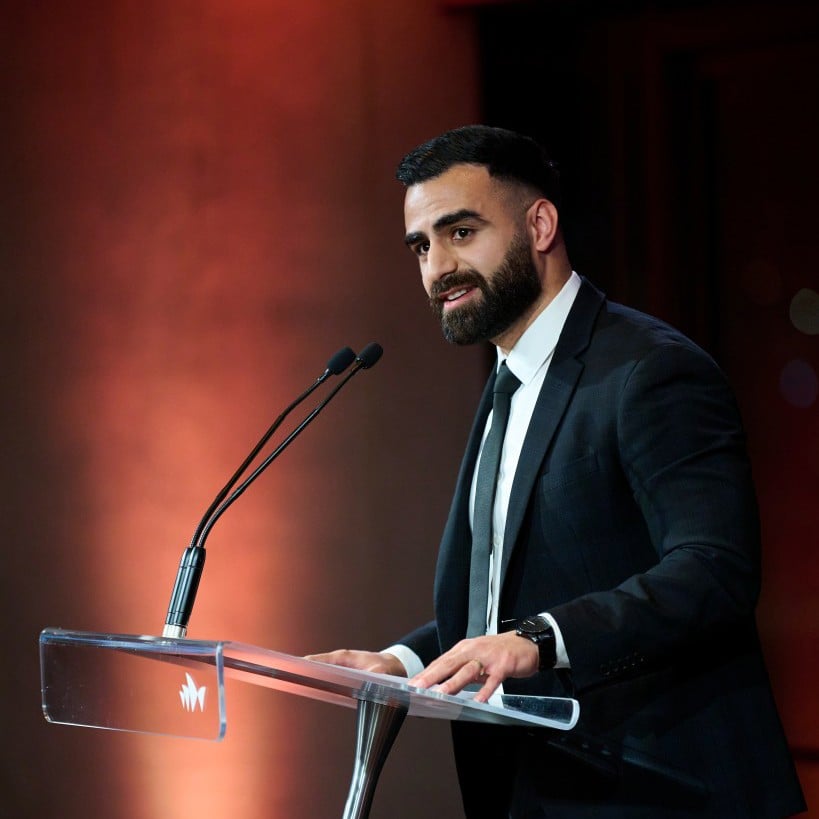
“I think having gone through a degree that’s all about being agile and being able to work under pressure while simultaneously being creative has translated, in an indirect way, into how I work on my projects at Grimshaw.”
For the first three years, students study their standard UTS degree during the semester and complete their BCII subjects during summer and winter schools. In the fourth and final year, they explore internships and other practical opportunities that draw on the entirety of their creative intelligence learning.
For Awkar, that fourth year included internships with Google’s creative think tank, Google Zoo, and with AMP.
“I think one of the reasons I managed to land both those internships is that the BCII prepares you to operate at the edge of what’s possible,” he says.
At Google Zoo, he worked on a challenge specific to a new Google product, although the details remain protected by an NDA. The AMP experience was more of a traditional internship, shadowing senior members of the company’s innovation team and getting a feel for what an innovation career might look like.
In both settings, Awkar could see the impact of his creative intelligence capabilities on real-world work.
Transforming urban spaces
Though he was learning to push the boundaries of creativity, at the time, Awkar didn’t necessarily see how the BCII would support his future architectural career. As an undergraduate student, he didn’t think about it too much – he was having fun, studying something he was passionate about, and was on track to progress into his dream career.
But once he was out in the world of work, the impact and relevance of the BCII became clear. For the last seven years, he’s worked at international architecture firm Grimshaw, first as a graduate, then as a designer, and now as a registered architect. In that time, he’s worked on major projects like Sydney Metro West; in 2025, he temporarily relocated to Perth to help deliver a new science building at Curtin University.
Even in the early days of his post-UTS life, Awkar had a sense that the skills he brought to his professional practice didn’t start and stop with drawing and design. The methodologies he’d learnt in the BCII kept showing up in his practice, from rapid brainstorming and iterating through to transdisciplinary communication and the ability to take on feedback from a place of curiosity, rather than defensiveness.
I think one of the reasons I managed to land both those internships is that the BCII prepares you to operate at the edge of what’s possible.
“It’s not always super evident that I’m using a specific BCII methodology to approach a problem, but I think having gone through a degree that’s all about being agile and being able to work under pressure while simultaneously being creative has translated, in an indirect way, into how I work on my projects at Grimshaw,” he says.
“Architecture comes with its own design methodologies and its own ways of thinking and drawing and modelling, but I think the BCII complements it a lot.”
But what really makes him stand out, he says, is his ability to bring people together. Collaboration is a hallmark of the BCII, in which students come together in transdisciplinary combinations to solve problems of every kind.
And, as it turns out, it’s a hallmark of the architecture profession, too. Architectural projects can involve everyone from developers to engineers, designers to surveyors, construction managers to tradespeople. Being able to find common ground among all these stakeholders is essential to shared success.
“I’m not a traditional architect in the sense of just designing, drafting and delivering ideas. I can also be empathetic with other people’s perspectives and discipline and step up as the mediator or facilitator, helping to foster conversations that often led to unexpectedly creative outcomes,” says Awkar, who now draws on those skills to mentor students as part of the BUILD program at the Sydney Opera House.
“When you’re dealing with people from different disciplines and backgrounds, being able to deploy this kind of empathy has been lifechanging for me in my career and my approach to design.”
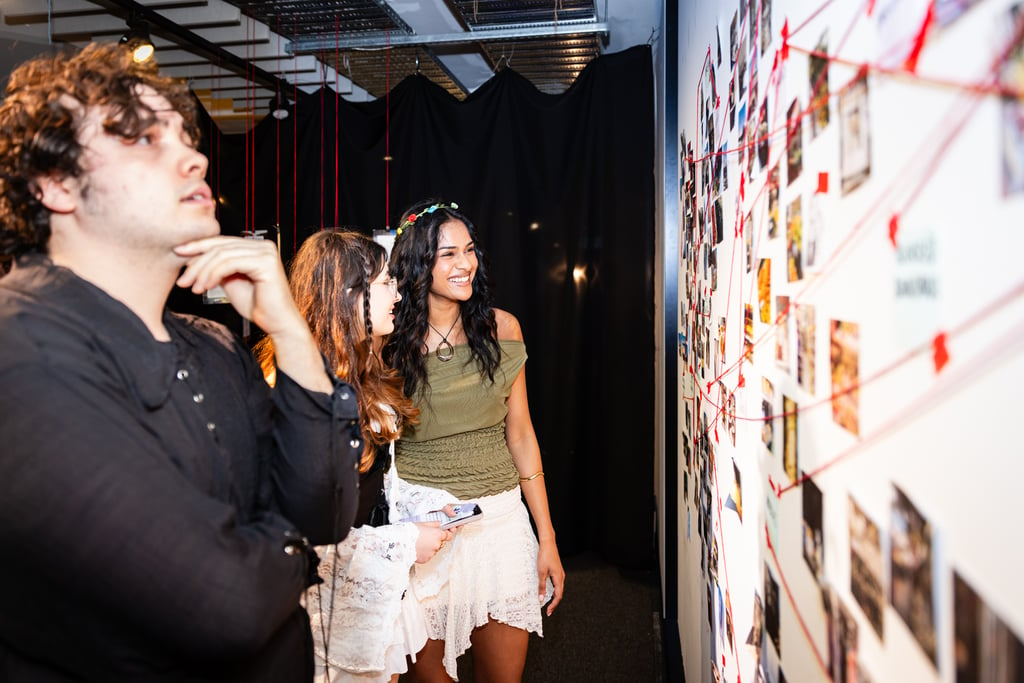
Creative intelligence will be essential to the future of work. Here’s why.
Creative graduates who can thrive within complex and uncertain environments and tackle challenges across disciplines, fields and industries are transforming...

Innovation for the greater good
Kirah Godsell was always going to change the world, but it wasn’t until she enrolled at the University of Technology Sydney (UTS) that she figured out how.

One degree, multiple paths to a data science career
One of the most valuable aspects of the Master of Data Science and Innovation is that graduates emerge with the skills to work in multiple industries.

Transdisciplinary Learning: Why It Matters in Education and the Future Workforce
Discover what transdisciplinary learning is, why it matters, and how it builds adaptable skills for solving complex real-world challenges.
Creative intelligence will be essential to the future of work. Here’s why.
Creative graduates who can thrive within complex and uncertain environments and tackle challenges across disciplines, fields and industries are transforming...
Innovation for the greater good
Kirah Godsell was always going to change the world, but it wasn’t until she enrolled at the University of Technology Sydney (UTS) that she figured out how.
One degree, multiple paths to a data science career
One of the most valuable aspects of the Master of Data Science and Innovation is that graduates emerge with the skills to work in multiple industries.
Transdisciplinary Learning: Why It Matters in Education and the Future Workforce
Discover what transdisciplinary learning is, why it matters, and how it builds adaptable skills for solving complex real-world challenges.