


Kirah Godsell was always going to change the world, but it wasn’t until she enrolled at the University of Technology Sydney (UTS) that she figured out how.
A student in the Bachelor of Advanced Science (Pre-medicine), Kirah started university with multiple career paths in mind. Every variation, from health care to international aid, involved doing work that would benefit more than just herself.
But when she stumbled across the Diploma in Innovation, part of the UTS Transdisciplinary School, the way forward became clear. Kirah is now the co-founder of Air2Energy, a start-up that could transform the marine sector—and the planet.
Collaboration that leads to innovation
The Diploma in Innovation is an add-on degree that’s open to undergraduate students from almost every discipline at UTS. It connects students with hands-on creative problem-solving tools and techniques, preparing them to tackle complex and undefined challenges in any sector.
Air2Energy, which transforms marine vessel exhaust into electricity, emerged directly from Kirah’s Diploma experience. In a subject focused on innovation in design, students were given a project on which they had to partner with peers from other UTS disciplines to investigate a complex challenge.

“I selected the Diploma in Innovation as a point to differentiate myself from other graduates in my field. I went in on a whim, did the first class and ended up loving it. It really taught me to think differently.”
Kirah Godsell

Kirah and her teammates, one studying Business and the other studying Software, chose climate change, something all three were concerned about. They combined their diverse expertise to design a system that could capture waste from the exhaust stacks of car tunnels and use it to generate electricity. It was a solution that combined science, tech and business in one.
From the outset, Kirah knew they were onto something. So did her UTS Business School teammate, Andrew Smithyman, now her co-founder. Over the next year or so, the pair kept building on the idea until it slowly started to become what Air2Energy is today.
“We registered a company and started working with some professors from the university who have become our advisory board and helped us grow,” Kirah says.
From sleepless nights to start-up success
Like every good founder story, Kirah and Andrew’s started in a garage—specifically, the garage at Andrew’s parents’ house—where they spent sleepless nights trying to turn Air2Energy from an idea into a tangible product, all while continuing their UTS studies.
The process was helped by staff at the Transdisciplinary School, who helped Kirah identify and enrol in Diploma in Innovation subjects that would help her build the business, and who supported her to work on Air2Energy as part of her assessments.
Kirah also added subjects in chemistry and physics to her degree mix, but it was the Diploma’s creative problem-solving techniques that really helped get Air2Energy off the ground.
“Whenever we come up against problems, a lot of the problem-solving skills I use to develop solutions come from the Diploma,” Kirah says.
“Just being able to think outside the box and assess the situation, look at what tools you have around and then go, ‘Okay, how are we going to fix this?’ has been invaluable.”
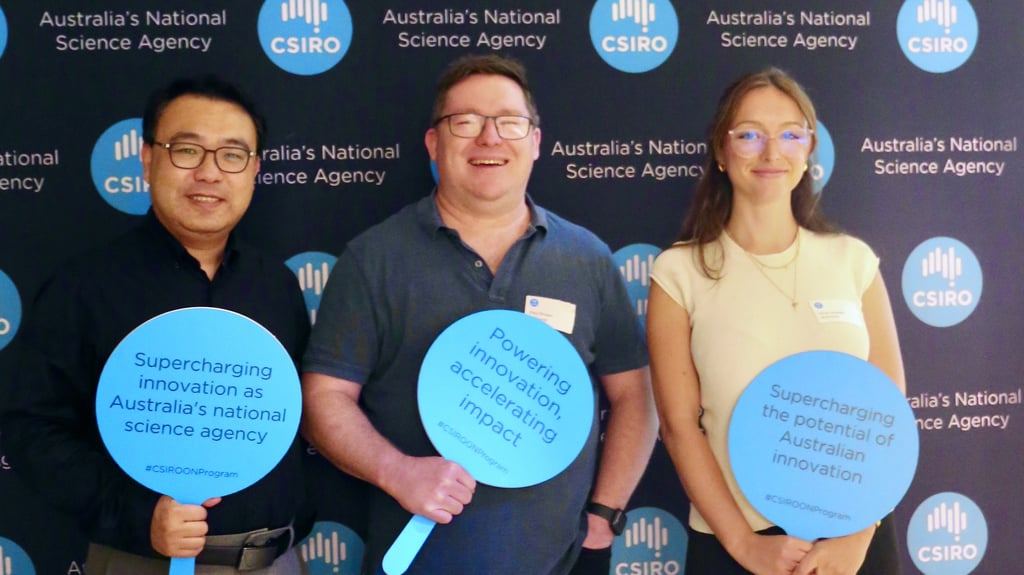
Success has been swift: in 2025 alone, Kirah, Andrew and their collaborators, UTS Engineering researcher Associate Professor Qiang Fu and Associate Professor Paul Brown from the Transdisciplinary School, have completed the CSIRO-led ON Prime business incubation program. They are now participating in the ON Accelerate initiative.
ON Prime supports small research teams to build evidence of research impact and better understand the target markets that could benefit from their work. ON Accelerate is a commercialisation accelerator that helps research teams prepare to take their innovations to market.
Kirah and Andrew also took out second place at the IBISWorld 3P Student Innovation and Entrepreneurship Program and scored an Honourable Mention in the Student Pitch competition at SXSW Sydney. Air2Energy is now part of UTS Startups, one of Australia’s largest entrepreneurship communities.

Ready for impact
These are all big steps towards an even bigger goal: to transform Air2Energy into a viable company that can start making inroads into the problem of marine pollution. The journey to this point has been long and winding, but now, the finish line is in sight.
“We’re currently working on our prototype design, and from there, once we do some lab testing, we can then pilot the technology on some marine vessels,” Kirah says.
“Hopefully, after a full-scale prototype and pilot test on a cargo ship, we’ll be ready for market in 2029.”
Just as Air2Energy has evolved over time, Kirah’s goals have too. She still has dreams of a health care career, but she’s putting them on hold to make the most of the Air2Energy experience. After all, the end goal of Air2Energy isn’t so different to the end goal of working in health care: doing something for the greater good.
“My career goals, if you look at them from an objective point of view, have always been about making an impact,” she says.
“With Air2Energy, I want to make as much environmental impact as possible.”

Designing a creative urban future
Awkar Ruel has creativity running through his veins. From a young age, he wanted to be an architect, working in a profession where he could bring the drawings...
Creative intelligence will be essential to the future of work. Here’s why.
Creative graduates who can thrive within complex and uncertain environments and tackle challenges across disciplines, fields and industries are transforming...

One degree, multiple paths to a data science career
One of the most valuable aspects of the Master of Data Science and Innovation is that graduates emerge with the skills to work in multiple industries.

Transdisciplinary Learning: Why It Matters in Education and the Future Workforce
Discover what transdisciplinary learning is, why it matters, and how it builds adaptable skills for solving complex real-world challenges.
Designing a creative urban future
Awkar Ruel has creativity running through his veins. From a young age, he wanted to be an architect, working in a profession where he could bring the drawings...
Creative intelligence will be essential to the future of work. Here’s why.
Creative graduates who can thrive within complex and uncertain environments and tackle challenges across disciplines, fields and industries are transforming...
One degree, multiple paths to a data science career
One of the most valuable aspects of the Master of Data Science and Innovation is that graduates emerge with the skills to work in multiple industries.
Transdisciplinary Learning: Why It Matters in Education and the Future Workforce
Discover what transdisciplinary learning is, why it matters, and how it builds adaptable skills for solving complex real-world challenges.