


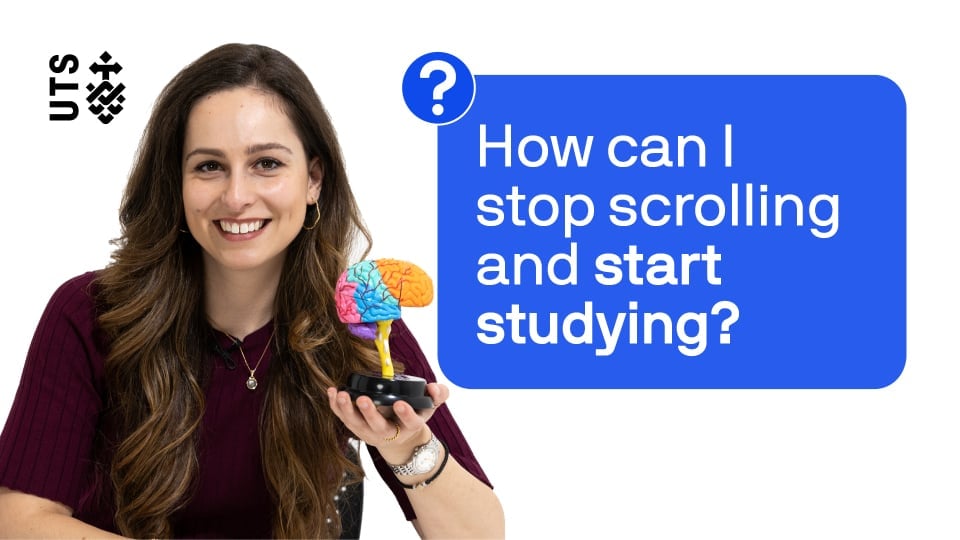
Finding it challenging to put down your phone and hit the books? Dr Anastasia Hronis, a clinical psychologist, lecturer and researcher at the UTS Graduate School of Health, offers insights and practical tips to help you regain your focus as we head into HSC season.
In today’s digital world, staying focused on studying can be challenging. Dr Anastasia Hronis understands that many students feel overwhelmed by the constant pull of digital distractions, especially during high pressure times like the HSC.
In her clinic, Dr Hronis often hears from people seeking advice on improving their study habits and breaking the cycle of endless scrolling on phones, social media and apps.
“Don't be too hard on yourself if you struggle to stop scrolling,” she says. "Social platforms are designed to keep us engaged for long periods, they're intentionally ‘sticky’."
The developers making these platforms understand human psychology and how the brain works. Their main goal is often to maximise profit, which means they need to keep us engaged with their apps for as long as possible. They know that using their apps gives us small dopamine hits, so they design features like notifications to keep us coming back for more.
Think about how effortlessly we use social media, it requires minimal cognitive effort. Platforms like Facebook, TikTok and Instagram have removed the 'click to see more' button, which used to interrupt the trance-like scrolling state. Now, users can scroll endlessly without breaks.
This doesn’t mean you should stop social media completely, unless of course you want to! It's important to find balance.
Here are 4 psychologist tested and approved tips to help you regain your focus:

Set timers
Use phone timers to notify you after 10 minutes on social media.

Create distance
Keep your phone in another room whilst studying to avoid distractions and minimise dopamine triggers. Even thinking about your phone can activate dopamine, making it harder to concentrate. Keeping your phone out of sight will help you maintain focus.

Use flight mode
Activate flight mode to create a barrier against automatic social media checking. This acts as a circuit breaker, giving you time to become more conscious of your actions.

Work with your schedule
Identify your peak times for studying, for example, when you feel most alert, and allocate those times for focused work. Procrastination is common, and it's easier to do quick and easy tasks than to study. If this is the case for you, prioritise study early in the day, then reward yourself with social media breaks or other enjoyable activities.

Set restrictions on your phone
Now that you have worked out your optimal study habits, use your phone's settings to set time limits and designate specific days for app access. Consider your study schedule and leisure time and manage your access accordingly. Prioritise limiting the apps you find hardest to control.
These strategies can be effective circuit breakers for managing your app use, boosting your focus and productivity. However, it's important to remember that breaking habits can be tough, and your phone use or study schedule doesn’t have to be perfect. These tips are designed to help you reflect on your habits and think more critically about how you spend your time, showing you what you miss out on, like studying, when you spend too much time scrolling your phone.
Contributor

Clinical Facilitator, Faculty of Health
Curious to know more?
Learn more about managing study and the impact of dopamine on your brain in this episode of Curiosities.

Webpage
8 things to think about when choosing a university degree overseas
To help you make a confident decision, we've put together eight important things to consider before choosing your university degree overseas.

Webpage
6 careers that will be crucial for addressing climate change
UTS’s Professor Chris Turney shares his thoughts on the careers and job titles that have the most potential to act on climate change now and into the future.

Webpage
Startup founders share their top tips for those starting out
We have the tips you need to navigate the early stages, from founders who've been there.

Webpage
Careers in fashion that aren’t being a designer
Want to work in fashion but don’t see yourself as a designer? The industry is full of exciting, essential roles beyond the sketchpad.
Webpage
8 things to think about when choosing a university degree overseas
To help you make a confident decision, we've put together eight important things to consider before choosing your university degree overseas.
Webpage
6 careers that will be crucial for addressing climate change
UTS’s Professor Chris Turney shares his thoughts on the careers and job titles that have the most potential to act on climate change now and into the future.
Webpage
Startup founders share their top tips for those starting out
We have the tips you need to navigate the early stages, from founders who've been there.
Webpage
Careers in fashion that aren’t being a designer
Want to work in fashion but don’t see yourself as a designer? The industry is full of exciting, essential roles beyond the sketchpad.