From artificial intelligence (AI) and virtual production to new formats like short-form video and vertical storytelling, the screen industry is changing fast.

We spoke with filmmaker and UTS academic Associate Professor Alex Munt to look at the trends, skills and education shaping the next generation of screen professionals.

Australia’s screen industry is evolving quickly. New technologies and formats such as artificial intelligence (AI), virtual production, streaming services and short videos are changing how film and television are made and viewed. These shifts are also reshaping the kinds of jobs available in the industry.

If you're thinking about a career in screen, you’ll need to work with new tools, adapt to changing workflows and understand how audiences engage with stories.

Learning to be agile

If you want to work in screen production today, you need to understand the complexity of contemporary screen production and feel confident working across different formats and platforms. Whether you’re a writer, director, editor or producer, Munt says having a solid foundation in traditional filmmaking is essential, but being open to change is just as important.

He outlines three core areas to understand:

  • Development: storytelling, screenwriting, producing and financing
  • Production: the creative and technical work on set
  • Post-production: editing, visual effects and AI-supported workflows

Breaking into the industry doesn't follow one path. Many students start in support roles or on smaller projects, gradually working towards their long-term goals. For Munt, being adaptable is essential, especially as technology continues to evolve.

That includes knowing how to work with new tools. At UTS, you’ll work with academics and industry professionals to learn how technologies like AI can support creative work, from generating visuals to shaping sound. You’ll be encouraged to experiment, test ideas and build confidence with tools that are already reshaping storytelling.

One new area to prepare for is virtual production, a method that uses LED volumes of screens powered by real-time rendering and game engine technology. Munt also points to Netflix’s use of generative AI for visual effects in The Eternaut as an example of how fast things are moving, especially in post-production. As technology evolves, so must education.

To support hands-on learning, UTS partners with industry leaders such as ARRI (cinematography), AVID (editing) and the Australian Directors’ Guild (ADG).  If you're already working in film or media, you can also upskill through short courses and microcredentials, particularly in areas like screen storytelling and AI-assisted editing.

What’s changing in the industry

There are several important shifts happening in the screen industry in Australia, creating more opportunities for new creatives starting out.

Munt identifies a few key trends: 

  • International streaming platforms continue to dominate distribution, but proposed policies to support local content could increase demand for distinctly Australian stories. 
  • Short-form and vertical storytelling are changing how narratives are constructed, largely driven by our smartphone use. While cinema has traditionally been a landscape medium, new vertical formats are emerging particularly in markets like China. 
  • Independent filmmaking remains a space for bold storytelling and diverse voices. Munt cites filmmaker Werner Herzog, who calls himself a “foot soldier of cinema.” These are creatives motivated by principle rather than commercial success. 
  • Cinema isn't disappearing. Despite frequent predictions, cinema is a resilient and important part of our culture. Audiences still value the shared experience of watching stories on the big screen, with film festivals like the Sydney Film Festival reporting record audiences in 2025.
  • At the same time, alternative screenings are becoming more popular. Events like those hosted by Static Vision bring audiences together in non-traditional venues like warehouses and industrial spaces. In an age of remote work and digital meetings, these events offer a sense of connection that many people are looking for.

Future creative roles 

The screen industry now offers more creative roles and work opportunities than ever before, from traditional cinema and television to streaming, branded content, games and immersive experiences. 

Key roles like producer, director, screenwriter and editor remain essential; however, the ways in which these creatives work are changing: 

  • Directors are starting to use AI to pre-visualise scenes and plan shots. 
  • Screenwriters are exploring AI-assisted drafting and story development. 
  • Editors are using advanced tools to speed up transcription, enable translation into multiple languages and streamline the integration of visual effects. 

There are also new specialist roles you can step into:

  • Virtual production specialists use advanced gaming and real-time graphics technology to create realistic digital environments during filming. Using tools like Unreal Engine, they help filmmakers and television producers visualise and adjust digital scenes (backgrounds, lighting and effects) live on set.
  • Data wranglers manage and protect digital files created during filming, including footage and audio. They organise, back up and track these assets to ensure safe transfer between departments, preventing loss or corruption and supporting a smooth production workflow.

What the industry needs now

Munt highlights several priorities that will help Australia’s screen industry grow and stay competitive:

  • Ongoing investment in local content, supported by government policies like the NSW Government’s $380 million screen and digital games package.
  • Expanding infrastructure and production capacity to attract international and large-scale projects.
  • Balancing strong storytelling with new production and post-production tools.
  • Building stronger connections between education and the industry, so you get hands-on experience through internships, mentoring and professional networks.

Munt also points to post-production and visual effects as areas with global potential. Australian studios already have a strong reputation, and as AI and digital workflows expand, these strengths could offer a competitive edge.
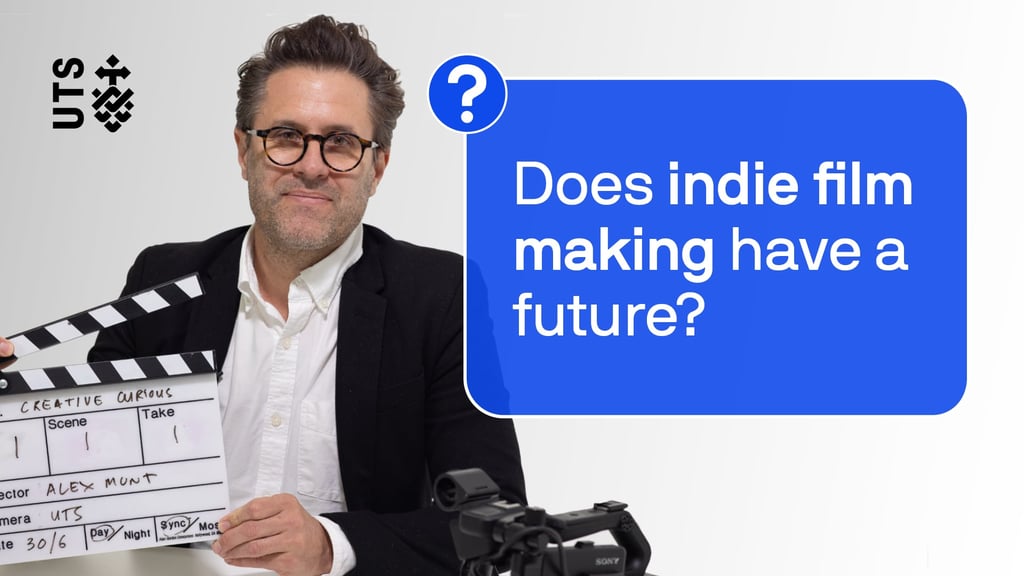
Alex Munt Curiosities thumbnail

Want to learn more about the future of film?

Check out our Curiosities episode, where filmmaker and researcher Asssociate Professor Alex Munt answers your questions about AI in screen storytelling, the rise of streaming and how technology is reshaping the industry.

Want to learn more about the future of film? transcript

Hello curious people. I'm Associate Professor Alex Munt, a filmmaker, screenwriter and media researcher at UTS specialising in micro-budget filmmaking and creative screen practices. I'm here today to answer your curious questions about filmmaking, creativity, and the future of cinematic storytelling. This is creative curious. 
 
00:00:25:10 - 00:00:57:19 
The UTS community has sent in some thought provoking questions to tackle. Let's get started. How is technology shaping the film industry? Technology has always shaped the film industry. It’s a medium that was first designed with inspiration from the sewing machine. We can think of the inventors of cinema as the Lumiere brothers or Thomas Edison. All kinds of technologies have shaped the way we screen stories and made, and screen stories arrive to us. We can think about, virtual effects. We can think about, the introduction of colour to moving pictures. We can think about the birth of television, the remote control, the zapper which makes from one, one image to the next. 
 
00:00:57:19 - 00:01:27:04 
 
Today, there's a lot of hype around a few things and interests.One of those is AI, but also around the way that gaming technologies are affecting cinema, cinematic language, and the cinematic image as well. Is AI enhancing or threatening creativity in filmmaking? The answer is it's a double edged sword. On the one hand, the power of AI can really support and help creatives working with a hungry and technical kind of workflows, for example, in post-production and editing. On the other hand, AI can be an a homogenizing force. 
 
00:01:27:04 - 00:02:02:03 
 
It can make everything the same. It can basically reduce the emotion within our, within our storytelling and therefore, really have some kind of threat to the way in which screen stories arrive to emotionally impact an audience and those ideas and around authenticity. The other ideas are around labor. And we saw this, for example, with the with the writers strikes. And so in America, there's a threat that AI can basically devalue what humans bring to screen stories simply through an efficiency quota and replacing that human, labor and skill, which has generated screen stories across time with cheaper kind of technology. 
 
 
00:02:02:03 - 00:02:35:22 
 
What are some of the ethical considerations around using AI in creative work? We've seen a few controversies here. I can think of The Brutalist which is a low budget film. Its Oscar nominated, and the filmmakers got into a bit of hot water when, when audiences realised that some of the dialog which is, which was Hungarian, delivered by actors not completely familiar with that language was was basically put through AI in order to refine and correct that language. That's a really good example of AI in filmmaking. On the one hand, the production would have benefited from some of the efficiencies in using and sculpting the dialog for the film. 
 
00:02:36:03 - 00:03:08:10 
 
On the other hand, some people would say, is this an authentic screen performance? Does not devalue the human performance in the acting. That's maybe one for you to think about and decide. The other controversy is around this idea of digital resurrection. We've seen this with Paul Walker in Furious 7, Carrie Fisher in Star Wars. The idea that an actor's performance is posthumously recreated, and I guess some of the ethical considerations about that is that that actors no longer control of their legacy if they have any new roles, new speaking parts, new roles in drama production after they've passed away. 
 
00:03:08:15 - 00:03:44:01 
 
The big one, and it's one that we talk a lot, a lot at UTS across the different faculties is around copyright and the training of these AI models. What what is the data set that relies upon and what is the copyright that and have the artists of that data set given their approval for this, for this use of the technology? Can technology 
like AI coexist with artistic integrity? Technology and cinema and television have always been, hand-in-glove in the way that they impact each other. The one thing to remember is the AI is a predictive technology, is trained on a data set, which means that it's based on what already exists, what the rather than what already might be. 
 
00:03:44:01 - 00:04:00:18  
 
When we come to the cinema, when we sit in a dark room with strangers and watch the fluttering light beam, we want to be entertained but we also want it to be meaningful. We want to be connected with emotionally. We want to be in the moment with the story. It's hard to think about the ways which AI can deliver that kind of experience. 
 
00:04:03:03 - 00:04:20:16 
 
How is streaming changed filmmaking? Okay, another good question. Streaming change filmmaking in both more smaller and subtle ways. And also larger, more obvious kind of ways we can think of really as streaming is opening up content and opening up, certain genres and styles. Things like Squid Game, the Korean series, which has captured the world. 
 
00:04:20:16 - 00:04:45:06 
 
In Australia we can think about this idea of what the streamers call hyper localisation. And a good example of that is Heartbreak High. Heartbreak high was an Australian series, and that in the mise en scene of that, it introduce a global audience to the Eshays what they wear, how they speak. And again, a very successful example of that. The other question here is back to IP again, and Netflix have just announced 
the adaptation of My Brilliant Career. 
 
00:04:45:06 - 00:05:10:19 
 
First made as a feature film by Gillian Armstrong in 1979 and now going to be reimagined for 2025ish, TV series. So again, this idea of the future is also bound up with the past in the way that existing films are now becoming IP for streaming television versions of them. Another way we can think about that is really looking 
closely at the industry itself in relation to how the streaming platforms negotiate Australian made content. 
 
00:05:11:10 - 00:05:36:21 
 
In New South Wales, the screen and digital game sector is worth about $1.2 billion annually, also supports around 15,000 jobs of the crews from above the line to below the line. We have the big US productions coming here Thor, Love and Thunder, Mad Max Furiosa or The Fall Guy. But really, what we really want in Australia is for our screen industry to be both creatively sustainable and also economically sustainable, 
and that's where this idea of quotas come in. 
 
00:05:36:21 - 00:05:55:02 
 
There's a bit of a push and pull whether we need to force our streamers, our international streamers, to have a mandate on a certain percentage of Australian content. But on the other hand, streamers are audience friendly and want to give the audiences what they perceive they want to a degree. So we can see streamers like Stan who Australian content has become part of their brand. 
 
00:05:55:08 - 00:06:11:09 
 
But also like we talked about Netflix in basically using, prime Australian IP, like My Brilliant Career and adapting that from a feature film into a television series as well. 
So quotas are difficult. It's a complex, ongoing conversation and really the jury's a little bit out on that. 
 
00:06:11:16 - 00:06:13:22 
 
Why does it seem like there are no original movies? Everything seems to be sequels, adaptations, or part of a franchise. IP is a risk measure. IP basically tries to ensure that producers know that they'll get the bang for the buck to the money that they kind of invested. Returns to this idea of William Goldman, screenwriter, is that nobody knows anything. IP is a risk mitigation device. 
 
00:06:32:16 - 00:06:53:07 
 
Does indie filmmaking have a future? Okay, I really like this question, and it's one important to me. I've got fond memories of the 1990s with a thriving independent film, and today that's not the case. Indie film making is under certain amount of threat. In the 1990s, it produced some of the most talented and innovative filmmakers, and think of Richard Linklater, Wes Anderson or Jim Jarmusch and many more. 
 
00:06:53:07 - 00:07:13:14 
 
More recently, Sean Baker at won Canne with his independent film called Enora. Sean Baker talked about his own commitment to indie film, talking about making personal films, talking about making films with artistic freedom, and also talking about films that are intended for a theatrical big screen release, films to be seen with an audience as opposed to going straight to streaming TV. 
 
00:07:13:14 - 00:07:35:03 
 
At UTS in our creative practice research,one of our research strengths is micro-budget film production, and in this way, look at the ways in which films are made. Can we be more innovative in the ways that films are made using technology? For example, can we find ways which can deliver those personal stories, stories which are both, dynamic and content or bold in content and also innovative in cinematic form? 
 
00:07:35:03 - 00:07:54:00 
 
What's a low budget film that has had a significant impact? I think Talk to Me is a really good example of it. Is a film made in Adelaide is a film made of $4.5 million, that took $90 million in the global box office. The Philippou brothers, started their careers, if you like, on YouTube, under RackaRacka and that's where they really honed, their craft of filmmaking. 
 
00:07:54:00 - 00:08:07:13 
 
And you can see this sense of that as a low budget film. It really has this sense of a much sort of grand, a kind of budget kind of behind it. It's a good example of what we think about the convergence of the small screen of YouTube over to the theatrical screen as well. 
 
00:08:07:14 - 00:08:30:02 
 
What do indie filmmakers offer compared to major studios? Okay, it's a really good question. Ted Hope is a veteran indie film producer out of the US. He talks about you can't rely on what worked before, and what I think he means by this is that's the studio model in relation to using things of risk mitigation, using things which are very predictive about audiences, what audiences want in relation to what's come before. 
 
00:08:31:03 - 00:08:51:05 
 
Indie film really operates at a different scale. And that scale is, again, is about personal films, is talking about films which can provide, can lean into, I guess, an uncertainty, even sometimes a discomfort with screen experience and providing audiences with important work which connects emotionally with their own lives and the authenticity of the human with the experience. 
 
00:08:51:05 - 00:09:24:11 
 
Does the research add any value to the film industry? Absolutely yes. Some of the research we found at UTS is around the process of filmmaking. In other words, as creative practice, how is filmmakers and budding filmmakers? Do we reshape our processes to be both creatively sustainable and economically sustainable as well to deliver cinematic visions to audiences? Other modes of research, are more quantitatively based, so we can think here about some of the,  research which shapes the industries around diversity, for example, the gender matters, project for Screen Australia and so on. 
 
00:09:24:21 - 00:09:38:00 
 
And we can think of these two modes of research, which are interacting to affect both the creativity and the filmmaking industry itself, from a, from a political or diversity or an equity point of view. 
 
00:09:38:00 - 00:10:06:06 
 
How do you prepare students for future careers in the screen industry? At UTS, what we prepare our students for in media arts and production is really to be agile, to be creatively agile, and also technically agile. What that means is that we want them to be able to write, to shoot, to edit, to produce, and having this sort of toolkit that will enable them to basically be both resourceful and valuable to, to, to a, to production companies in the film and television industry. 
 
00:10:06:16 - 00:10:31:00 
 
At UTS, we're Avid and Arri certified. In other words, we work really closely with industry partners to make sure that our students, you know, practice orientated model of learning, learn the industry kind of protocols and proficiencies with the tech as well. We also work closely with the Australian Directors Guild, the ADG. It's the prime body for Australian, directors in Australia. And again, we've got sort of a collaborative relationship in that in relation to our pedagogy curriculum. 
 
00:10:31:00 - 00:10:58:13 
 
What are the strengths of the Australian film industry? I think the strengths, are our historical ones. What we have in Australia is really, a strong sense in screen storytelling. New Zealand as well. We can see that as well in the sense of it's underpinned by, creative and strong technical crafts in conjunction with really strong acting performances as well. We know how well Australian screen actors are performing on the world stage, but it's also our film disciplines as well. 
 
00:10:58:17 - 00:11:27:03 
 
You can think of a cinematographer like Greig Fraser. He shot Dune, their part of the Star Wars franchise as well, producing dynamic, moving images for an audience. So this interaction of the moving image and the lighting, the cinematography, the sound design, in conjunction with the screen performances of our actors and the screen directors are really those kind of, forces which, traditionally, historically really serve the Australian film industry, really well and will continue to do so. 
 
00:11:27:03 - 00:11:31:11 
That's all the questions for today. I hope you learned something new. Until next time, stay curious.

Share

Contributor

Alex Munt

Associate Professor, Faculty of Design and Society
Discover the UTS experience

Explore the opportunities that are waiting for you.

Student stories and news

Webpage

Want your ideas to make an impact? Dr Joshua Pate reveals why communication is key and how to get better at it.

Webpage

Mentorships and cross-disciplinary collaboration are helping fashion design student Alex Maccoll find her perfect career path.

Webpage

Tom's efforts have seen him share in the glory of four consecutive premiership victories.

Webpage

We have the tips you need to navigate the early stages, from founders who've been there.