


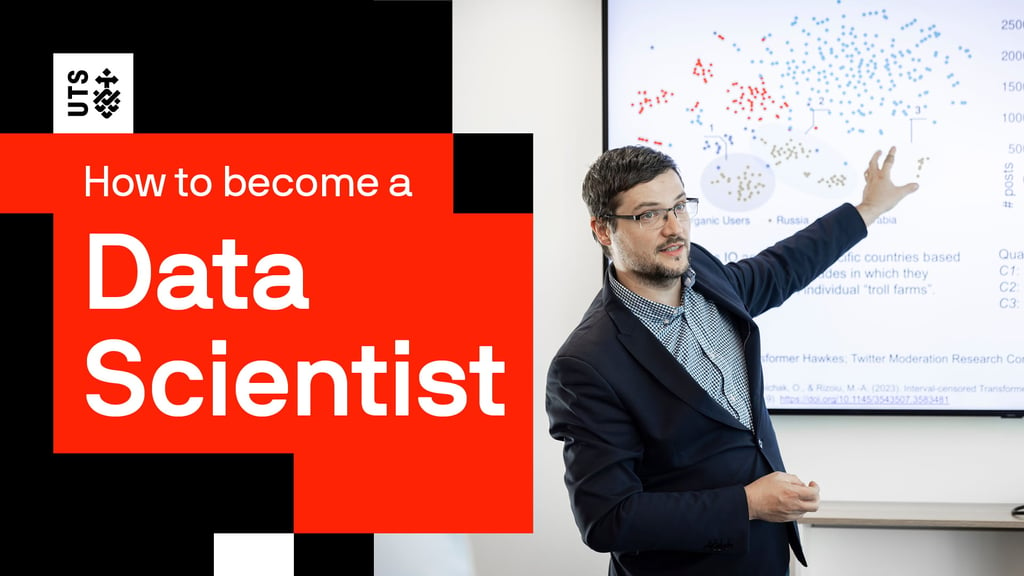
Associate Professor Marian-Andrei Rizoiu shares what data scientists do, where they work and what drives discovery in the field.
Every day, vast amounts of data are created across finance, healthcare, technology and science. On its own, that data is messy, fragmented and often unusable. Making sense of it and turning it into insight is the work of a data scientist.
Associate Professor Marian-Andrei Rizoiu leads the Behavioural Data Science Lab at the University of Technology Sydney (UTS). He describes data science as a discipline grounded in scientific thinking, where scale and complexity are part of the challenge.
“A data scientist is essentially a scientist who uses data,” he says. “Our job is to work through very large volumes of information and uncover what’s meaningful within it.”
He compares the process to mining. If data is the ore taken from the ground, information is the gold within it. Data scientists are the ones who extract that gold.
What is data science and what do data scientists do?
Data science focuses on extracting information from large datasets and using it to explain patterns or make predictions. It is used wherever large volumes of data are generated.
In finance, data scientists help keep people safe from scams. In medicine, they analyse genetic and medical data to understand which parts of DNA and chromosomes are linked to particular conditions. Increasingly, data science is also used to understand human behaviour at scale, from how information spreads online to how people respond to health or policy interventions.
Data scientists’ work can include:
- Collecting large datasets
- Cleaning data and fixing inconsistencies
- Conducting descriptive analysis to explore distributions and patterns
- Breaking data into groups to understand how it behaves
- Using machine learning and artificial intelligence to explain data or predict future outcomes
Much of a data scientist’s time is spent preparing data before analysis can begin. Real-world data often contains errors caused by equipment malfunctions or misalignment. These issues must be corrected before the data is usable.
Once the data is clean, analysis begins. This usually starts with descriptive analysis and progresses to predictive analytics, where models are used to explain what has been observed or anticipate what might happen next.
A typical day might involve cleaning data, testing models, discussing results with collaborators and refining questions based on what the data reveals.
Getting started in data science
Becoming a data scientist typically requires a university degree. This usually involves three to four years of undergraduate study, sometimes followed by a master’s degree. For those working on cutting-edge scientific problems, a PhD is often required.
Training in data science draws on several disciplines, including:
- Mathematics and statistics
- Computer science
- Programming and database systems
- Scientific and analytical languages
Rizoiu notes that advanced research roles, particularly those tackling unresolved scientific questions, generally require doctoral study. He also emphasises the importance of curiosity, patience and persistence, as progress often comes through trial, error and refinement.
Where data scientists work
The demand for data scientists is high, largely because data in digital form is everywhere. Some data scientists, particularly those with PhDs, work in universities, where they combine teaching with research.
Most people trained in data science work in industry. In these roles, they may be embedded within organisations or lead data science teams. They are often involved in developing new products, extracting insights from data and creating data-driven tools and applications that are passed on to consumers.
Data scientists typically work alongside others, applying their skills in collaboration with researchers, engineers or domain experts. Rizoiu describes data science as a versatile set of skills, with opportunities to work in both research-focused and applied settings.
For Rizoiu, the most compelling part of data science is discovery.
“There’s a unique excitement in realising you’re the first person to know the answer to a question,” he says. “Even if it only lasts for a few minutes, that moment is incredibly powerful.”
It’s that sense of curiosity, and the drive to uncover something previously hidden that sustains the work, even when the process is complex or demanding.
Thinking about a future in data science?
Data science is a field with growing demand and wide-ranging applications. For people who enjoy problem solving, working with technology and exploring unanswered questions, it offers a career that can evolve across industries and roles.
As data continues to shape how decisions are made and systems are designed, the ability to understand and interpret it will only become more valuable.
Contributor

Director, Defence Innovation Network, Faculty of Engineering & Information Technology
Webpage
6 careers that will be crucial for addressing climate change
UTS’s Professor Chris Turney shares his thoughts on the careers and job titles that have the most potential to act on climate change now and into the future.
Webpage
Careers in fashion that aren’t being a designer
Want to work in fashion but don’t see yourself as a designer? The industry is full of exciting, essential roles beyond the sketchpad.

Webpage
The future of film in Australia
The screen industry is evolving fast, driven by new technologies and fresh storytelling formats. Associate Professor Alex Munt from UTS breaks down the key...

Webpage
What practical learning really means for your time at university
Practical learning at UTS means hands-on, real-world experience from day one. Through projects, internships, competitions, technology and industry-connected...
Webpage
6 careers that will be crucial for addressing climate change
UTS’s Professor Chris Turney shares his thoughts on the careers and job titles that have the most potential to act on climate change now and into the future.
Webpage
Careers in fashion that aren’t being a designer
Want to work in fashion but don’t see yourself as a designer? The industry is full of exciting, essential roles beyond the sketchpad.
Webpage
The future of film in Australia
The screen industry is evolving fast, driven by new technologies and fresh storytelling formats. Associate Professor Alex Munt from UTS breaks down the key...
Webpage
What practical learning really means for your time at university
Practical learning at UTS means hands-on, real-world experience from day one. Through projects, internships, competitions, technology and industry-connected...