


For Dr Clyde Webster, Earth is the perfect place to test people-first robotics that will prepare humankind for the final frontier: space.
Dr Clyde Webster might be a robotics engineer, but curiously, robots aren’t the end goal of his work. Instead, the bio-inspired machines he builds are all designed with one objective in mind: keeping human workers safe and well.
“That’s always been the goal with robots, getting them to take over repetitive, dangerous labour that poses risks to humans,” says Clyde, the founder of Sydney-based Crest Robotics, a graduate of the UTS Bachelor of Engineering (Mechanical and Mechatronic) and a UTS PhD recipient.
“Most companies focus too much on the robot. We’re interested in freedom from injury and freedom from menial, repetitive and damaging work.
It isn’t so much about the robot as it is about what the robot can do for people or society.
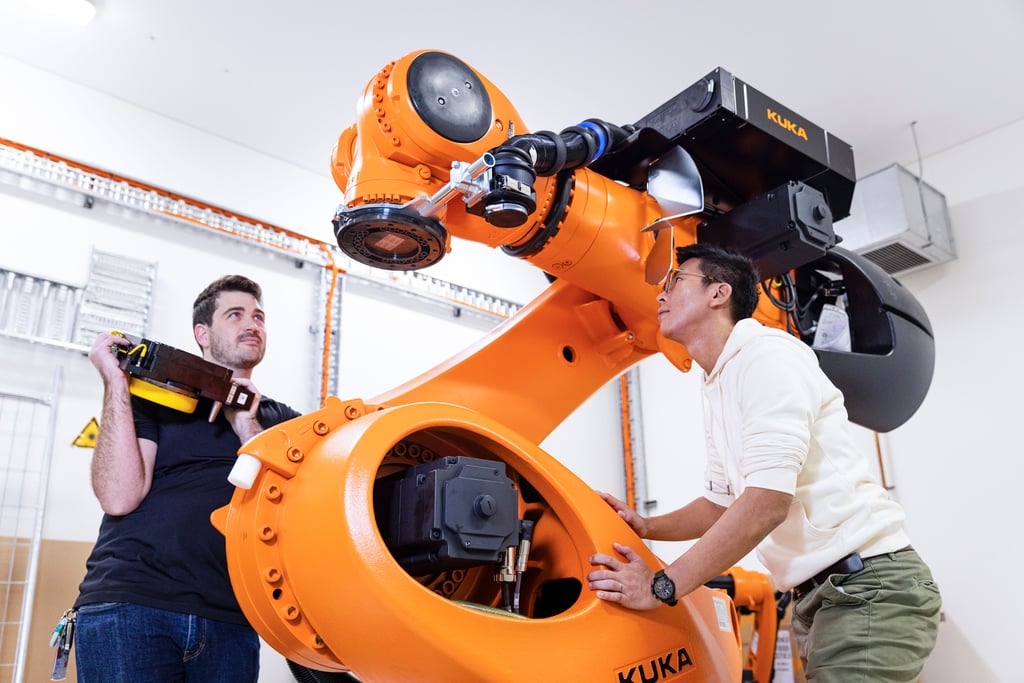
It’s a vision that first emerged during Clyde’s PhD, which he spent designing parrot-inspired climbing robots that could conduct maintenance tasks at height. While he was fascinated by the potential of robotics to solve safety issues, he was also frustrated by what he saw as fundamental gaps in the existing technology.
“The industry partner for my PhD needed a particular type of robot that, back then, just didn’t exist. And I thought well, why doesn’t it? Why don’t we have them climbing transmission towers? Why can’t we get them to use tools and do work?
“I realised that we could be doing more with robotic systems, including in terms of human safety, and if it wasn’t happening, I was going to make it happen.”
Since founding Crest in 2023, Clyde has stayed true to this people-first robotics ethos. It sits at the core of Gorilla, a robotic system that supports the replacement of high-voltage transmission lines. It’s also the foundation for EMU, a self-balancing arm that can support construction workers to safely undertake tool-based tasks off the ground.
And now, it’s guiding the development of Charlotte, a robot developed in partnership with sustainable building company Earthbuilt Technology that can build houses and other structures at rapid-fire pace. Charlotte is set to transform the construction industry, but she won’t just do it here on Earth.
She’s also headed for the moon.
People-first robotics, but in space
Charlotte is a six-legged, spider-like machine that produces continuous blocks from materials like earth, sand and waste materials, stacking them one on top of the other to construct buildings. This sustainable construction technique requires no new materials; instead, it draws on whatever’s available nearby.
Charlotte is expected to fast-track what’s normally a highly labour-intensive and risky process for human workers; eventually, she’ll be able to construct the walls of a 200m2 home in a single day.
Earthbuilt Technology’s initial goal was to build a hundred million homes, offering a viable solution to housing shortages across the globe. But now, thanks to Charlotte, they’ve got their sights set on a much loftier target.
NASA’s Artemis program will return humans to the moon in 2027, with the added goal of establishing a sustainable presence. By 2040, Japanese exploration company ispace, with whom Crest recently signed a Letter of Collaboration, aims to have a lunar colony of 1,000 people that can support 10,000 visitors each year.
Lightweight, innovative construction and infrastructure technologies will be in high demand to support these initiatives. Charlotte could be just what they’re looking for.
“In space, you can't take a lot with you, so the requirement for high sustainability technology and processes is extreme. And so construction in space has to be the most sustainable thing we can possibly do,” says Clyde.
“When you give yourself those requirements, you can come up with systems that you wouldn't have thought of otherwise.”
For Crest, joining the space race makes perfect sense. Building homes is a tangible example of Clyde’s ‘what the robot can do for people or society’ ethos. Helping to advance space exploration takes that vision to the next level.

When NASA comes calling
If space applications feel out of left field for a robotics company focused on worker safety, consider this: during his UTS PhD, Clyde spent six months working for NASA’s Jet Propulsion Laboratory (JPL), the result of a networking connection through his PhD supervisor Professor Robert Fitch.
When the NASA connection came along, initially Clyde didn’t really see the relevance to his PhD program. He accepted anyway; as an engineer, he says, “you just don’t say no to that sort of opportunity.”
He spent six months working remotely for the JPL, researching the design of rovers that could traverse the south pole of the moon. To his surprise, he found that many of the key research questions he was grappling with were the same as those in his PhD: how can form and function come together to create an optimal, fit-for-purpose robotic design?
“I tried to take a really scientific approach to how we go about designing robotic systems to be fit-for-purpose for specific tasks,” he says.
“What I figured out by the end of my PhD was the strategy for getting robots to be very lightweight, very safe, and able to use tools. That matters on Earth, but it’s also very important in the context of engineering in space.”
“If you really want to challenge yourself, space is where you go.”
After finishing his PhD, which he completed alongside an engineering role at the Space Machines Company, Clyde took the leap into entrepreneurship. By then, he had specialist skills in both worksite and lunar robotics but no logical way to combine them.
He decided to re-focus on the workplace safety angle, immersing himself in the UTS Startups entrepreneurship community as he worked to get his business off the ground. There, surrounded by 250 entrepreneurs and a wealth of professional support and advice, he started to sketch out what Crest Robotics could be.
“When you're starting your own company for the first time, there's just a lot to learn. Murray Hurps, the Director of UTS Startups, did an excellent job making some early connections for me,” Clyde says.
Those connections helped him launch Crest in 2023. In just a few short years, the company has attracted attention from major players in the construction, energy and telecommunications industries who can see the potential of robotics both to protect human workers and advance their business goals.
If Clyde had resigned himself to leaving his space robotics expertise behind, clearly the universe, and ispace, had other plans. But as he and his team work to bring Charlotte’s lunar potential to life, he’s keeping one foot firmly planted on his home planet.

“If you really want to challenge yourself, space is where you go. But it's a challenge to make ourselves better and to bring all that knowledge back here on Earth where it matters the most.”
Clyde Webster
At UTS, Dr Clyde Webster turned a passion for robotics into an interstellar career.
Because it’s not just a university—it’s a giant leap for human and robotkind.
What can we be for you?

Webpage
A taste of community
In a city where food often means fine dining, Shaun Christie-David serves something deeper: dignity, connection and second chances.

Webpage
Putting inclusivity on centre stage
Children’s entertainer Dr Emma Watkins is passionate about three things: dance, film and Auslan. Now, in her show Emma Memma, she’s introducing children across...

Webpage
All stories, every screen
Sam Reilly is passionate about telling stories of diversity. Now, as a graduate of the UTS Master of Animation and Visualisation, they want to bring those...
Webpage
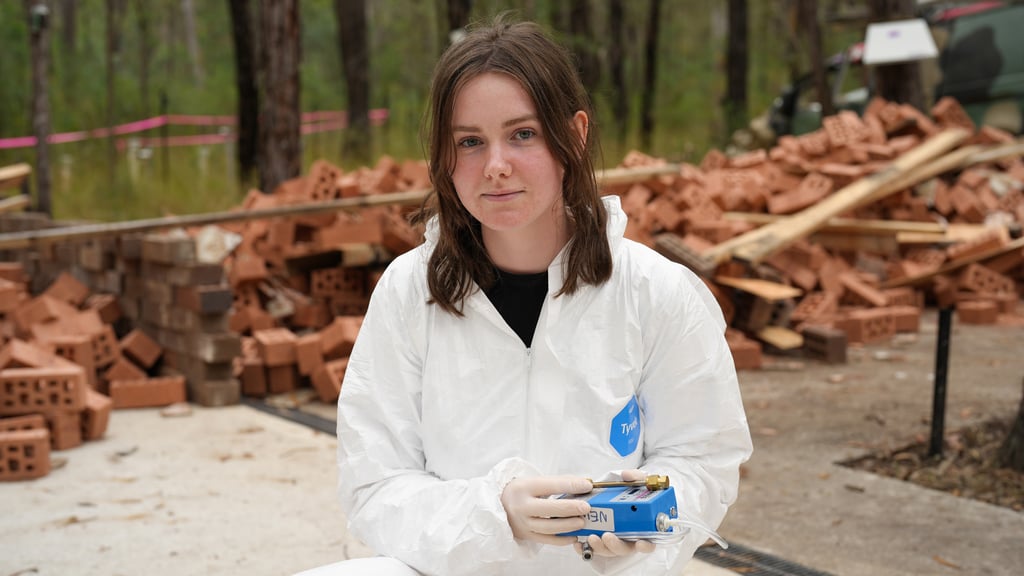
Life finds a way
Forensic scientist and PhD student Bridget Thurn is untangling the mysteries of life, death and what it means to be human.
Webpage
A taste of community
In a city where food often means fine dining, Shaun Christie-David serves something deeper: dignity, connection and second chances.
Webpage
Putting inclusivity on centre stage
Children’s entertainer Dr Emma Watkins is passionate about three things: dance, film and Auslan. Now, in her show Emma Memma, she’s introducing children across...
Webpage
All stories, every screen
Sam Reilly is passionate about telling stories of diversity. Now, as a graduate of the UTS Master of Animation and Visualisation, they want to bring those...
Webpage
Life finds a way
Forensic scientist and PhD student Bridget Thurn is untangling the mysteries of life, death and what it means to be human.