


- Posted on 26 Jan 2026
- 4 minute read
Hands‑on investing with the Anchor Investment Fund
For students studying a Bachelor of Business with a major in finance, practical, industry‑aligned experience is essential. At the UTS Business School, a great program helps students connect classroom learning with real finance work.
This program, called the Anchor Investment Fund (AIF), includes the Circle the Square industry round-table series. This elective subject lets students learn about investing and market analysis. They will gain experience with money management and can also ask important questions about global finance to experienced professionals.
The AIF is a fund managed by students. It involves selected finance students who are studying finance in real investment decisions. Through the subject, they're able to conduct equity research, develop investment recommendations, pitch ideas to finance professionals and contribute to live portfolio management.
Dr. Lorenzo Casavecchia from the UTS School of Accounting and Finance and Adjunct Professor Michael Block lead the program. Michael Block is a former Chief Investment Officer of a multibillion-dollar fund. The subject reflects the real-world setting of equity analysis and funds management. Students will gain applied experience in portfolio construction and our financial system, exposure to the discipline and accountability required in capital markets, and a wide range of practical skills often learned only through internships or industry roles.
This example of work-integrated learning is what sets UTS apart from traditional finance degrees.
Industry‑led insight through Circle the Square
To get more exposure to the industry, students can join Circle the Square series. This is a quarterly round-table discussion hosted by the UTS Business School and the UTS School of Accounting and Finance. The series brings together senior finance practitioners, UTS academics and undergraduate students.
The goal? To challenge assumptions, debate trends, and unpack complex market dynamics with the people shaping the industry.
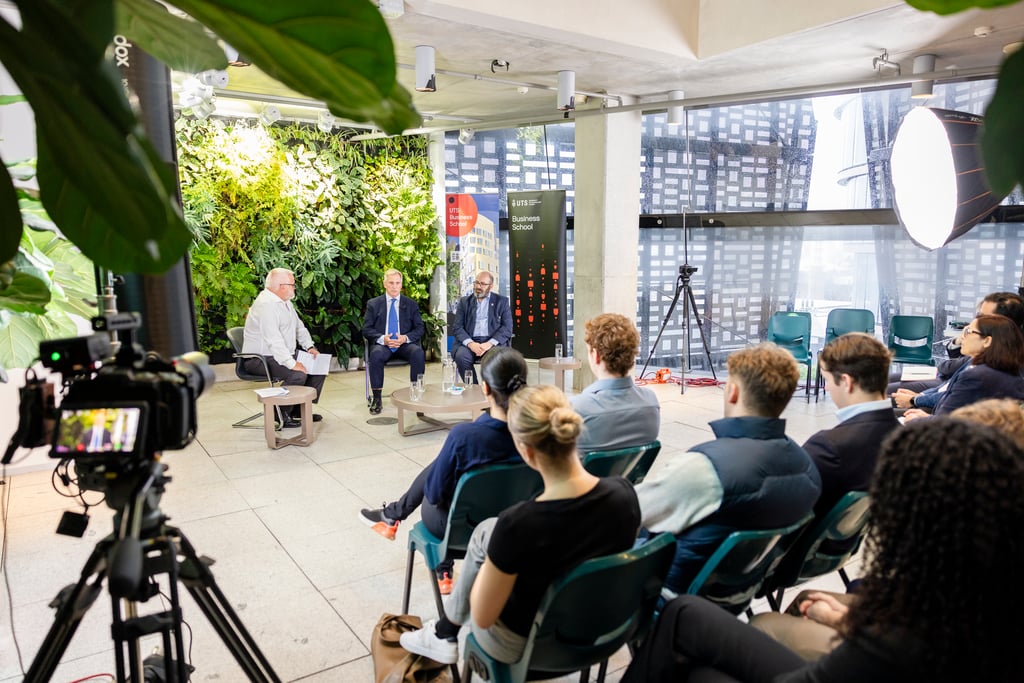
The first event looked at how political changes, especially during Donald Trump’s early presidency, affect financial markets. Finance leaders Rob Prugue and Wayne Fitzgibbon joined the discussion, examining:
- how political change influences investor sentiment
- whether markets respond differently today compared to historical patterns
- what counts as a “safe haven” in modern finance
- how investors can hedge against volatility in an uncertain global landscape
These discussions help students learn how to analyse market events and make strategic decisions so they can tell the difference between noise and important changes.
Why this time it really could be different
“Today’s volatility actually feels structural rather than cyclical. The profit bubble has ended. Confidence is eroding. And when confidence goes, recession follows.”
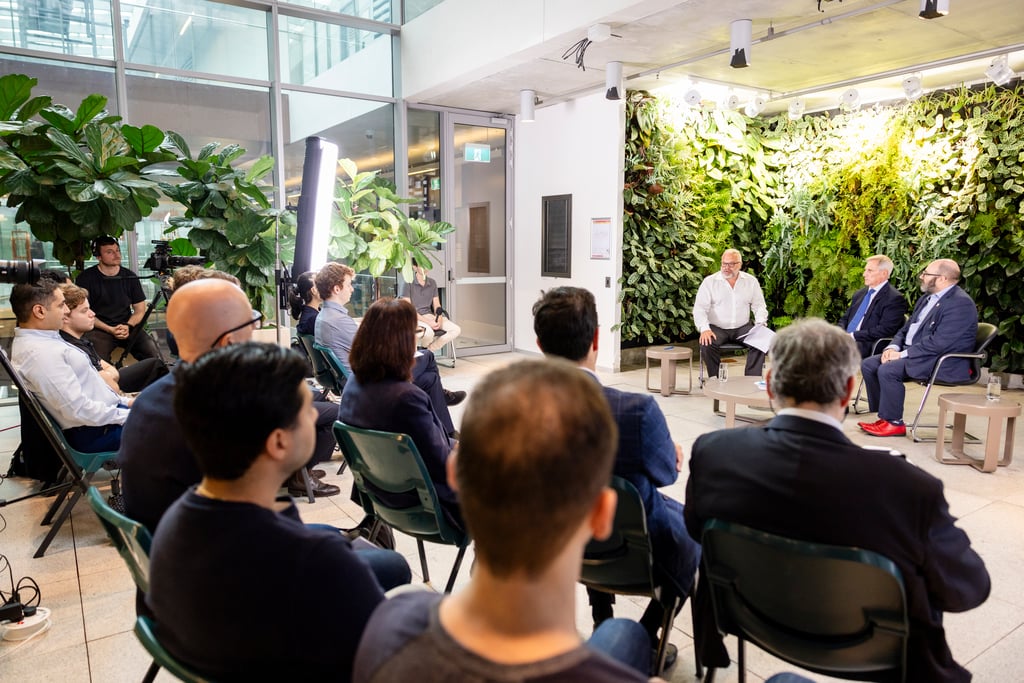
This framed the central question of the inaugural series. Are we living through a temporary disruption, or a fundamental shift in the economic order? The panel consisted of finance experts with more than 40 years of experience, having worked in asset management, central banking, trading, and advisory roles.
It’s not about whether the president is left or right. It’s the chaos. Announcements contradict each other within hours. Cabinet members refute statements. Markets hate uncertainty and this level of chaos is unprecedented.
“I’ve seen political upheaval before, but never in the world’s largest economy. You cannot price assets when markets move 2–3% on a single midnight post.”
Volatility has shifted from economic fundamentals to unpredictable political behaviour.
Tariffs, trade wars and structural instability
Trade policy is now a key focus of analysis. This is not because tariffs are new. Both left and right leaning governments have used them in the past. The reason for the focus is how erratic and dramatic the current delivery is.
Participants noted that tariffs are acting less as economic tools. Instead, they are becoming instruments of political disruption.
Key insights included sudden and extreme tariff announcements, like a 245% increase. These announcements are similar to an embargo.
Inconsistent communication makes it hard for companies to plan. Supply chains struggle to adjust to unpredictable policy changes. The uncertainty caused by tariffs is often more harmful than the tariffs themselves.
The decline of the profit bubble
The conversation then changed from political issues to deeper problems. The main focus was the end of the U.S. corporate profit bubble.
Over the last decade, U.S. tech giants fuelled market returns, masking stagnation in other sectors. As profit growth normalises, markets face a reality check. Tariffs and political disruptions don’t cause this shift, but they accelerate it.
Safe havens no longer safe?
Perhaps the most consequential question raised was whether U.S. Treasuries and the U.S. dollar itself—remain global safe havens. Some panellists said the U.S. is still important in the short term.
They pointed to the strength of its Treasury market. They also mentioned the role of Treasuries as global collateral and the size of USD-based leverage. However, others warned that political instability is hurting confidence in the U.S. as a reserve currency.
“We’re seeing a huge anti‑America sentiment. Confidence is collapsing. Without confidence, recession follows—and safe‑haven status becomes vulnerable.”
Human psychology drives prices
The panel stressed that while quantitative models matter, markets ultimately reflect human behaviour. The discussion showed that Trump's first term shows short-term thinking is stronger than ever. Retail investors buy every dip, wrongly believing that markets "always recover." Algorithmic trading increases behavioural swings.
Today, flows drive market movements more than fundamentals do. The panellists asked students to remember that the one thing that mean-reverts in markets is human beings.
"Our optimism, our fear, our biases. That’s the constant.”
Is this time different? A cautious but serious question
Traditionally, investors argue that markets mean‑revert, cycles repeat, and “this time” is never truly different. The panel asked the audience to think about structural change.
Political factors now influence markets more than economic basics. Supply chains, trade rules, and geopolitical factors have changed. Technology and retail trading are changing how investors behave. Global trust in financial and political institutions is weakening.
The industry guests closed the discussion with the following message to students before taking questions from the audience.
"If we cling to old norms without questioning them, we become vulnerable. Humility is required. Curiosity is required. And most importantly, critical thinking is required.”
Why it matters
Getting first-hand exposure to these insights help students become not only better analysts but better thinkers capable of navigating complexity with confidence. Financial services is a field defined by uncertainty, rapid change, and global interconnection. Programs like AIF and Circle the Square empower students to:
- build practical experience into their learning experiences
- understand how professional investors think
- test their skills in real‑world scenarios
- develop confidence in making informed financial decisions
This mix of theory, practice and industry involvement is what gives UTS business students a strong advantage in the job market.
Learn more about the UTS Business School
Watch episode one of Circle the Square: Is this time different?
Listen to episode two of Circle the Square: The Devolution of Neoliberalism
This UTS Accounting student is turning opportunity into achievement
For Liv Coxsedge, success came from saying yes to opportunities, backing herself and helping others do the same.

Learning to lead responsibly
For Alison Gibson, the UTS MBA transformed years of experience into the confidence to lead change and champion sustainability.

Taking the classroom into the community
What happens when business education steps beyond the classroom? Explore how UTS students are applying their skills in community settings - building meaningful...

Reinventing life and career with a supply chain course
A UTS MBA helped international student Shiva Sharma find confidence, connection and a career in supply chain management.
This UTS Accounting student is turning opportunity into achievement
For Liv Coxsedge, success came from saying yes to opportunities, backing herself and helping others do the same.
Learning to lead responsibly
For Alison Gibson, the UTS MBA transformed years of experience into the confidence to lead change and champion sustainability.
Taking the classroom into the community
What happens when business education steps beyond the classroom? Explore how UTS students are applying their skills in community settings - building meaningful...
Reinventing life and career with a supply chain course
A UTS MBA helped international student Shiva Sharma find confidence, connection and a career in supply chain management.