


Dr Emma Camp shares the skills, challenges and rewards of studying life in the ocean.
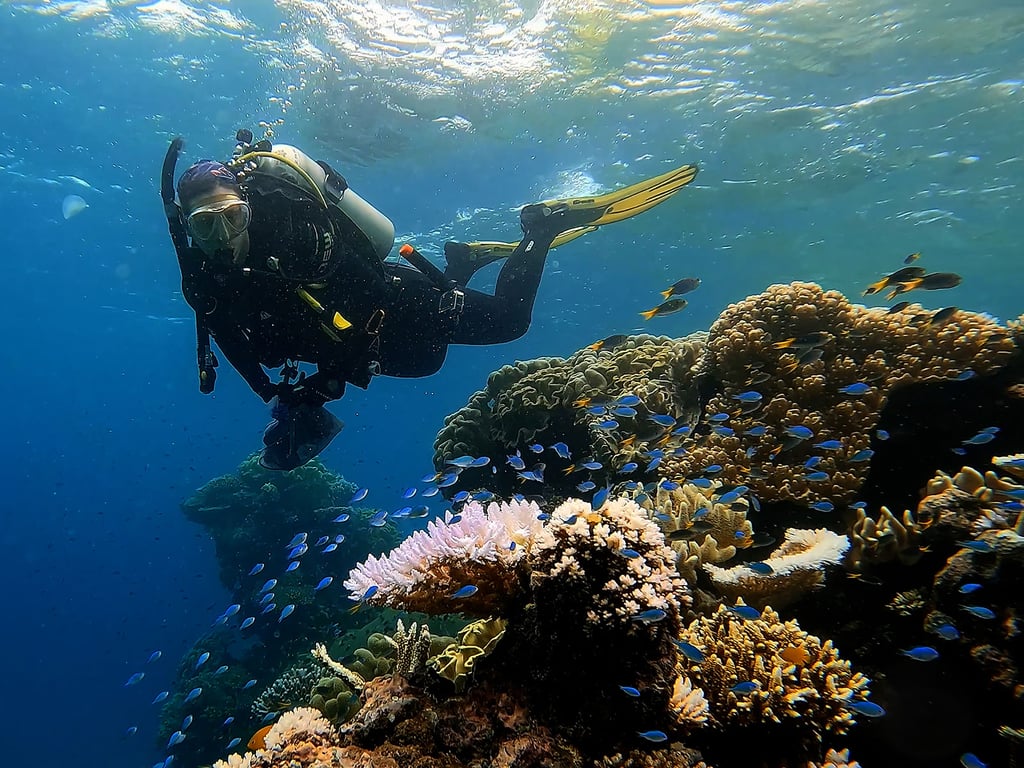
When you think of marine biologists, you might picture long days in the water, exploring coral reefs or swimming with dolphins. And while those moments do happen, they are only a very small part of the work.
According to Dr Emma Camp, marine biologist and team leader of the Future Reefs Program at the University of Technology Sydney (UTS), the reality of marine biology is much broader and often more complex.
From analysing data and writing up research to teaching students and working with communities, marine biology can involve a wide range of skills and settings.
What is marine biology and what do marine biologists do?
Marine biology is the study of life in the ocean and how marine organisms interact with each other and their environment. This includes not only living creatures like fish, corals and plankton but also abiotic factors such as temperature, salinity and ocean currents that influence marine ecosystems. By understanding these connections, marine biologists play a vital role in protecting the health of our oceans.
Marine biologists work can include:
- Collecting samples from the ocean or marine organisms
- Conducting experiments in the field or in laboratories
- Analysing data to monitor trends or model ecosystem changes
- Studying marine species including their behaviour, reproduction and genetic diversity
- Investigating human impacts, such as pollution, overfishing and climate change
- Contributing to policy, education and community engagement to support conservation
To do this work, marine biologists need a solid foundation in reef biology, ocean systems and marine chemistry. But success in the field also requires more than technical expertise. Resilience, patience and curiosity are just as important, along with a passion for asking questions and the drive to discover answers.
Getting started
While a foundation in biology, chemistry, ecology and environmental science is extremely useful, there’s no single route into the field. Camp’s own journey began with a degree in environmental science, followed by further study in environmental management and business, and eventually a PhD in marine biology.
Camp often meets people in the field who have come from a diverse range of academic and professional backgrounds, highlighting how varied the paths into marine biology can be.
A diverse working environment
Marine biologists can work in a wide range of settings, from offices and laboratories to the open ocean. This variety means they must often adapt to changing conditions. Some marine biologists spend long periods at sea collecting data, while others are based at field stations located near marine environments like coral reefs. These stations act as research hubs, allowing scientists to conduct on-site studies and gather real-time samples, often in remote or environmentally sensitive areas.
For Camp, no two days are the same. She might be in the office, in the lab, or out on the reef collecting samples. She also gives public talks, meets with industry and government groups, and works closely with communities to understand local concerns and explore how science can help.
The bigger picture and the big challenges
Marine biologists face a number of challenges, from securing funding and publishing research to communicating the urgent issues facing our oceans. For coral scientists especially, there is an emotional toll in studying ecosystems that are under increasing threat from climate change.
Camp notes that while the risk of losing these systems within our lifetime is real, it also motivates scientists to act and to use their skills to help conserve reefs.
Advice for future marine biologists
Camp’s advice to anyone considering a career in marine biology is to start connecting with others in the field. Talking to people, asking questions and building relationships can help you understand the work and open doors to opportunities.
Reflecting on her own path, she says she wishes she had known from the start that it wouldn’t be straightforward. There will be ups and downs but learning from those experiences helps build resilience and ultimately makes for a stronger scientist.
Contributor
Associate Professor, Faculty of Science
Webpage
What it’s really like to be a data scientist
Associate Professor Marian-Andrei Rizoiu shares what data scientists do, where they work and what drives discovery in the field.
Webpage
What it’s really like to be a fashion designer
Associate Professor Timo Rissanen explores what you study in fashion, the careers it can lead to and what designers really do in practice.

Webpage
How study led to job opportunities before graduation
From study to industry, two UTS students share their journey – and the tips they’d pass on to others.

Webpage
Your child is applying for university. What do you need to know?
Here are four practical ways to support your child on their journey to university.
Webpage
What it’s really like to be a data scientist
Associate Professor Marian-Andrei Rizoiu shares what data scientists do, where they work and what drives discovery in the field.
Webpage
What it’s really like to be a fashion designer
Associate Professor Timo Rissanen explores what you study in fashion, the careers it can lead to and what designers really do in practice.
Webpage
How study led to job opportunities before graduation
From study to industry, two UTS students share their journey – and the tips they’d pass on to others.
Webpage
Your child is applying for university. What do you need to know?
Here are four practical ways to support your child on their journey to university.