


On social media, the joke goes like this:
The gender pay gap doesn’t exist. Men make more because they choose higher-paying jobs like doctor, lawyer and engineer, but women choose lower-paying jobs like female doctor, female lawyer and female engineer.
If you substitute the doctors, lawyers and engineers for business and management leaders, it’s a social observation that could have been custom-made for Dr Claire Wright. A business historian and senior lecturer at the UTS Business School, she was recently named one of the Australian Research Magazine’s Top 250 Researchers of 2026.
Claire’s work is largely focused on corporate leadership. And you can’t really research corporate leadership without investigating why the gender pay gap persists and why women still make up only a third of key management positions in Australia today.
“In Australia, corporate leaders were exclusively men until about the 1980s. That’s when women began to enter corporate leadership as the beneficiaries of second-wave feminism,” she says.
“We now have 32 per cent of women in either executive roles or board roles, which is good compared to some countries, and could be better compared to other countries. I don’t want to discount the importance of that improvement, but there are some problems that remain .”
Claire’s work is building UTS’s reputation for research excellence, and it’s also filtering down into the University’s business and management degrees. Here, it provides an entry point for students to explore the historical forces that have held women and other marginalised populations back for decades.
“I teach Diversity and Inclusion, which is one of our postgraduate subjects. It looks at how marginalisation has shown up in the workplace at different timepoints, why it exists and what we can do as practitioners and orgaisations to try and improve or resolve some of these challenges,” she says.
Glass ceilings, sticky floors: why women still struggle to reach CEO roles
Chief among these challenges is that women still comprise only a paltry number of CEOs: according to the Financial Review, there were only 27 female CEOs running ASX 300 companies in 2025. And, with men holding 80 per cent of CEO pipeline roles, those numbers aren’t going to change anytime soon.
Throw in some systemic sexism and you have an additional set of demands that govern women’s workplace behaviours and how they’re perceived by others. Or, as Claire puts it:
“They still have to walk a tightrope with regards to their behaviour. They’re seen as women first and foremost, and so they’re expected to act as women leaders, not just as leaders,” she says.
“If they’re too feminine, they’re penalised. If they’re too masculine, they’re also penalised. And so I think women are quite frustrated. They feel like they can’t win.”

But women are just the tip of the iceberg when it comes to the titanic inequities of the business world. Women’s experiences can be viewed as stand-ins for other marginalised groups, such as people of colour or people with disability, who experience even more daunting barriers to progress. If women face a gender pay gap, for example, women of colour face will inevitably face a larger one.
That’s because the power structures on which the business world is built centres a particular type of person in corporate leadership roles: someone male, white, middle class, able bodied (and often tall, Claire says). Shifting this narrative requires representatives of marginalised groups to demonstrate far more than the professional competency required to perform a leadership role.
“There’s this image of a corporate leader that I think is at the heart of why people continue to experience marginalisation in the workplace,” Claire says.
“The same forces of capitalism and greed are maintaining the current system as the status quo.”
Progress for women is progress for everyone: how gender equality benefits us all
But even as we recognise these issues as a hugely troubling reflection of the society we’ve built, the past has a lot to tell us both about how these systems emerged and what we can do to combat them.
In the last few decades alone, Claire says, we’ve see a range of policies and programs that have increased women’s workplace participation, for example. These include paid parental leave, the Sex Discrimination Act 1984, which (on paper, at least) prevented unequal pay, and other affirmative action and HR policies that have boosted the numbers of women in various corners of the workforce.
“All of these things have made a real impact, and so we can take those examples and apply them to any type of marginalisation,” she says.
“Through my teaching and research, I want to give people not just an understanding of the current state of things but a really practical understanding of what we can do to move forward.”
In that spirit, Claire is currently writing the first history of Australian women in corporate leadership across the 20th and 21st centuries. Her research has brought her into close proximity with many corporate women who are providing firsthand insights into the changes that are slowly pushing open the door to the C-suite.
These include technologies that have enabled more flexible work and a growing appetite for more robust diversity and inclusion policies that create opportunities for a broader group of people. While many of these changes are happening within workplaces, others are happening to the sector as a result of external pressures.
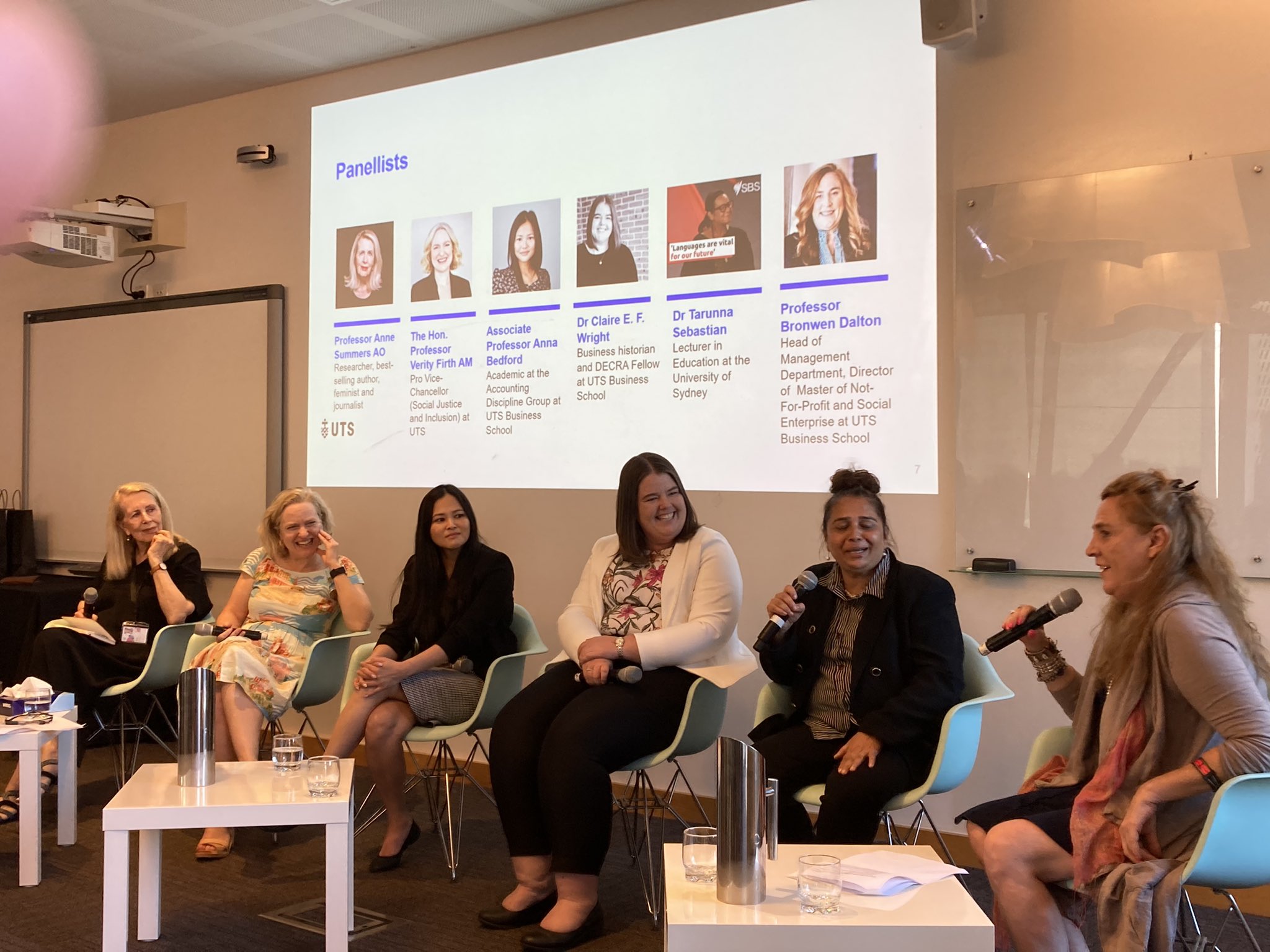
But, while Claire is tracing these policy and cultural shifts as they happen, integrating the findings of her research into the student learning experience is critical to keeping the momentum going. By teaching students to draw links between the past, present and future, Claire is preparing the next generation of business and management professionals to drive the equitable change that the sector so urgently needs.
“By equipping our graduates and future leaders with the right kind of knowledge, I hope they take away not just an understanding of the past and current state of things but a really pratical understanding of what we can do from here,” she says.
And if history is anything to go by, there’s plenty to be hopeful about.
“One of things history gives you is just an appreciation for how far we’ve come. If we look at even my parents’ generation or my grandparents’ generation, the prospects for women and lots of other minorities was so poor, and we’ve improved it so much,” Claire says.
“That gives me a lot of hope in what can be achieved if we put our minds to it.”
Learn more about Claire

Senior Lecturer, Business School
More from the UTS Business School

Top100 Future Leaders Awards 2026
Celebrating outstanding success in 2026 Top100 Future Leaders Awards.

Book a one-to-one chat with UTS Business School
Interested in having a one-on-one chat with a professional at the UTS Business School? Get all your questions answered about your course options, eligibility,...

Sustainability of The Volte’s Peer-to-Peer Clothing Rental Model
In an era of fast fashion exasperated by social media, where individuals are enticed to click and purchase, what alternatives are there? And how can we make...