


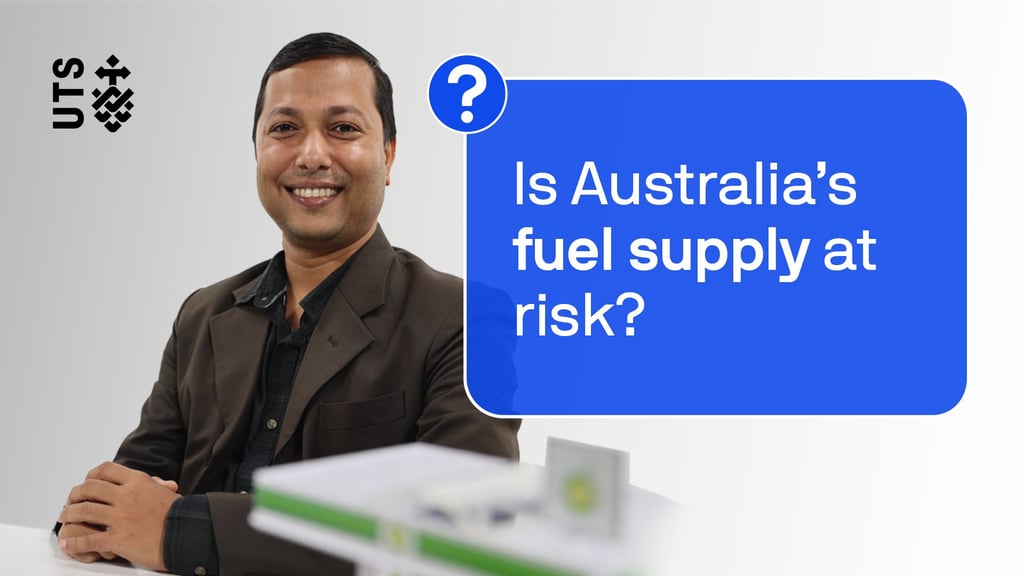
Associate Professor Sanjoy Paul tells us what’s changed in global supply chains – and why analysts now play a critical role.
When shelves go empty or fuel prices spike, most people want to know why. The answer usually comes back to the same thing – a supply chain under pressure. These are the networks that move goods from where they are made to where they are needed, and in recent years they have been tested like never before. The people helping businesses navigate that pressure are supply chain analysts, and their role has never mattered more.
From stability to constant disruption
For around two decades leading up to 2020, global supply chains operated with few major problems. Trade was growing, systems were efficient and most companies focused on reducing costs rather than preparing for disruption.
“From 2000 to 2020, those 20 years were a good time for our supply chains,” says Associate Professor Sanjoy Paul, a supply chain expert at UTS.
“Supply chain management worked well because there was not much uncertainty.”
That stability ended with COVID‑19. Since then, supply chains have been hit by repeated shocks, including geopolitical tensions, shipping attacks, fuel shortages and extreme weather. What was once an occasional disruption is now a constant feature of global trade.
“We used to see a major disruption once every few years,” Paul says.
“Now, we can see several disruptions in a single year.”
Consumer behaviour can also make matters worse. When fears of shortages take hold and spread quickly across social media, panic buying can quickly push demand beyond what supply chains are designed to handle.
“This kind of panic buying puts extra pressure on the system because it drives demand much higher than expected,” Paul says.
These shocks expose deeper vulnerabilities. One of the most significant is reliance on a small number of suppliers for critical goods. Australia’s fuel supply is a clear example: around 95% of the country’s oil needs are imported as refined fuel. Any disruption along these supply routes can have fast and serious effects.
Another weakness was the cost‑reduction mindset that dominated before the pandemic. A 2019-20 survey by the Australasian Supply Chain Institute and UTS found that more than half of organisations did not have a risk management plan in place to mitigate disruptions or build resilience.
Cyberattacks are also an increasing threat. Recent data breaches in Australia have shown how security incidents can disrupt operations, damage trust and limit a company’s ability to work effectively with suppliers and customers.
Risk management needs resources, time and skills. We ignored that before, because there was no real reason to be concerned.
What supply chain analysts do
Supply chain analysts work at the intersection of a business’s internal operations and the external environment. Their role takes into account social, political and environmental factors alongside day-to-day business needs. They often work across demand forecasting, inventory planning, procurement, logistics and risk management at the same time.
In practice, this might involve modelling and planning what happens if a key supplier fails, identifying alternative sources during trade disputes, or testing how supply networks perform under different disruption scenarios.
“They deal with both internal and external activities,” Paul says.
“They make operational plans – how and when you source goods, where you keep inventory and how much you hold – so you can meet demand.”
Sustainability also sits within the role. If a business wants to move away from plastic packaging, for example, an analyst might assess alternative suppliers, model cost impacts and present options for decision‑makers to consider. While analysts rarely make final decisions, their analysis strongly shapes the choices organisations make.
One ongoing challenge is making the case for resilience investment when cost‑cutting remains a priority. Increasingly, analysts are showing that efficiency and resilience do not always need to be treated as trade-offs and can often reinforce one another.
Why the role matters now
The skills supply chain analysts bring: data analysis, scenario planning, risk assessment and network modelling have always been valuable. What has changed is how urgently these skills are now needed.
Real-time decision‑making has become essential. When a supplier fails or a shipping route closes without warning, organisations need fast, informed responses. Building contingency plans before a crisis hits is exactly the kind of work supply chain analysts specialise in.
There is also growing awareness that supply chains rely on a small number of suppliers and are overly dependent on global networks. Paul believes a gradual shift is underway towards more local manufacturing, shorter supply routes and a wider mix of suppliers. Supply chain analysts will play a key role in making this change possible.
“Analysts need to identify where major dependencies exist and assess the costs of sourcing closer to home. They also look for realistic local or regional alternatives and build the case for change,” he says.
Supply chains are also generating more data than ever before. Information flows in from suppliers, logistics providers, retailers and external sources.
We now collect data and information from hundreds of buyers, suppliers and external inputs. Being able to analyse that data and make decisions from it is a critical role analysts play.
Sustainability and the future for supply chain analysts
The push towards net zero is changing how supply chains operate. With Australia and many other countries committed to reaching net zero by 2050, businesses are under increasing scrutiny for how goods are sourced, produced and transported, including emissions, waste and labour conditions across supplier networks.
“For a lot of organisations, the real blind spot sits beyond their direct suppliers,” Paul says.
“They might know who they buy from, but not where those suppliers source their materials, or what the emissions and labour conditions look like further up the chain.”
Uncovering these hidden parts of the supply chain is now a priority, with analysts responsible for tracking impacts and improving transparency across entire networks.
Looking ahead, supply chains are expected to place more value on resilience and flexibility than on cost alone. Sustainable sourcing and emissions reduction will become part of everyday decisions, rather than being treated as extras. Over time, renewable energy is also expected to replace fossil fuels across manufacturing and transport networks.
For supply chain analysts, this means the role is becoming broader and more complex. Analysts are now expected to model new supply networks, assess local sourcing options, track emissions across multiple supplier levels and respond quickly when disruptions occur. As global systems face increasing economic, political and environmental pressure, people who understand how supply chains work – and how they can adapt – will be in growing demand.
Featured researcher

Associate Professor, Business School

Webpage
Five tips to land a job before you graduate
What if your career could start before you finish your degree? UTS graduate Akshaya Parthasarathy shares the five tips that helped her turn university...
Webpage
How UTS research students are advancing forensic science
At a research facility in the outskirts of Sydney, UTS students are studying what happens to the human body after death – and applying that knowledge to some...

Webpage
Climate solutions need diverse skills. Here’s what matters most.
Solving climate challenges needs more than technical expertise. Sustainability researcher Alex Baumber shares the 6 core skills you need to shape climate work.

Webpage
Making the leap into data engineering
Akshaya Parthasarathy’s journey to a thriving career as a data engineer in Sydney shows how bold decisions, practical education and staying true to your...
Webpage
Five tips to land a job before you graduate
What if your career could start before you finish your degree? UTS graduate Akshaya Parthasarathy shares the five tips that helped her turn university...
Webpage
How UTS research students are advancing forensic science
At a research facility in the outskirts of Sydney, UTS students are studying what happens to the human body after death – and applying that knowledge to some...
Webpage
Climate solutions need diverse skills. Here’s what matters most.
Solving climate challenges needs more than technical expertise. Sustainability researcher Alex Baumber shares the 6 core skills you need to shape climate work.
Webpage
Making the leap into data engineering
Akshaya Parthasarathy’s journey to a thriving career as a data engineer in Sydney shows how bold decisions, practical education and staying true to your...