


Imagine a well-designed climate solution that a local community refuses to accept. The technology works and the emissions calculations add up, yet the project struggles to move forward.
Situations like this highlight a challenge that has little to do with engineering.
According to Associate Professor Alex Baumber, a sustainability researcher at UTS, solving climate challenges depends on far more than scientific breakthroughs or new technologies. What often determines whether a solution succeeds is the ability to bring together knowledge from different fields and understand the broader systems these solutions operate within.
“Technical expertise is important, but often what matters most is the ability to bring together different kinds of knowledge and get the best out of a team,” Baumber says.
Across renewable energy, agriculture and policy, a common set of human and analytical skills is becoming just as important as technical expertise.
6 core skills shaping climate work
People working on climate and sustainability challenges come from many different backgrounds – engineering, law, policy, science and design. But regardless of their field, the most effective professionals tend to share a set of capabilities that help them navigate complexity, work across disciplines and bring people with them.
1. Collaboration
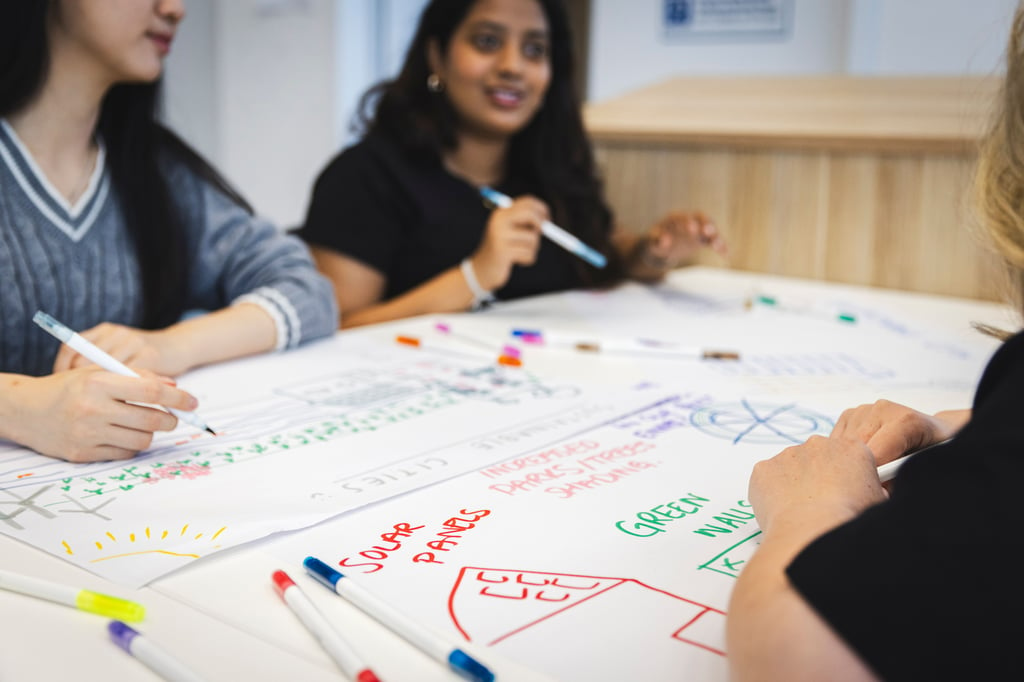
Climate challenges are rarely solved by one discipline alone. Strong collaboration skills help professionals build the right team, draw on different types of expertise and coordinate work across sectors.
In practice, this might mean bringing engineers, policy experts and community groups into the same room to design solutions together, rather than handing off a finished product and hoping it lands.
2. Critical thinking
Sustainability challenges are complex, and many have been attempted before. Critical thinking allows professionals to analyse a problem from different angles, identify gaps in earlier approaches and uncover why previous solutions may not have worked before repeating the same mistakes.
3. Systems thinking
Climate challenges are part of complex, interconnected systems rather than simple cause-and-effect problems.
A change in energy policy or farming practice can create ripple effects across environmental, economic and social systems in ways that are easy to miss if you're only looking at one part. Systems thinking helps professionals anticipate those wider impacts before they become problems.
4. Creative problem-solving
Where critical thinking analyses what exists, creative problem-solving imagines what does not yet exist. It involves thinking beyond conventional solutions and having the courage to propose ideas that may feel uncertain or untested.
In climate-related work, professionals often need to combine insights from different disciplines and actively trial new approaches, learning through experimentation as they respond to urgent, complex problems.
5. Reflexivity
Reflexivity is the ability to reflect on your own assumptions, values and biases. It is less obvious than the skills above, but equally important.
In sustainability work, blind spots can undermine even well-intentioned projects. Recognising how your own perspective shapes the way you approach a problem is the first step to designing solutions that work for people beyond your own experience.
6. Empathy
Empathy is crucial when working with communities affected by environmental change.
Understanding how different groups experience a problem and why they might support or resist a solution helps professionals design initiatives that people are more likely to accept. This often means listening and co-designing solutions with communities rather than presenting them with a finished plan.
Why these skills matter
Climate challenges are not just technical problems. They happen in complex social systems, shaped by different priorities and real community concerns. Technology alone does not guarantee success or a project’s social licence to operate – that is the trust, acceptance and ongoing support a community gives to a solution.
Rooftop solar and electric vehicles are good examples. The technology exists and the emissions benefits are clear. Yet uptake still depends on trust, cost, cultural values and whether communities support the change. The gap between a solution that works and one that is widely adopted is often social, not technical.
Sustainability problems are ultimately social problems. If people don’t buy into the solution, or they respond negatively to it, then it won’t work.
These issues also appear in Australian agriculture. Farms have strong potential to reduce emissions through soil carbon practices, changes to land use and new feed additives that reduce methane from livestock. But adoption is never guaranteed.
Whether farmers take up these approaches depends on factors that go beyond the science, including how well new practices fit into existing farming systems, whether they align with farmers’ identities and values, consumer views on food production, and trust in policy or financial incentives.
Similar challenges arise in large infrastructure projects. Wind energy plays an important role in reducing emissions, but some rural communities have concerns about landscape change, biodiversity and increased infrastructure. These concerns are sometimes seen as opposition to climate action. In reality, many people raising them care deeply about climate change and want solutions that work for their communities.
This is where skills such as empathy, collaboration and systems thinking become essential.
“If solutions aren’t designed with communities,” Baumber says, “you risk losing support, even for projects that are trying to do good.”
Getting the technology right is important, but it is rarely enough. Understanding people, communities and the systems they live in is what turns a good idea into a solution that works.
Building these capabilities through postgraduate study
Developing these capabilities often means learning to work across disciplines, not just within one field.
Postgraduate study can provide an environment where this happens. Students often come from different professional and life backgrounds and work together on real‑world problems.
This helps them see how different disciplines approach the same challenge, and how those perspectives can be combined to design more effective solutions. Through collaboration and applied projects, students build skills such as teamwork, adaptability and systems thinking – all essential for climate work.
As climate challenges grow more complex, the ability to connect technology, policy and people becomes increasingly valuable. The professionals who can bridge those worlds may be the ones best equipped to drive change.
Featured researcher

Director, Teaching And Learning, Faculty of Law

9 tips for juggling postgraduate study and life
Postgrad life is busy. Here’s how two students made it work, and their top tips for you.
Here’s why entrepreneurs are critical for addressing climate change
Tackling climate change takes bold ideas, innovation, adaptability and determination. UTS’s Professor Chris Turney shares five important ways entrepreneurs are...
3 questions to ask if you're thinking of going back to uni
Considering postgraduate study? Ask yourself these three questions to understand the commitment, costs and direction that’s right for you.

Top tips to build your peer networks during postgrad study
Networking isn’t just for industry events. When you’re in your postgraduate program you’re surrounded by top minds, often in the same field or industry, who...
9 tips for juggling postgraduate study and life
Postgrad life is busy. Here’s how two students made it work, and their top tips for you.
Here’s why entrepreneurs are critical for addressing climate change
Tackling climate change takes bold ideas, innovation, adaptability and determination. UTS’s Professor Chris Turney shares five important ways entrepreneurs are...
3 questions to ask if you're thinking of going back to uni
Considering postgraduate study? Ask yourself these three questions to understand the commitment, costs and direction that’s right for you.
Top tips to build your peer networks during postgrad study
Networking isn’t just for industry events. When you’re in your postgraduate program you’re surrounded by top minds, often in the same field or industry, who...