Lecturer:
Kendal McGuffie Faculty:
Science Subject:
Foundations of Physics Keywords:
Collaboration, workshop, group work, class presentations | | Associate Professor Kendal McGuffie wanted to increase his large student cohort's physical and intellectual engagement with science concepts, so he moved them away from the traditional lecture format and into a more collaborative space.
What changes were initiated
Associate Professor McGuffie started rearranging the first-year subject by halving the amount of lectures and the class-size. Rather than having 160 students sitting seemingly passively in a lecture, students are now able to work collaboratively in two groups of 80 in a workshop, which is now the preferred face-to-face time. The workshops were part of a larger change to the subject, which also looked at how the content was presented and how it was assessed.
Why the changes were introduced
The workshops were introduced to deal with a number of issues in the subject, such as improving retention, encouraging networking and broadening the range of skills used.
How the changes were implemented
Associate Professor McGuffie planned four 30-minute activities for the workshop sessions:
- An internet research activity related to the kinetic energy of balls in sport. The students researched the values needed for the kinetic energy calculation and constructed a table. The activity required them to evaluate sources of their data and note where it came from, thereby developing their research skills in organising, referencing and evaluating sources in Physics.
- Students worked in groups to solve four problems from the subject resource book. The problematic questions then became the focus of the lecture.
- A second research exercise where they had to test the bounce factor, or bounce resilience, of various balls. This again involved some internet research combined with some practical bouncing of balls.
- A mini test that in principle would be self-marked.
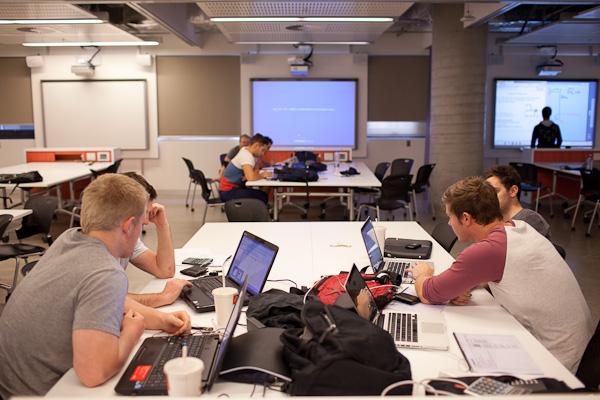
These workshop sessions took place in the collaborative pod classroom, set up for large group- and project-work with 12 pods and a capacity of 88.
Having arrived at class, the students had up to 10 minutes to get used to the space, and familiarise themselves with the technology and the pod arrangement of the room. Associate Professor McGuffie organised the students into small groups to allow a team dynamic to occur, with skill-sharing and division of tasks.
On the interactive whiteboards at each pod, students displayed their presentation to the group, which was either a spreadsheet of numbers from the research exercise, or a specific PowerPoint slide.
Challenges and considerations
Associate Professor McGuffie noted the following observations, suggestions and challenges:
Get help in managing large groups and checking attendance. In a large room it can be difficult to distribute material, explain the process and answer minor problems with the projectors and computers. Pick up a radio microphone from Audio Visual Services (AVS) on Level 4 in the Tower Building to make yourself properly heard throughout the classroom. Also, recognise the audio-visual control in the room are ‘student centred’ so there is no central control of the microphone. Orientate yourself and the students to the new space and its technology in the first class (pods, screens, etc.) which will save time in the next workshop. Assign small breakout groups to increase productivity. Smaller groups (one to three students) are more productive than larger ones (five to seven students). Having a group of eight to 10 people share a PowerPoint slide by email was quite a complex social exercise; so it may be better to appoint smaller groups to complete such exercises. Be flexible with your exercises; there might not be enough time to complete all the ones you planned, so plan the activities separately so the students don’t see if things have changed or if time runs out. At the end of the workshop, the planned exercises took longer than expected. In theory there were four 30-minute exercises, but in reality they took 40-45 minutes each and the final ‘test’ was dropped. Students enjoyed this learning experience, as it was more active than the traditional lecture. Students largely tutored each other on a free-body analysis problem. With one student taking the lead and showing the group how it was done on the interactive whiteboard, it offered the lecturer a chance to interact with small groups or to address the class for more common issues.
Exploring further
Foundations of Physics Workshop resources:
Research Exercises 1 and 2_McGuffieGroup Worksheet_McGuffieQuick Quiz_McGuffie
Guide for using collaborative pod classrooms (Building 6)
Using room 06.04.40.pdf
Delving even deeper
Thomas, L. (2012). Building student engagement and belonging in Higher Education at a time of change. What works? Student retention & success programme. Paul Hamlyn Foundation. London. (pp. 16-19; 31-38; 48-59)
Read... |