

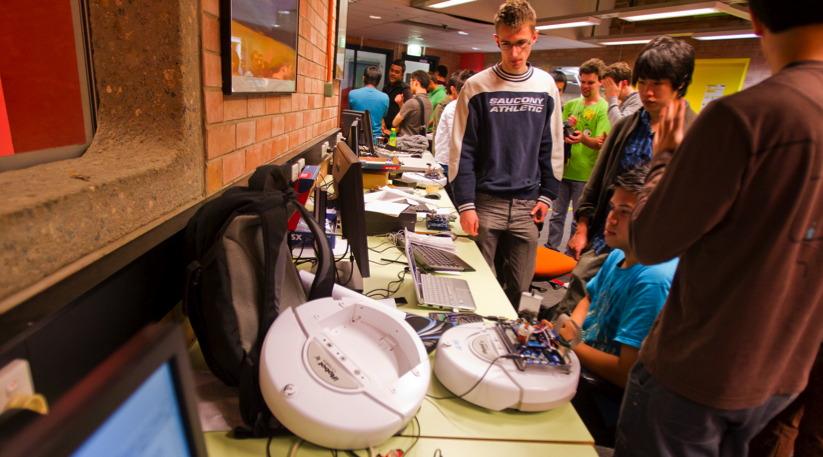
Engineering students working on a problem
Lecturers: Faculty: Keywords: | Dr Keith Willey and Dr Tim Aubrey wanted to use students’ time in class more productively and for students to really understand what it was they were learning. What changes have been madeDr Willey and Dr Aubrey introduced 'flipped' enquiry-based learning activities, collaborative in-class exercises and a threshold exam into the subject Continuous Communication. The teaching team wanted to change the culture in the subject, in which they felt students were focusing too heavily on accreditation, rather than learning. As part of this culture change, they wanted to move away from the traditional lecture format and introduce new teaching and learning techniques. So they are testing whether this approach strengthens students' critical thinking skills and provides them with a wider range of resources. How the subject is now being taughtThe subject's new teaching and learning techniques are implemented as follows: 1. Flipped Learning “Anything that a student produces that only they and you [the lecturer/tutor] sees is a waste of time. It’s only valuable if students can exchange ideas. In this subject students get readings, design problems, enquiry based problems, and online research. And then using SPARKplus as a tool we get them to post their opinions, and answer some multiple-choice questions about what they were meant to learn. We then publish those results to the students without correct answers. Being able to discuss their choice and read other students' reasoning they can hopefully start getting some opinions about this subject's content and outcomes, and all before they come to class.” 2. Online enquiry-based activities 3. Collaborative in-class activities 4. Final assessment a. Multiple-choice examination in Week 13 “Having to get 80% in a test is sometimes a psychological barrier for students. But they soon overcome that, as this is a satisfactory knowledge test to give them a chance to see where their gaps in knowledge lie; if they have to scratch three times for the answer, for example.” b. The final exam The teaching team recognise the advantages of 'flipped learning' and pre-class work, however they also identify common misconceptions about 'flipping' including the idea that technology must be used and entire lectures should be put online. Instead, “you can use screencasts of your hand drawing a diagram, or writing out notes - anything that explains the information simply, in less than five minutes.” Dr Willey also suggests allowing students to have some say in how and what they learn in the class activities. “The activities should be guided by their needs. This means that sometimes you may head off into uncharted waters, not be fully prepared and get it wrong. But that's ok, you learn what works through making mistakes.”
MathWorks. Get an overview of MATLAB, the language of technical computing.
| |