

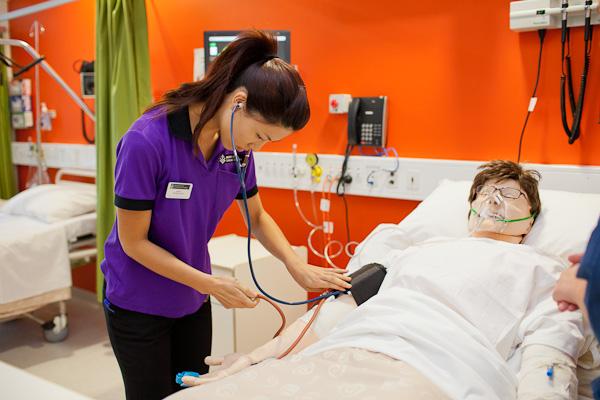
Students engaged in simulated hands-on experience. (Photo by Anna Zhu)
Lecturer: Faculty: Project: Keywords: | Simulations are common in health care education but their use in undergraduate Science is relatively new. Dr Hui Chen and her team are paving the way, introducing simulation scenarios to their Science students. What the project is aboutDr Chen's project is building on the success of a recent collaboration between Health and Science that produced two simulation scenarios for a second year Science subject, Human Pathophysiology. In the developed simulation scenarios, students interact with manikins and their peers, providing a more authentic link to clinical settings than traditional, paper-based methods. In response to the success of the simulation sceanrio in second year the project is developing and piloting additional simulation scenarios for first and second year subjects. Why the project is being introducedPhysiology and Pathophysiology in the Faculty of Science traditionally work with paper-based case studies and whilst these cases are built around a scenario that is authentic, they lack context relating to the clinical setting. Introducing simulation scenarios to first year students in human anatomy and physiology helps support:
This hands-on approach provides students with opportunities to experience and exercise both theoretical and practical skills. Dr Chen hopes that the simulation classes provide the students with a better understanding of the discipline in human physiology and a smoother transition into second year physiology-based subjects. Beyond second year subjects, simulation as contextualised learning develops students' graduate attributes such as team work and communication (with group members and with the ‘patient’), leadership skills, problem solving and decision making. All of which are not easily achieved with a paper-based case study approach. How the project is being implementedThe process of Dr Chen’s project is as follows: In Autumn semester:
In Spring semester:
Initial feedback in 2012 from students who performed some simple medical examinations on the manikins and fellow students, showed that students better understood the process, the underlying knowledge and the realistic setting of the exercise. However in the implementation of Dr Chen's 2013 project, passive observation dominated the students' learning time during class. Further modification are being implemented to develop learning activities where students work as a team in response to the sceanrios with faciliation by the demonstrators supporting active engagement. Exploring further Parr, M.B. & Sweeney, N.M. (2006). Use of human patient simulation in an undergraduate critical care course. San Diego State University.
Lasater, K. (2007). Clinical judgment development: Using simulation to create an assessment rubric. Journal of Nursing Education. | |