

Our clinical laboratories provide hands-on learning environments for nursing and midwifery students. 

With support from our clinical education team, you’ll have the resources you need to practise and refine your skills.  
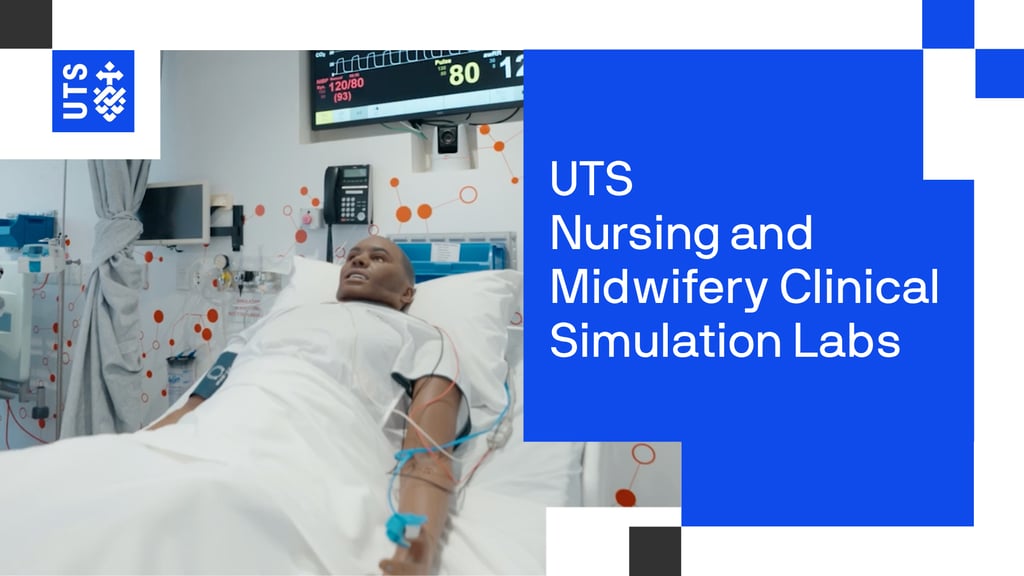
A patient simulation mannequin lies in a hospital bed connected to monitoring equipment and medical lines in a clinical simulation lab. A large blue panel displays the text “UTS Nursing and Midwifery Clinical Simulation Labs”, with the UTS logo in the top left corner.

Take a tour of the UTS Nursing and Midwifery clinical simulation laboratories

Take a tour of the UTS Nursing and Midwifery clinical simulation laboratories transcript

Hi, and welcome to the Clinical Simulation Laboratories at UTS.

Before we begin, we'd like to acknowledge the Gadigal people the traditional custodians of the land on which our city campus stands.

We pay respect to Elders past and present.

On level six is a beautiful piece of indigenous artwork titled We Walk Together, commissioned for the School of Nursing and Midwifery by Leona McGrath, a UTS midwifery alumna.

Reflecting our commitment to cultural safety for all staff and students.

We're excited to take you through our nursing and midwifery simulation labs. Honestly, one of our favourite parts of our programs. This is where hands on education brings our theory to life and prepares us for clinical placement and professional practice.

The UTS Simulation Center is one of the largest in Australia, with incredible equipment and technology that allows us to practice and apply our professional skills in a safe, realistic environment.

In our nursing tour we will be meeting our high-fidelity manikins and walking through our specialist nursing labs, including pediatrics, the operating theater, and critical care.

Let's start with nursing. Come this way.

Our labs are large spaces where students can be briefed on theory, policies and procedures then then directly apply them in the clinical area.

There are also scrub bays attached to each lab where students collect their consumables and medications for patient care.

The UTS Sim Labs are so realistic, they truly mimic real clinical environments.

Our labs have a huge suite of simulation technology and full-body patient simulator manikins for us to learn with.

Across our labs we have a wide range of patient simulator manikins, from task trainers right through to high-fidelity simulators.

The higher the fidelity, the more life-like a manikin is.

Meet Manny Quinn, one of our high-fidelity simulators. Manny can cough, vomit, sweat, seize, bleed, and even speak, and anything a student does to treat him is reflected in his vitals in real time.

Our simulation team runs Manny from the control room, giving students a truly realistic and immersive simulation experience.

Simulation isn't just about the technology, it's also about the experience. We use role play and manikins to replicate real clinical scenarios, so that when students step into an actual healthcare settings, we're prepared technically, emotionally, and professionally.

At UTS, we believe in preparing our nursing students for the full reality of clinical practice, including situations that may be challenging.

With this in mind, we've embedded virtual reality into our nursing curriculum.

Using VR headsets, students are immersed in highly realistic scenarios impossible to safely recreate in a lab, to safely recreate in a lab, for example, recognising and managing challenging patient behaviours.

UTS is the first university in Australia to roll out such a program to its nursing students.

We also use an AI-powered communication tool where the AI plays the role of a patient, allowing students to practise professional communication, including building rapport, gaining consent, and taking a patient history.

Our Paediatric Ward is set up to look and feel just like a real children's hospital. Our manikins range from newborn babies right through to teenagers covering the full range of paediatric care. Caring for children requires a very different approach to adult nursing. Everything from medication dosing to communication is adapted for age and developmental stage, and in paediatric nursing, the family is always central to the care of the child.

This is our UTS Operating Theatre, designed to replicate the look, feel, and workflow of a real surgical suite. What makes this face unique is that it covers the complete pre-operative patient journey from pre-admission and anaesthetic preparation, through the intraoperative phase, and into post-anaesthetic recovery.

Throughout their peri-op course, students rotate through the four key nursing roles in the operating theatre, the anaesthetic nurse, the scout nurse, the scrub nurse, and the recovery nurse, building a well-rounded understanding of how the surgical team works together to deliver safe care.

We also have an operating theatre set-up, which allows students to practise preparing for and responding to situations where a caesarean section may be required.

This is our Critical Care space, designed to replicate a range of high-acuity environments, including intensive care units high dependency units, and emergency departments. Students work hands-on with equipment you'd find in a real critical care setting, including ventilators, invasive monitoring devices, and complex drainage systems. 

Here, students develop the advanced nursing skills required to care for critically ill patients, including advanced life support and complex medication administration. Because every second matters in critical care, simulations here are designed to be intense and realistic.

Finally is our Practice Lab, a space where students can come outside of scheduled classes to refine their clinical skills. The lab offers open practice sessions where you can work on any skill independently. We also run Masterclasses here, structured group sessions focused on specific clinical topics linked to our subjects assessments, and placements. They're very popular with our nursing students!

That's the end of our nursing lab tour, thanks so much for joining us.

Now we’ll hand over to our midwifery students, who will take you through the midwifery facilities. Over to you.

Midwives partner with women and they work in a variety of settings

The simulation labs here at UTS are designed to reflect this diverse setting, maternity settings such as home, community, birth centre and hospital.

We also have dedicated spaces for newborn care neonatal intensive care practice.

Our first stop is our homebirth simulation setting. With increasing availability of publicly funded homebirth programs and opportunities to work as a privately practising midwife, this space provides an important opportunity for students to practise in a homebirth context.

This room is set up to simulate a home environment, including equipment such as an inflatable birth pool for women to labour and give birth in. Following discharge, midwives provide ongoing care to women and their newborns in the home. So this space is also used to simulate postnatal home visits. This space facilitates students to practise essential skills, including health assessments, education, and supporting early parenting in a familiar environment for families.

This is our simulation room to mimic community antenatal care. Students can run an antenatal appointment in these rooms to practise for clinical placement.

This is our birth centre simulation room. The room is set up to reflect a real birthing environment, with the bath at the centre, reflecting current evidence-based design commonly seen in contemporary birthing spaces. In this lab, students participate in simulation and role-play activities to develop skills in supporting women during labour and birth. The labs feature equipment commonly used to support normal labour and birth, including a supportive rope, peanut balls, floor mats, beanbags and TENS machines. Students can also use wearable simulation equipment equipment to experience labour from the woman's perspective. This enhances our understanding of the physical and emotional experience of childbirth. This also supports our development of communication empathy, and clinical decision making skills prior to going on placement.

Now let's move to the lab space designed to reflect a hospital environment. This is where we develop skills in managing more complex clinical scenarios and providing care to women and babies with additional health care needs.

The space is typically configured with six simulated bed areas, each equipped with high-fidelity manikins. These reflect real-world clinical care alongside more complex scenarios such as managing high blood pressure in pregnancy, as well as other maternity emergencies. Simulation-based learning and role play helps us develop clinical skills, critical thinking, case management, and effective communication with women, families and the multidisclinary team.

Here is one of our birthing simulation manikins. She is capable of birthing in real time. The manikin also simulates contractions that we can palpate. This helps us learn how to respond to different clinical scenarios, like excessive bleeding after birth.

Finally, we also have dedicated spaces for newborn care and neonatal intensive care simulation. These labs are set up to develop our skills caring for a newborn in complex situations prior to our newborn care clinical placement. These areas allow us to develop specialised skills in newborn assessment and resuscitation. We learn how to care for well and unwell newborns. The different high-fidelity manikins and equipment help us develop our skills in a supportive space for learning and practice to care for women and babies in any setting.

Thank you for joining us on our tour. We can't wait to welcome you to UTS.

Thank you for watching.

Nursing and Midwifery clinical simulation laboratories 

The School of Nursing and Midwifery is home to 16 clinical simulation laboratories which are designed to replicate real-world clinical environments for nursing and midwifery practice. There is also a specialised community laboratory which mimics a home-birthing environment for midwifery practice. 

Briefing areas (where you’ll start and finish the class) open onto clinical spaces that are populated with high-fidelity patient simulator manikins in hospital beds, and a wide variety of medical equipment, including:   

  • wall-mounted simulated oxygen, medical air and suction outlets 
  • intravenous (IV) infusion and cannula therapy equipment 
  • heart rhythm (ECG) simulators 
  • advanced nursing care equipment related to perioperative, paediatric and critical care nursing 
  • cardiopulmonary resuscitation equipment such as airway trainers, CPR manikins and automatic external defibrillators 
  • vital signs, wound management and manual handling tools, and 
  • audiovisual and text resources. 

All our clinical learning activities are supported by an expert team of clinical health simulation officers and technicians who prepare, maintain and support learning in this highly technical space. 

Specialised learning in Nursing and Midwifery 

The clinical simulation laboratories are designed to transform into specialised clinical areas for teaching.  

Nursing labs

Our nursing labs can transform into a unique perioperative theatre lab and a variety of nursing specialties such as: 

  • medical surgical nursing 
  • paediatric nursing 
  • critical care nursing 
  • aged care, and  
  • palliative care nursing. 

Midwifery labs

Our midwifery labs transform into both clinical birthing suite environments and community home-birthing environments that promote woman-centred care and reflect evidence-based practice.

High-fidelity simulation spaces

UTS has two specialised high-fidelity simulation spaces to immerse students in complex nursing and midwifery simulation scenarios to improve critical thinking and clinical preparedness.  

Each lab has 3-5 bed spaces for team simulations and is equipped with cameras, microphones and speakers. This allows clinical scenarios to be recorded for debriefing and feedback.
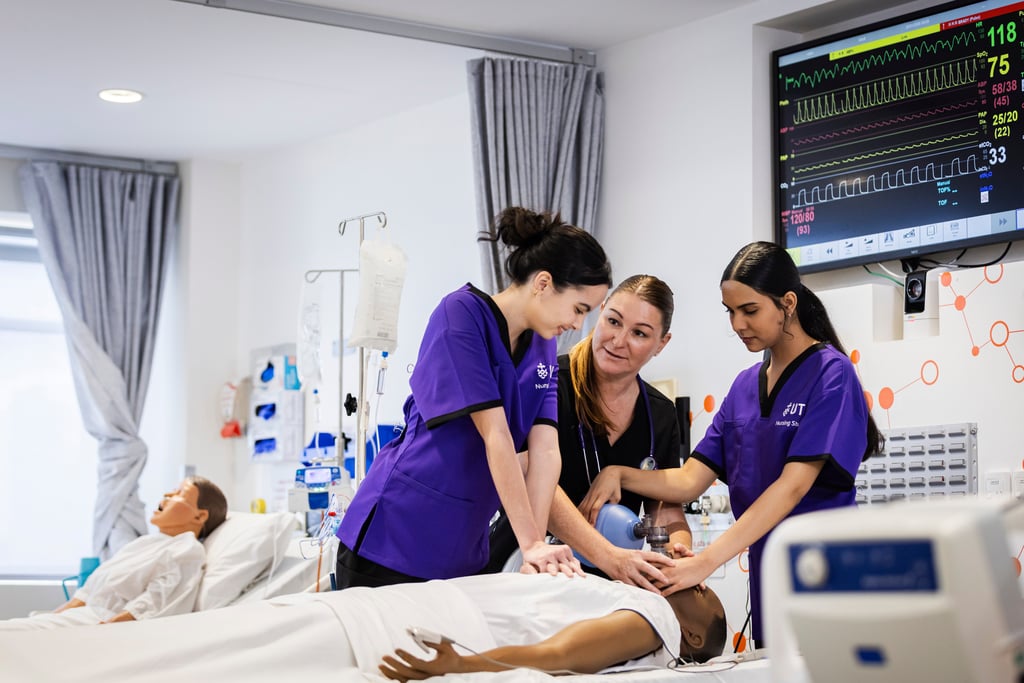
Two nursing students practice CPR on a manikin
A manikin used in the UTS laboratories.

Simulated patient care

Simulation is a key part of our lab teaching. In our clinical labs, you will work through case studies, skills stations, and various simulated scenarios using patient simulator manikins and medical technologies to develop your nursing and midwifery practice. 

The labs are purpose-built to develop your clinical skills and prepare you for work-integrated-learning through clinical placements.   

Patient simulator manikins

Our labs feature a range of manikins programmed for specific clinical tasks.

Low-fi technologies help with fundamental tasks such as vital signs monitoring, while mid-range models support basic to intermediate clinical skills.

High-level robotic models, such as SimMan®3G, are used for complex clinical scenarios and mimic many human body functions.

These manikins can:

  • blink
  • dilate pupils
  • sweat
  • breathe
  • register pulse
  • have cannula and tubes inserted realistically, and
  • respond verbally in real time when connected to wireless microphones. 

More than just a place to learn 

As well as having access to innovative clinical environments, you’ll benefit from a range of student spaces that have been designed to support your learning. 

These include: 

  • bookable meeting rooms for group work and assignments 
  • a multi-purpose, configurable community room where you can work on assessments, practice your clinical communication skills, or convene large meetings, and 
  • designated student lounge spaces for Faculty of Health students where you can catch up with friends after class, or just catch your breath. 

Learn more about studying Health