

JUMP TO
Energy
Energy plays an essential role in our buildings, research facilities and everyday campus activities. UTS is reducing the environmental impact of its energy use through renewable electricity, energy-efficient buildings, electrification, technology upgrades and careful monitoring of our energy consumption.
The UTS Climate Positive Plan outlines targets and initiatives to help UTS achieve net zero for scope 1 and 2 emissions by 2025 and become carbon neutral by 2029.
100% renewable electricity
UTS is now sourcing all its electricity from renewable energy through onsite roof top solar panels and by entering into long term renewable electricity agreements to ensure that all of our remaining electricity consumption is matched by equivalent renewable generation from wind and solar farms.
UTS achieved its 100% renewable electricity target in July 2025. The transition is supported by a long-term power purchase agreement for electricity generated from solar and wind farms in New South Wales.
Since 2014, UTS began to roll out rooftop solar across the main City campus. Over the past decade, this has been expanded to facilities outside of the main campus including the UTS Tech Lab at Botany which has our largest solar array and the UTS Haberfield Rowing Club. In total, UTS now has 3,483 solar panels with a combined capacity of approximately 1,254.6 kW.
UTS has now begun to invest in battery storage to manage electricity demand, reduce pressure on the electricity grid and make more effective use of renewable energy.
Our renewable energy pledge
Universities can help accelerate the transition to clean energy by demonstrating what is possible and encouraging broader action. UTS publicly supports the transition to renewable energy through its operations, research, education, partnerships and engagement.
Through the UTS Climate Positive Plan, UTS advocates for a rapid and just transition to a low-carbon, renewable economy. The plan extends beyond campus operations by drawing on UTS research and education and working with the local precinct, community, industry and government.
Significantly, researchers from UTS’s Institute for Sustainable Futures along with the German Aerospace Centre and the University of Melbourne’s Climate and Energy College, established the One Earth Climate Model (OECM). The OECM shows how countries and industry sectors can meet the Paris Agreement’s target of limiting global temperature rise to 1.5°C and the research team continues to update and model new scenarios.
At a local level, UTS has served as a major venue partner for Climate Action Week Sydney since its inauguration in 2024, providing campus spaces for flagship plenaries, networking sessions and community-led panels. Climate Action Week Sydney seeks to connect people across Sydney to elevate global climate actions, initiatives, solutions and collaborations.
UTS now also hosts the Net Zero Futures series to support leaders and changemakers from across Australia shape Australia’s net-zero future.
Low carbon energy usage
UTS measures the amount of energy it uses, and the proportion supplied from low-carbon sources.
In 2025, 104,477 GJ or 50.8% of the university’s total energy came from renewable sources. Since July 2025, all electricity consumed by UTS has been matched with renewable electricity generation. However, total energy use also includes fuels used for activities such as space and water heating. UTS is progressively electrifying campus systems to reduce its remaining reliance on fossil fuels. The graph below shows our steady increase in low-carbon energy use.
| YEAR | TOTAL ENERGY (GJ) | LOW-CARBON ENERGY (GJ) | % LOW-CARBON |
|---|---|---|---|
| 2019 | 220,626 | 24,197 | 11.0% |
| 2020 | 200,436 | 25,883 | 12.9% |
| 2021 | 185,933 | 29,911 | 16.1% |
| 2022 | 208,498 | 39,812 | 19.1% |
| 2023 | 210,784 | 47,546 | 22.6% |
| 2024 | 223,585 | 53,409 | 23.9% |
| 2025 | 205,501 | 104,477 | 50.8% |
Note: Our reporting methodology has changed from location to market based as of July 2025.
Electricity and gas consumption
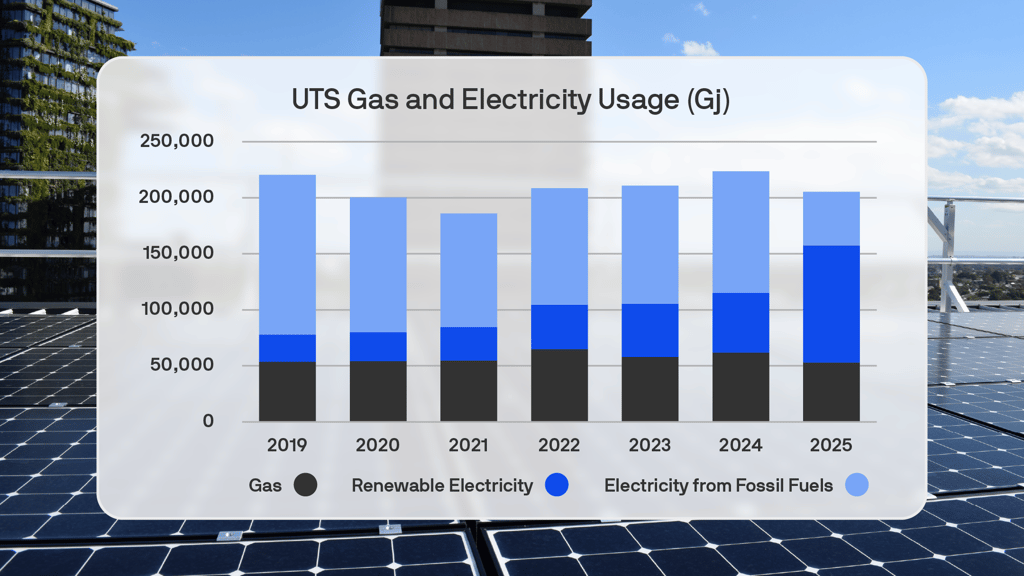
In 2025, UTS used 152,521 GJ of electricity compared with 161,845 GJ in 2024, representing a 5.8% decrease due to the implementation of building analytics projects, building maintenance system tuning and ongoing energy and water efficiency initiatives.
Gas usage decreased 14.2% from 61,740 GJ in 2024 to 52,980 GJ of gas in 2025 due to energy efficiency and UTS’s first electrification project coming online. The graph below tracks our gas and electricity use since 2019.
Annual electricity and gas consumption
| YEAR | ELECTRICITY (GJ) | GAS (GJ) | TOTAL ENERGY USE (GJ) |
|---|---|---|---|
| 2019 | 166,877 | 53,749 | 220,626 |
| 2020 | 146,233 | 54,203 | 200,436 |
| 2021 | 131,189 | 54,744 | 185,933 |
| 2022 | 143,726 | 64,772 | 208,498 |
| 2023 | 152,881 | 57,903 | 210,784 |
| 2024 | 161,845 | 61,740 | 223,585 |
| 2025 | 152,521 | 52,980 | 205,501 |
Energy use per square metre
UTS measures energy-use density by comparing the total energy used in university buildings with our gross floor area. As a high-density campus, our energy use based on gross floor area may seem high, but we use our space very efficiently with high occupancy levels compared to campus population.
| YEAR | TOTAL BUILDING ENERGY USED (GJ) | GROSS FLOOR AREA (m2) | ENERGY USE DENSITY (GJ/m2) |
|---|---|---|---|
| 2019 | 220,626 | 434,688 | 0.508 |
| 2020 | 200,436 | 437,756 | 0.458 |
| 2021 | 185,933 | 434,517 | 0.428 |
| 2022 | 208,498 | 412,285 | 0.506 |
| 2023 | 210,784 | 421,656 | 0.500 |
| 2024 | 223,585 | 415,775 | 0.538 |
| 2025 | 205,501 | 409,602 | 0.502 |
Reducing Energy Consumption
UTS has an ongoing program to reduce energy consumption and improve campus energy performance. Energy efficiency is supported through monitoring, building optimisation, equipment upgrades, electrification and improved operational controls.
UTS monitors energy use using meters across individual floors and buildings. This allows Facilities Management, Engineering and Sustainability teams to identify faults, leaks and unexpected consumption and respond to emerging issues. Quarterly energy reviews and regular building optimisation meetings are used to coordinate improvements.
Current initiatives include:
- Working with our internal AI team and external building analytics platforms to predict when a building’s peak electricity demand is likely to occur and undertake preventative actions such as pre-cooling in periods of low demand.
- Multiple Building Management System (BMS) optimisation projects are currently underway such as BMS analytics to suggest correct actions to reduce energy wastage.
- A masterplan has been commissioned to electrify all fossil fuels used for domestic hot water and space heating on campus. This will further reduce our use of fossil fuels and heat water much more efficiently.
- Building audits have been conducted to identify opportunities for further LED upgrades. upgrading lighting and lighting controls
- Installing battery storage to manage peak electricity demand.
Identifying and reducing energy wastage
Energy reviews help UTS identify where energy is being wasted and where operational or technical improvements can be made. Monthly meetings with facilities managers help to ensure that we optimise our energy usage including minimising energy wastage whilst maximising thermal comfort.
The university uses building-level and floor-level metering to detect abnormal consumption, faults and energy leakage. Our Building management system analytics recommend corrective action, while audits identify opportunities for measures such as LED lighting upgrades and improved control strategies.
This monitoring and review process helps UTS:
- identify equipment operating outside required hours
- investigate unexpected peaks in electricity or gas use
- find faults and inefficient building settings
- prioritise maintenance and energy-efficiency projects
- assess whether completed upgrades are delivering the expected benefits
Project Spotlight: Campus Electrification
In 2025, UTS embarked on the first phase of the electrification masterplan with the replacement of gas boilers for a new energy efficient electric heat pump system in buildings 1 and 2. This is particularly significant as UTS is now matched to 100% renewable electricity. The second phase will be converting buildings 10 and 11 space heating and domestic hot water to electric heat pumps.
- 36.5 tonnes of CO2-e avoided to date
- Improved overall asset performance
- Enhanced staff capability and knowledge in sustainable operations
Energy efficient buildings
UTS integrates sustainability into the planning, design, construction and operation of new and existing buildings and campus infrastructure. The UTS Sustainability Policy assigns responsibility for this integration to the Director, Property, in consultation with the Head of Sustainability.
The UTS Design Guidelines establish requirements for university building projects, including requirements intended to continually improve energy efficiency across campus. The Sustainability Vision for the Campus Master Plan provides a longer-term framework for creating a more sustainable, regenerative and resilient campus. All new buildings and major refurbishments meet energy-efficiency requirements.
UTS also has several 5 Star and one 6 Star Green Star certified buildings. Their sustainability features include energy-efficient technology, rooftop solar, water recycling, green roofs and walls, and facilities that support active transport.
Project Spotlight: Building Optimisation
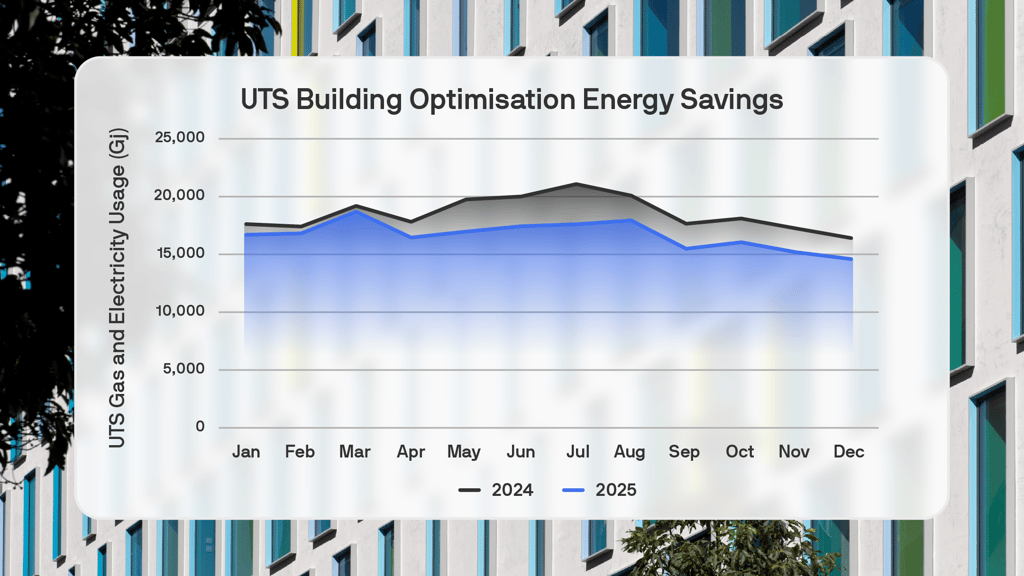
In 2025, UTS commenced a building optimisation program to improve energy efficiency as well as improve building comfort and temperature regulation. This has largely been achieved through scheduling temperature and fan speeds and where possible placing campus buildings into an ‘overnight’ mode. As seen in the graph below, the program has delivered 22,452 GJ in energy savings.
Energy upgrades across campus
UTS is upgrading existing buildings to improve energy efficiency, lower energy consumption and support the transition away from fossil fuels.
Projects completed or underway include:
- LED lighting and lighting-control upgrades
- Building Management System optimisation
- Improvements to energy and water monitoring
- Building audits to identify further energy-efficiency opportunities
- Battery storage to reduce peak electricity demand
- Electrification of space heating and hot-water systems
- Optimisation of air-conditioning systems using occupancy and building-performance data.
- Earlier projects included sensor-controlled LED lighting, upgrades to older lighting systems and room-occupancy controls that automatically adjusted air conditioning.
Program Spotlight: Household electrification
In 2024, UTS sustainability commenced a series on Household electrification which included face to face presentations, webinars and drop-in sessions. These sessions were free and open to staff and students as well as the general public. Participants learned about ways to electrify their homes, solar installation, the economics and payback options on household and induction cooking.
Watch: Chats for the Goals – Accelerating your home’s renewable transitions
Project Spotlight: Supporting the development of clean energy policy
UTS researchers are helping shape the policies, standards and regulatory frameworks needed to support a global transition to clean energy. Through the Australia–EU Green Hydrogen Dialogue, researchers from the Institute for Sustainable Futures (ISF) collaborated with policymakers, industry leaders and researchers from Australia and Europe to support the development of green hydrogen policy and governance.
The Dialogue facilitated knowledge sharing on green hydrogen production, policy alignment, technical innovation, investment and trade, with a particular focus on how Australian and European policies, standards and certification frameworks can work together to accelerate the clean-energy transition.
By contributing research expertise and policy insights, UTS helped support international cooperation on hydrogen regulation and clean-energy development, strengthening the foundations for low-carbon industries and future renewable energy markets. The project also promoted dialogue on sustainable finance, climate-related trade and investment, and pathways for achieving climate-neutral economies.
How you can help
Everyone at UTS can help reduce energy use.
- Switch off lights when leaving an empty room
- Turn off monitors, computers and other equipment when they are not needed
- Use natural light where possible
- Avoid heating or cooling empty spaces
- Shut laboratory, kitchen and workshop equipment down safely when it is not in use
- Boil only the amount of water you need
- Take the stairs instead of the lift where practical and accessible
- Report faulty lighting, heating, cooling or equipment through the UTS maintenance process
- Share energy-saving practices with everyone in the UTS Community
Advice and resources
Refer to the following useful links for more advice and information on water savings.
Your Home
Your Home is an award-winning guide, published by ISF in collaboration with the Commonwealth Government and provides lots of great advice on sustainable housing to householders and building professionals including energy use.
Department of Climate change and Energy Efficiency
Provides information about climate change initiatives in Australia and actions you can take to reduce your greenhouse gas emissions.
Department of Environment and Energy
Provides information on how to save energy, reduce your energy bills and make your home more comfortable
Climate Positive Plan
Climate change is one of the greatest existential threats the world has faced. At UTS we are working to decarbonise as rapidly as possible in line with our values.
Institute for Sustainable Futures Energy Futures
The ISF team provides tailor-made research in renewable energy, energy efficiency and consumer energy resources with the aim to decarbonise the energy sector.
Centre for Clean Energy Technology
We develop efficient devices for energy harvesting, storage and conversion, turning scientific discoveries into practical solutions.
Related policies and resources