


- Posted on 16 Sep 2026
- 14-minute read
This article originally appeared in Inside Story on September 16 2026.
Are you at a very Chinese time in your life? Or is there more to “becoming Chinese” than buying a Labubu doll, drinking warm water, hopping into a BYD electric car or even joining a group of Chinese baby-boomers in synchronised dancing?
In early 2025 a wave of sinophilia swept across social media in the West. It soon became known as “China-maxxing,” a play on “looks-maxxing,” that corner of the manosphere in which (mostly) young men use increasingly outlandish methods to reshape their bodies and “max out” their looks. The China-maxxing catchphrase, “you met me at a very Chinese time in my life,” played on the closing dialogue of the movie Fight Club, which is misinterpreted in the manosphere as a eulogy to ultra-masculinity. China-maxxing means adopting Chinese culture with similar fervour in order to “become Chinese.”
For more than a year, China-maxxers seemed to operate in their own internet realm untouched by swirling international tensions. But established media outlets — Fox News, CNN, the Financial Times, Foreign Policy magazine, even Australia’s own Financial Review — eventually dignified this phenomenon with serious coverage combined with varying degrees of critique. By then, the internet meme had settled from its pandemic outbreak to an endemic existence, the media attention having unwittingly cemented the place of “China-maxxing” in popular culture.
But was China-maxxing a flash-in-the-pan for China’s soft power or an early chapter in the Chinese century?
“China has been pre-eminently a culture,” wrote Stephen FitzGerald in 1976. “Even the extension of the Chinese Empire and its further influence is described by historians as being a process of ‘acculturation’. By this process China is still the dominant politico-cultural influence in our region.”
When FitzGerald, Australia’s first ambassador in Beijing, made this observation in a despatch to Canberra half a century ago, it took a brave soul to speak of China’s “politico-cultural influence” in anything but the past tense. The mutual accommodation with Washington seemed to be giving Beijing more strategic space in Asia, but China’s government apparatus was still reassembling itself after the damage wrought by the Cultural Revolution. The country’s underdeveloped economy had remained sluggish since its recovery from the early-1960s famine and largely autarkic despite Beijing’s détente with the West.
Diplomatically, the People’s Republic was still finding its feet within its neighbourhood. Japan, Malaysia, the Philippines and Thailand hadn’t recognised Beijing until after Richard Nixon’s visit — the first by a US president — in 1972; Singapore and South Korea held off until 1990 and 1992 respectively. Across China’s northern land border loomed a hostile Soviet Union, the former ally and economic partner that was now China’s greatest military threat.
FitzGerald was only too aware of these constraints. But he also took a long view of China’s historical trajectory: “The influence it wielded in its own separate universe for two thousand years[,] before the Europeans arrived and prised open its doors and plundered its treasure[,] is unknown.” By implication, the re-emergence of China would transform the world the Europeans had dragged it into.
Before the century ran out, any retreat by the United States had proven temporary. Washington policymakers’ fears about a “domino effect” — the loss of Vietnam precipitating a rolling red wave through Southeast Asia — gave way as communists started fighting each other in Cambodia and on the China–Vietnam border. The two potential challengers to Washington’s leadership in Asia — Tokyo and Beijing — both focused on economic development, albeit from quite different starting points.
When Japan flew too close to the sun, Washington clipped its wings via the Plaza Accord of 1985. After abandoning the gold standard, America transformed its trade deficit into its commanding role at the centre of international finance as the dollar earnings of foreign firms were recycled through Wall Street.
Global pop culture took shape with an unmistakably American accent, even in critiques of America. Director George Lucas admitted his genre-defining film Star Wars was an allegory of the resistance in the third world to US military interventions. It premiered in 1977, the same year China reinstituted university entrance exams as a foundational step to modernising its educational system.
As young Chinese students flocked into universities, their fascination with the newly accessible American movies, fashion, music and intellectual discourse would become a defining feature of Chinese society. Both Xi Jinping and Wang Huning, another senior figure in today’s Communist Party, spent time in the United States in the late 1980s.
The world was America-maxxing. Communism fell in Eastern Europe; Mikhail Gorbachev traded his leadership of an alternative international order for a cameo in a Pizza Hut advertisement. It seemed impossible to resist what Francis Fukuyama called the “end of history,” with all countries seemingly converging towards liberal democracies inhabiting a US-led global order.
Another quarter-century later, though, history returned with a vengeance. Pax Americana is under challenge both by those refusing to surrender and by malcontents from within. Even Fukuyama recently conceded that “it may turn out that they [China] have a real alternative.”
The China-maxxing moment was hardly preordained. As the country increasingly integrated into global commerce, diplomacy and culture following the economic reforms launched in the late 1970s, the Communist Party’s leadership has swung between liberalising and tightening, frustrating optimistic forecasts about China’s soft power.
For decades the manufacturing boom merely entrenched China’s reputation as a source of cheap, low-quality goods. Its cultural policy, meanwhile, was decidedly defensive, with Beijing jealously guarding the populace from becoming enthralled by the “free world.” International tourism, through which it might have won over outsiders by showcasing its developmental miracle, also underachieved. Beijing preferred manufacturing over services as China’s export engine, and tourism operators already had more than a billion potential customers at home before worrying about the linguistic and legal complexities of dealing with foreigners.
China’s soft power reached its first potential watershed in 2008. While America and then Europe hurtled to the brink of financial collapse, China steamed ahead, putting on an extravagant show as a first-time host for summer Olympics. The electoral victory of a Mandarin-speaking prime minister in Australia late in the previous year seemingly added to a sense of inevitability — before Kevin Rudd proved himself a “brutal realist” rather than a panda-hugger in words and policy.
As China acquired the strategic heft to rival America, critical scrutiny of its territorial disputes, trade imbalance, civil liberties and pollution also began to gather force. Some never accepted the legitimacy of what they regarded a remnant communist dictatorship. Proponents of the “China threat” could claim political victory with the first presidency of Donald Trump, who ranted in graphic terms about how China was ravaging the American economy. Strategic contest with Beijing soon became bipartisan in Washington, and a slew of policies followed. Cold War 2 seemed to be taking shape, a framing which revived the reassuring moral lessons from the first Cold War.
With the Covid-19 pandemic, commentators in the West struggled to make up their minds between “China threat” and “China collapse,” though the two were hardly incompatible. Some found it impossible to resist the analogy between the virus outbreak and the Chernobyl disaster: a mortal blow to an authoritarian regime with no regard for human life or international obligations. Adding to the alarm was Beijing’s forceful retaliation against the Australian government’s targeted call for a UN investigation into the pandemic’s origin.
Accusations of totalitarianism only intensified when, in 2022, China remained virtually the only “zero-Covid” holdout, the cliché of its supposed callousness to life quietly forgotten. And when the government abandoned that policy following public protests, it became commonsensical to declare a triumph of ordinary freedom-loving people over a fragile Orwellian regime.
This apparent retreat, together with an economy still reeling from lockdowns and faced with a collapsing real estate bubble, prompted ponderings of “peak China.” In one of the more sensational stories about the country’s woes, undocumented Chinese migrants were reported to be trekking through Central American jungles to find salvation in the United States. But linear predictions about “peaks” — as in the case of “peak oil” — always invite reality checks. Too often they ignore underlying shifts.
Behind the spectacle of housing crash was Beijing’s policy of redirecting the flood of credit and resources from oversupplied real estate towards advanced manufacturing. Shocked into action by the Trump and Biden administrations’ tightening chokehold on critical technologies, Beijing also hastened to build self-sufficiency in high-tech sectors and redundancy in energy. Like any industrial policy, these efforts took time to produce results, and the transitional pains and entrenched problems were very real. Only a systemic approach would suffice when making sense of China, a country simply too enormous to have just one peak.
Still, for those who take a different view, a peaking China might be a more dangerous China. A certain realist logic dictates that Beijing, perceiving a narrowing opportunity to challenge the United States, would resort to adventurism while its rival roared ahead with its post-Covid recovery and reinvigorated alliance networks cultivated by the Biden administration.
Against this backdrop of excitable prophesies and the transformation of the Chinese economy, China-maxxing broke out in January 2025. The movement was triggered by a pending ban of TikTok in the United States, a Chinese-owned (but separately operated) video platform that had been in the crosshairs of both the Biden and the incoming Trump administrations.
Whatever the validity of Washington’s concerns about TikTok’s data-harvesting, much of the public considered it the platform most free of algorithmic manipulation. Resentful of the high-handed intervention, three million Americans — mostly young and broadly progressive-leaning — flocked to Xiaohongshu (RedNote), a China-based TikTok rival popular among young, urbane members of the country’s middle class. Since Beijing banned foreign social media providers in 2009, this was the first time direct user-to-user contact had happened on a large scale on Chinese turf.
The free world’s internet “refugees,” as the self-deprecating term went, encountered neither hostages of an Orwellian state nor rabid anti-American ideologues, but well-educated interlocutors enjoying a standard of living surprisingly comparable to their own. They had stumbled into a cultural universe with its own self-contained richness, tempered by a cosmopolitanism deriving from China’s size and complexity as well as its (more modern) fascination with the West.
China’s offerings now went well beyond social media. Concurrent with the Xiaohongshu craze, Hangzhou-based DeepSeek released its first generative AI model, soon to be joined in the race by other Chinese tech firms. China’s ultra-competitive electric vehicle makers also came to prominence at mid- and high-end markets. Even the chief executive of Ford had divulged his attachment to his electric sedan from Xiaomi, a company better known as a phone-maker. And while the “green new deal” had disappeared from American politics, China charged ahead with solar and wind electricity, deploying more than the rest of the world combined.
Making China-maxxing even easier was Beijing’s new policy of visa-free travel for citizens from an expanding list of (mostly developed) countries. The new policy had come in late 2024, just as the US re-elected a president vowing to drive out “illegal aliens.” Inbound tourism to China surged in 2025, reaching sixty-eight million visitors, effectively matching the numbers visiting the United States. The tourists did what no state propaganda machinery could hope to do, producing a torrent of organic, on-the-ground testimonies that bypassed news filters to reach tens of millions more outside China.
No less real than the concrete experience of China-maxxing is its geopolitical overtone, cutting against the Cold War framing of China that had been crystalising for a decade. A March 2026 survey showed 62 percent of young American adults preferring improved relations with China, more than twice the number of those who would prioritise containing China. Polling by two major Australian foreign policy think tanks has also found the young spearheading the lift — however tentative — in public perceptions of the country.
As a Western phenomenon, China-maxxing reflects foremost the societies where it bloomed. Since the end-of-history moment, with social democratic institutions having eroded, popular discontent has been brewing. More recently, millennials and gen Zs in the world’s richest societies have found themselves increasingly disenfranchised, helpless against widening inequality, the climate crisis and live-streamed atrocities supported by their governments’ foreign policy. The more the rulers and priests of the liberal democratic order insist on its virtues, the less convincing they sound.
Yet anti-liberal movements in the West have also failed to deliver on their revolutionary promises. Between mass deportations and economic squeeze for the average voter, Donald Trump’s popularity has nose-dived since returning to office. Likewise, having served as a far-right radicalisation pipeline, the manosphere had lost its magnetism. Its more recent iteration, the half-sardonic looks-maxxing movement, is almost deliberately apolitical.
If the existing order is losing legitimacy, why should the young not at least look with curiosity towards its supposed challenger? Why should they maintain antagonism towards a country that has at least delivered significant material improvements for its own citizens?
China-maxxing is thus also a reverberation of China’s modernisation. In this, the public in English-speaking countries have merely joined the rest of the world. As recent Pew surveys show, attitudes toward China have almost invariably warmed since Covid: in Africa, Southeast Asia, and even much of the European Union, China is viewed more favourably than America. It would be more surprising if the public showed no interest in a country that supplies so much of their (increasingly sophisticated) manufactured goods, has built metropolises spectacular in both scale and connectivity, and has made conspicuous technological leaps once thought only possible from the fertile soils of liberal societies. And, notwithstanding Beijing’s restrictions on speech or ham-fisted attempts at promoting soft power, China’s population size, history, and relative prosperity translate to a wealth of human experience.
The centre of cultural gravity tends to follow the centre of economic gravity. At the height of the Qing Empire in the eighteenth century, chinoiserie emerged as an integral part of European aesthetics. Even earlier, many intellectuals already held such regard for China that the Jesuits could leverage their (relative) China expertise to gain influence on the other end of the Eurasian continent. Intellectual exchange with China — and indeed the rest of the world — was a crucial catalyst in European Enlightenment.
But the China-maxxing of our time is not simply a return to this westward flow of cultural influence. Modern China already bears deep imprints of the West. American tech firms introduced China to social media before Chinese entrepreneurs would invent their own. Consumer demand from developed countries helped kick-start China’s manufacturing boom and shaped the tastes of its new middle class, before their Labubu dolls took the world by storm. Marxism-Leninism, which drew on earlier European intellectual developments in political economy and Hegelian philosophy, is at the heart of the Beijing’s official ideology.
Nor is China a mere reflection or evolution of the industrialised world. Rather, the People’s Republic itself has become a central stage for the still unfolding drama of modernity. As the economic historian Adam Tooze has repeatedly pointed out, perhaps the starkest display of China’s centrality lies in climate change.
In the first decade of the twenty-first century, China’s coal production more than doubled, making it the single largest greenhouse gas emitter in the world by the late 2000s. Indeed, between 2000 and 2014, China accounted for the majority of increase of global CO2 emissions. In 2023, however, China’s green industrial policy began to turn the tide. At the time of writing, China’s fossil fuel consumption has effectively plateaued, with coal’s share in electricity generation falling below 50 percent for the first time. This renewables manufacturing boom spilled over into developing countries like Pakistan, allowing rapid electrification without further strains on their struggling grids or increased dependency on imported fossil fuels.
The history of climate and energy transition in our century necessarily revolves around China. When China-maxxing tourists cruise through Chinese countryside on the world’s most extensive high-speed rail network and gawks at the hills outside clad in solar panels, they see from front-row seats the developments that will determine the habitability of this planet.
The more observant China-maxxers would have quickly understood that the futuristic mega-metropolises were just a small slice of the country. With just over two-thirds of its population urbanised, there are still as many Chinese living in rural areas as there are inhabitants of the European Union. Nor are most urbanites electric SUV owners who spend their weekends perusing luxury brands in palatial shopping malls, or financially secure retirees socialising in public parks while showing off impressive gymnastic moves.
These urbanites are also new university graduates anxiously seeking employment while lost in cities far from their hometowns; young parents juggling the brutal hours of office jobs and the demands of child-rearing and often settling for only one child per household despite official encouragement to have more; a growing cohort of the elderly who find themselves in a different province or country from their children and a world away from the agrarian society of their youth; migrant workers squeezing out meagre savings working not just in the massive factories feared by industrialists and pundits in the West, but also as construction labourers, delivery riders and kitchen hands, living largely in parallel from the resident middle class.
If China is a focal point of the most dynamic forces of modernity, it also necessarily displays some of the era’s most acute and interlocking challenges of large-scale migration, inequality, environmental preservation, social transformation and personal mobility. In this sense, everyone is already “at a very Chinese time” in their lives: whatever your struggles, there is someone in China who can relate.
Except, perhaps, for parts of the Chinese diaspora, which became a somewhat surprising source of scepticism about “China-maxxing.” Some noted the bitter irony that the last thing many in the West wanted at the height of the Covid pandemic was to “become Chinese.” The sudden reversal in public attitudes was, to them, as flippant as when the same public indulged in Sinophobia.
China-maxxers, their critics say, had treated China as an object for their fantasies while continuing to sideline those for whom being Chinese was not a choice and was often a burden. That sentiment has little resonance within the country itself, where many were simply flattered — if somewhat bemused — at this outburst of Sinophilia. The China they are only too happy to share with China-maxxers is different from the one carried by many in the diaspora. The China of a rich urbanite on Xiaohongshu is again different from the one experienced by her peer in precarious manual labour.
If there are many “Chinas” then the self-proclaimed China-maxxers may not have a monopoly on the business after all. While their undertaking has an anti-establishment edge, are the same establishments in the West not engaged in their own version of China-maxxing? Are they — by no means just the Trump administration — not expanding the surveillance state, curtailing public demonstrations, circumscribing internet access, pursuing industrial policy with national security goals, or even seeking technology transfer from foreign (now Chinese) investment?
Only a few short years ago, these measures were considered quintessential Chinese Leninist statecraft. Yet, in 2021, Hillary Clinton had supplied an early example of this convergence, urging “Western democracies” to “take back the means of production.” The liberal grandee was prescribing how America must “compete and win against” China in a grand geopolitical contest. But it is no surprise that states respond in increasingly similar ways to shared conditions and predicaments.
The question, then, is not so much about how far-reaching “China-maxxing” has been in public consciousness, but which China is being “maxxed” and by whom. In other words, the contest around China-maxxing is fundamentally the struggle to define modernity. A China-maxxing quip might be useful here: “To me it’s not even ‘Chinatown,’ just ‘town’ — that’s how Chinese my mind has become.” Rather than welcoming the “Chinese century,” we are simply living in the “century” — another contested phase of the modernity happening in China and everywhere.
Author
Dr Frank Yuan is an Adjunct Fellow at the Australia-China Relations Institute, University of Technology Sydney. He has previously worked at the Australia Institute as a Postdoctoral Fellow, at the Lowy Institute as a research assistant, and a history lecturer at the University of Sydney.
AUTHOR
Frank Yuan
Adjunct Fellow, Australia-China Relations Institute, University of Technology Sydney

News
The US and China cannot slow the AI race, but they can make It safer
The United States does not need to trust China, share frontier models with China, or slow its own AI development to have a national security interest in AI...
News
Australia-China Weekly Brief: October 2026 issues
The Australia-China Weekly Brief by the Australia-China Relations Institute at the University of Technology Sydney (UTS:ACRI) tracks key developments in...
News
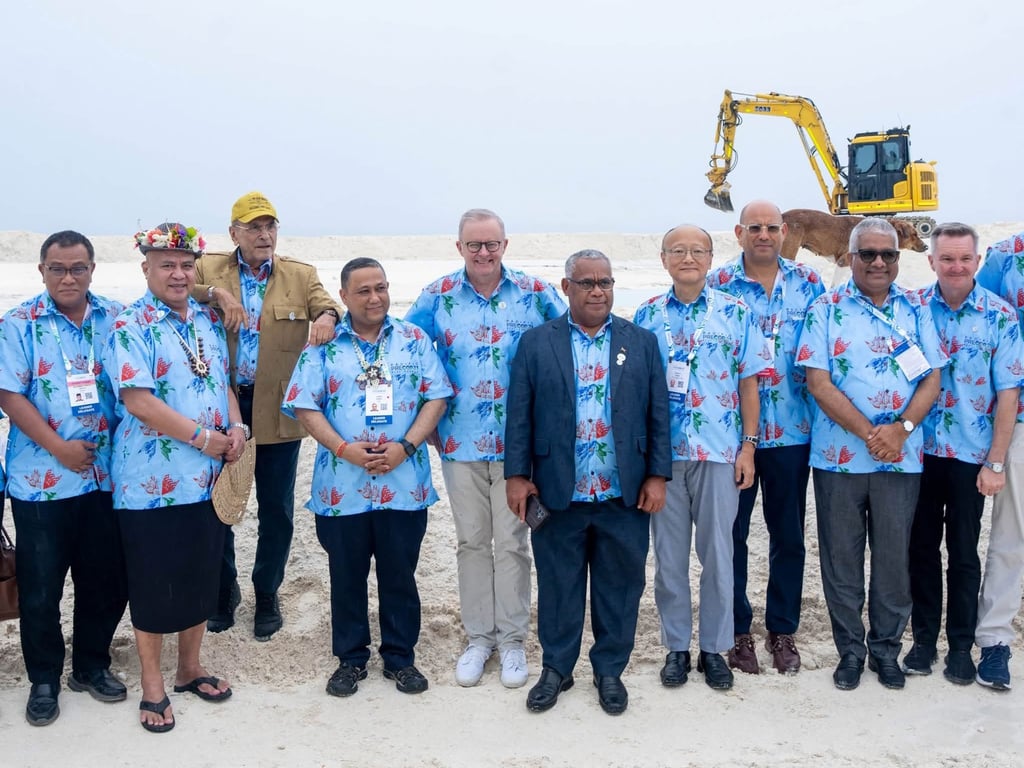
Whose security counts in the Pacific?
While climate-related spending gets criticised, billions forked out for security and strategic engagement gets framed as for the “national interest”.
News
BOOK REVIEW | Hard New World: Australia’s Post-American future
This article was published in The Round Table, https://doi.org/10.1080/00358533.2026.2739547
News
The US and China cannot slow the AI race, but they can make It safer
The United States does not need to trust China, share frontier models with China, or slow its own AI development to have a national security interest in AI...
News
Australia-China Weekly Brief: October 2026 issues
The Australia-China Weekly Brief by the Australia-China Relations Institute at the University of Technology Sydney (UTS:ACRI) tracks key developments in...
News
Whose security counts in the Pacific?
While climate-related spending gets criticised, billions forked out for security and strategic engagement gets framed as for the “national interest”.
News
BOOK REVIEW | Hard New World: Australia’s Post-American future
This article was published in The Round Table, https://doi.org/10.1080/00358533.2026.2739547