


- Posted on 17 Nov 2026
- 5-minute read
By Marina Zhang
The choice of Shenzhen as the venue for the annual APEC Economic Leaders’ Meeting is intended as a deliberate reminder of China’s tech prowess. Marina Yue Zhang writes the message to visiting leaders is blunt: severing ties with this industrial base would not isolate China; it would cut foreign firms off from the world’s most cost-effective engine of hardware manufacture.
This article appeared in Asialink Insights on November 17 2026.
Shenzhen is the message
In the 2026 Global Innovation Index released by the World Intellectual Property Organisation (WIPO), the Shenzhen–Hong Kong–Guangzhou conurbation was named the world’s top innovation cluster for the second consecutive year. It outpaced both Tokyo–Yokohama and San Jose–San Francisco.
Alongside international patent applications filed under the Patent Cooperation Treaty (PCT) and peer-reviewed scientific output, the WIPO ranking now incorporates venture capital deal volume. Between 2021 and 2025, this cluster accounted for 9.2% of all PCT patents globally. Per million residents, it recorded 2,259 PCT applications, 4,060 scientific publications, and 138 VC deals.
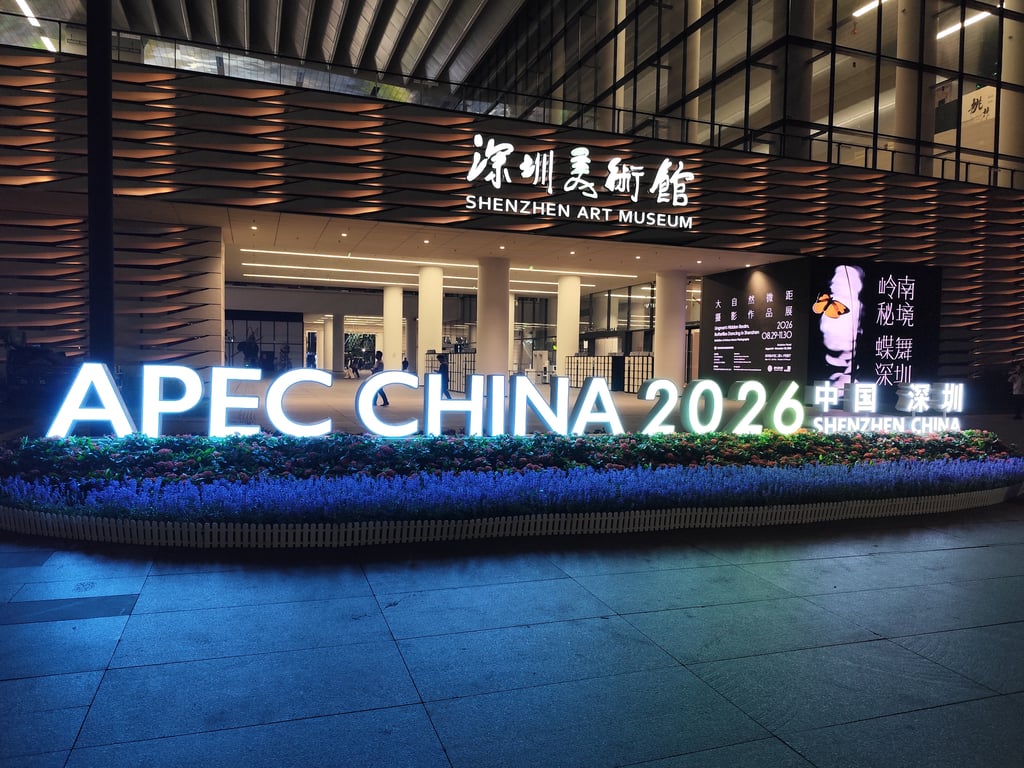
On November 18 and 19, leaders from the 21 member economies of the Asia-Pacific Economic Cooperation (APEC) forum will gather in Shenzhen—the engine room of that cluster—for the 33rd APEC leaders’ meeting. China is hosting the event for the third time.
For summit planners in Beijing, geography is rarely incidental. The choice of location is itself political language.
When China first hosted the APEC Economic Leaders’ Meeting in 2001, it chose Shanghai. The country was less than two months from joining the World Trade Organization, and its economy ranked sixth globally in nominal terms. Its posture was that of a diligent apprentice seeking admission to the established global trading order.
By China’s second turn as host in 2014, the meeting had moved to Beijing, and China had become the world’s second-largest economy. Washington was championing the Trans-Pacific Partnership, a proposed high-standard trade pact whose 12 negotiating parties did not include China. China used its APEC presidency to advance the Beijing Roadmap for the Free Trade Area of the Asia-Pacific. The venue matched a more assertive posture: China no longer intended merely to take the rules; it wanted a hand in writing them.
Now comes Shenzhen in 2026. The official theme is “Building an Asia-Pacific Community to Prosper Together,” supported by three priorities: openness, innovation and cooperation. But the geopolitical terrain has changed fundamentally. Export controls, technology sanctions and growing fragmentation along geopolitical lines now dominate the strategy debate.
Choosing Shenzhen invites an unsubtle reading: in an era of technological containment, Beijing is presenting physical evidence of Chinese resilience.
The new frontier
Western observers often mistake Shenzhen for a top-down showcase of state capitalism. The reality is more complex—and far more formidable.
When Andrew Robb, Australia’s former trade minister and the architect of the China–Australia Free Trade Agreement, toured the city earlier this year, he stood inside an SF Express hub and watched a cargo drone deliver 35 parcels across town in 16 minutes—a journey he said would take 90 minutes by truck. What Robb observed was not an isolated pilot but part of a dense commercial network crisscrossing the municipality. Meituan’s airborne couriers alone have completed more than one million orders across their network.
Shenzhen’s GDP reached RMB 3.87 trillion in 2025, with strategic emerging industries contributing more than 40% of output. More strikingly, the city invests 6.67% of its GDP in R&D—an intensity exceeding South Korea’s and rivalling Israel’s. Crucially, enterprises fund more than 93% of that investment.
What distinguishes Shenzhen from the other Special Economic Zones established in 1980 is that its prowess was forged not by state capitalism alone but through institutional flexibility, bottom-up entrepreneurship and brutal market Darwinism.
Huawei, BYD, and DJI were not birthed as state champions: Huawei began in 1987 in a rented flat with little more than 20,000 yuan in capital; BYD was founded in 1995 in a dilapidated factory by an entrepreneurial chemist who quit a Beijing-based state research post; and DJI began inside an apartment in a Shenzhen “urban village” in 2006.
What anchors them today is an unmatched physical ecosystem. Shenzhen is enveloped by Dongguan’s components belt and Foshan’s precision-machinery corridor. Across the wider Pearl River Delta, an engineer can source raw parts, fabricate custom printed circuit boards, test modular prototypes and scale production to commercial volumes at extraordinary speed. While the United States retains structural leads in cutting-edge semiconductor architecture, electronic design automation tooling and foundational AI models, Shenzhen exposes an uncomfortable asymmetry: China has mastered the translation of technical concepts into scaled, high-margin manufactured hardware at breakneck velocity.
If Beijing’s objective is to demonstrate that China has transformed from the world’s assembly floor into an indispensable innovation machine, walking foreign dignitaries through this ecosystem is far more persuasive than issuing diplomatic white papers.
Interdependence as deterrence
Shenzhen sits at the sharpest edge of the techno-economic rivalry between Washington and Beijing. It exposes a central feature of economic statecraft: the weaponisation of interdependence.
Washington has wielded tariffs, outbound-investment restrictions and the Commerce Department’s Entity List to blunt the advance of Chinese technology firms. Yet China controls countervailing chokepoints of its own. It dominates the processing of rare earths and production of permanent magnets, as well as battery anode materials. The engineering networks underpinning green technologies are similarly difficult to reproduce. These capabilities cannot be duplicated overnight or easily replicated at scale.
The result is a fragile, asymmetric deterrence. Both powers can inflict acute pain on the other’s high-tech industries, but neither can do so without imposing heavy costs on its own economy.
This dynamic reframes the strategic calculus for middle powers. Viewed exclusively from Washington or Beijing, APEC can appear as a binary tug-of-war for regional hegemony. Yet its members include economies such as Australia, Japan, South Korea, Indonesia and Canada, all of which inhabit the uncomfortable middle.
For these countries, the American security umbrella and access to its capital, core software architectures and market remain vital; so do China’s deep supply chains, massive intermediate manufacturing capacity and appetite for primary resources. They do not want bloc politics to force an economic divorce. They need the diplomatic and operational space to preserve functional ties with both sides.
An unwritten communiqué—and implications for Australia
The arrival of leaders from APEC’s 21 member economies in Shenzhen will carry two pointed messages: one domestic, the other international.
At home, staging China’s premier diplomatic gathering of 2026 in the city that gave rise to Huawei, BYD, and DJI will amount to an implicit, high-level reaffirmation of private enterprise after years of regulatory turbulence. Abroad, it will pose an empirical challenge to decoupling. The implied message to visiting leaders is blunt: severing ties with this industrial base would not isolate China; it would cut foreign firms off from the world’s most cost-effective hardware-prototyping engine.
Communiqués are routinely negotiated down to polite, forgettable generalities. The physical reality of the host city will endure, as Andrew Robb’s account of SF Express illustrates.
That reality should prompt Australian policymakers and business leaders to reconsider the assumption that innovation resides exclusively in the West. It also exposes the contradictions of blanket decoupling, given that Australia’s energy transition and high-tech deployment remain entangled with Pearl River Delta component supply chains and China’s midstream processing of Australian minerals.
Canberra should therefore adopt a pragmatic posture: ring-fence core national-security domains while preserving the economic latitude and technological access essential to an autonomous middle power.
AUTHOR

Associate Professor - Research, Australia-China Relations Institute, University of Technology Sydney
News
APEC finally delivers, just not what we hoped for
Xi, Trump and Putin will meet in Shenzhen while the forum’s Australian architects watch on from the sidelines.

News
PERSPECTIVES | Garry Woodard: An appreciation
This article appeared in UTS:ACRI's Perspectives on November 16 2026. Perspectives is the commentary series of the Australia-China Relations Institute at the...
News
Australia-China Weekly Brief: November 2026 issues
The Australia-China Weekly Brief by the Australia-China Relations Institute at the University of Technology Sydney (UTS:ACRI) tracks key developments in...
News
APEC finally delivers, just not what we hoped for
Xi, Trump and Putin will meet in Shenzhen while the forum’s Australian architects watch on from the sidelines.
News
PERSPECTIVES | Garry Woodard: An appreciation
This article appeared in UTS:ACRI's Perspectives on November 16 2026. Perspectives is the commentary series of the Australia-China Relations Institute at the...
News
Australia-China Weekly Brief: November 2026 issues
The Australia-China Weekly Brief by the Australia-China Relations Institute at the University of Technology Sydney (UTS:ACRI) tracks key developments in...