


- Posted on 14 Nov 2025
- 4-min read
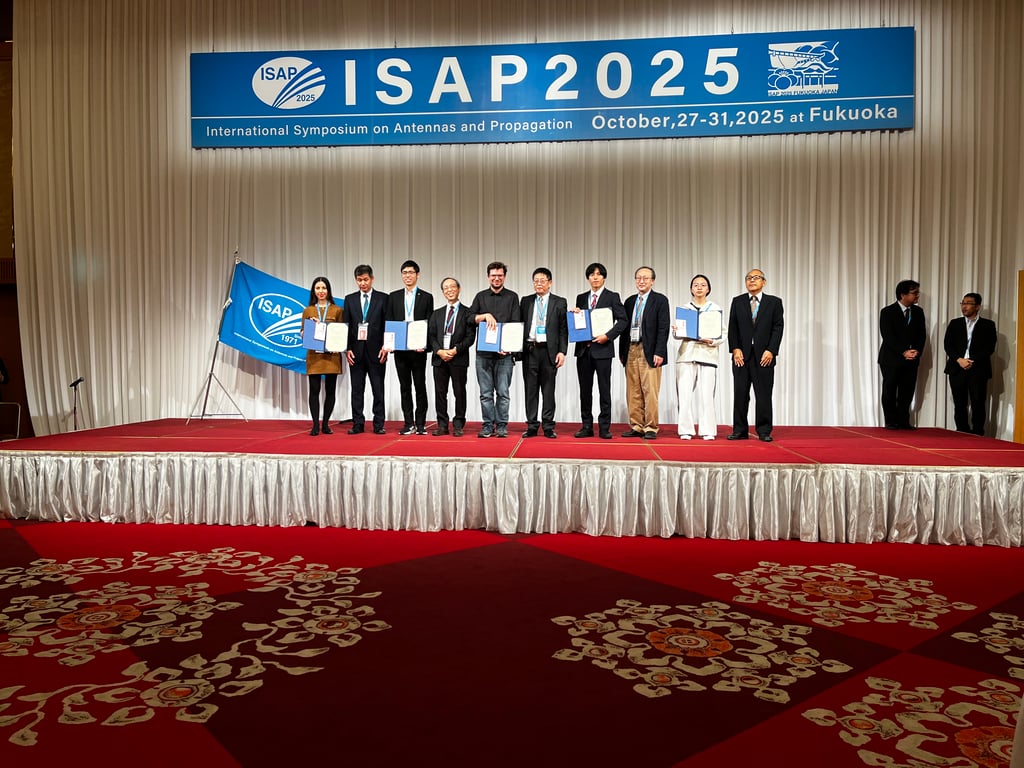
Showcasing excellence in antenna design at the International Symposium on Antennas and Propagation (ISAP 2025) in Fukuoka, Japan.
The International Symposium on Antennas and Propagation (ISAP) is one of the world’s most prestigious conferences in the field of antenna and RF engineering and was held this year in Fukuoka, Japan on October 27-31.
University of Technology Sydney (UTS) PhD student Mina Feizi has won First Prize in the Student Design Contest (Category B: Flexible Antenna Design).
In the category Topics A. Antenna, Yi He was a awarded the Best Paper Award for the paper titled “A Low-Profile Share-Aperture Antenna Array with Self-Descaterring and Self-Decoupling Capabilities”. This paper was co-authored with Shaodong Wang, Gengming Wei, Assoc. Prof. Can Ding and Dist. Prof. Jay Guo.
Winning Antenna Design: UTS Team makes waves
Representing the UTS team, Mina showcased the group’s innovative antenna design before an international judging panel, securing the top position in this highly competitive global event.
The UTS team, “Team Making Wave”, comprised of Mina Feizi, Doruk G. Baran, and Rhyse Williams, under the supervision of Dr Shu-Lin Chen, A/Prof. Pei-Yuan Qin, and Distinguished Prof Jay Guo from the Global Big Data Technologies Centre (GBDTC), Faculty of Engineering and Information Technology.
Competing against finalists from leading institutions, including the Tohoku Institute of Technology (Japan), TH Cologne University (Germany), Saga University (Japan), and the Harbin Institute of Technology (China), they ultimately took first place for their reconfigurable, flexible antenna design.
Pioneering Flexible Antenna Innovation “Gains” Attention
The competition challenged participants to design a flexible FM-band antenna operating at 90 MHz that could adapt to two constrained enclosures while maintaining strong performance.
UTS’s winning design featured a dual-segment meandering architecture, a compact, mechanically reconfigurable antenna capable of folding and extending between two configurations while preserving impedance stability and radiation efficiency.
During the live evaluation session at ISAP 2025, Mina’s presentation demonstrated the antenna’s outstanding performance, achieving the highest measured gain among all finalists. The final judging was based on measured gain, innovation, and FM signal reception quality.
Building better antennas towards 6G
Yi He’s prize winning Best Paper titled “A Low-Profile Share-Aperture Antenna Array with Self-Descaterring and Self-Decoupling Capabilities” presents a shared-aperture base station antenna array that allows one antenna system to handle multiple frequency bands within a compact, low-profile structure.
As we move toward 6G, base-station antennas must support more bands while staying compatible with legacy 4G/5G systems, but placing many antennas together usually causes strong interference between them.
This work tackles that interference challenge across a wide frequency coverage using a new array scheme that avoids the conventional reliance on complex filtering structures, while maintaining a compact and cost-efficient design.
In practice, this means improved signal quality, lower wind load on towers, easier installation and maintenance, and better compatibility with existing communication infrastructure—key advantages for real-world network deployment.
Written by Dr Leesa Smith
Centre Operations Manager, GBDTC

News
Dr Xu Wang recognised at Defence & National Security Workforce Awards 2026
The Global Big Data Technology Centre (GBDTC) recognises the achievement of Dr Xu Wang, who has been named Best Cyber Technician or Specialist Under 35 at the...

News
GBDTC researcher Dr Lizhao Song awarded an ARC Discovery Early Career Researcher Award (DECRA)
Dr Lizhao Song of the Global Big Data Technologies Centre (GBDTC) has been awarded a prestigious ARC DECRA grant for 2026 for her project, “Adaptive Multi-Beam...

News
CASPER AI: the friendly ghost in the machine to keep you safe online
A virtual assistant that applies artificial intelligence to detect, interpret and respond to cybersecurity threats has been publicly unveiled at UTS.
News
The Australian names UTS the country’s top research institution in seven fields
The University of Technology Sydney has been recognised for its leadership in seven research fields of national importance in the 2026 Research magazine...
News
Dr Xu Wang recognised at Defence & National Security Workforce Awards 2026
The Global Big Data Technology Centre (GBDTC) recognises the achievement of Dr Xu Wang, who has been named Best Cyber Technician or Specialist Under 35 at the...
News
GBDTC researcher Dr Lizhao Song awarded an ARC Discovery Early Career Researcher Award (DECRA)
Dr Lizhao Song of the Global Big Data Technologies Centre (GBDTC) has been awarded a prestigious ARC DECRA grant for 2026 for her project, “Adaptive Multi-Beam...
News
CASPER AI: the friendly ghost in the machine to keep you safe online
A virtual assistant that applies artificial intelligence to detect, interpret and respond to cybersecurity threats has been publicly unveiled at UTS.
News
The Australian names UTS the country’s top research institution in seven fields
The University of Technology Sydney has been recognised for its leadership in seven research fields of national importance in the 2026 Research magazine...