


- Posted on 14 Nov 2025
- 1-minute read
The Department of Infrastructure, Transport, Regional Development, Communications, Sport and the Arts awarded the grant to TPG Telecom – UTS partnership in early in October as part of the power resilience round of its Telecommunications Disaster Resilience Innovation Program.
The Digital Twin project, led by GBDTC’s Associate Professor Wenjing Jia, is seeking to develop a cloud-based Disaster Resilience Digital Twin solution for TPG Telecom.
This system will integrate historical and real-time environmental and network data to enable predictive flood risk forecasting and telecom resource optimisation during natural disasters.
The Digital Twin acts as a dynamic, real-time model of the physical environment, providing actionable insights that help maintain mobile network resilience when extreme events occur.
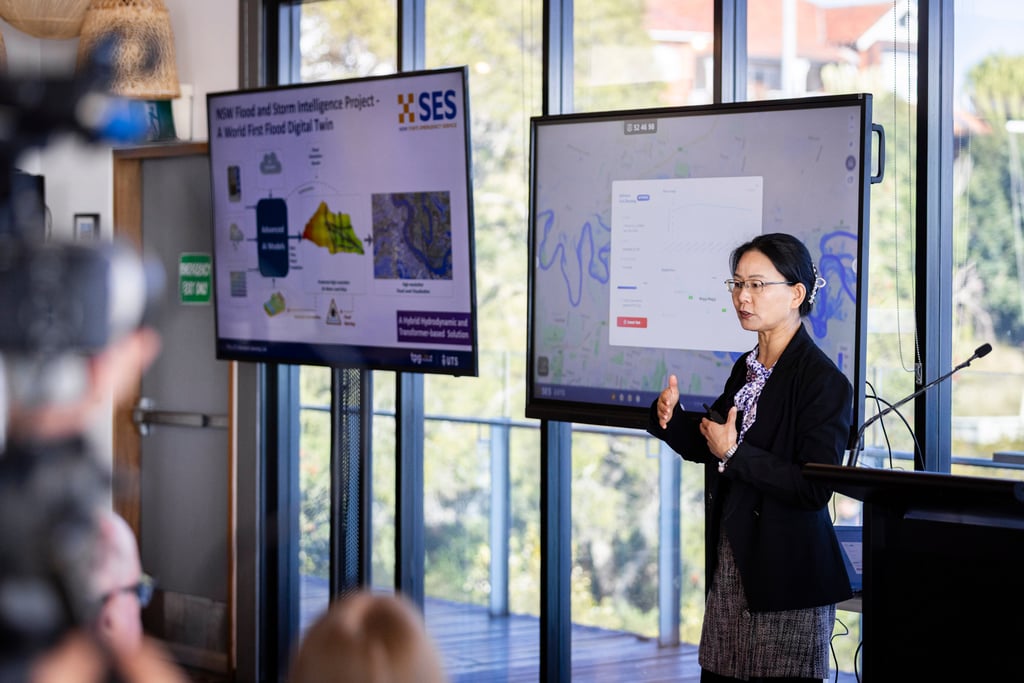
Digital twin programs have become more common in recent times, with current deployments including economy and infrastructure monitoring in NSW, and land management in Western Australia. This Digital Twin could help to address environmental risks to TPG Telecom’s infrastructure and services due to disaster such as flooding – addressing gaps in coverage gaps in its network sooner.
Early warnings provided can help operators identify problems early and act quickly to keep services running, as well as enable insights to be shares with emergency responders to improve coordinate and reduce network downtime.
The AI-enabled digital twin will also have the potential to be informed by mobile networks acting as a sensor to improve local data accuracy and prediction and quality. This technology was recently showcased via a live demonstration on Parramatta River on June 16, 2025.
Written by Dr Leesa Smith
Centre Operations Manager, GBDTC
News
Dr Xu Wang recognised at Defence & National Security Workforce Awards 2026
The Global Big Data Technology Centre (GBDTC) recognises the achievement of Dr Xu Wang, who has been named Best Cyber Technician or Specialist Under 35 at the...

News
GBDTC researcher Dr Lizhao Song awarded an ARC Discovery Early Career Researcher Award (DECRA)
Dr Lizhao Song of the Global Big Data Technologies Centre (GBDTC) has been awarded a prestigious ARC DECRA grant for 2026 for her project, “Adaptive Multi-Beam...

News
CASPER AI: the friendly ghost in the machine to keep you safe online
A virtual assistant that applies artificial intelligence to detect, interpret and respond to cybersecurity threats has been publicly unveiled at UTS.
News
The Australian names UTS the country’s top research institution in seven fields
The University of Technology Sydney has been recognised for its leadership in seven research fields of national importance in the 2026 Research magazine...
News
Dr Xu Wang recognised at Defence & National Security Workforce Awards 2026
The Global Big Data Technology Centre (GBDTC) recognises the achievement of Dr Xu Wang, who has been named Best Cyber Technician or Specialist Under 35 at the...
News
GBDTC researcher Dr Lizhao Song awarded an ARC Discovery Early Career Researcher Award (DECRA)
Dr Lizhao Song of the Global Big Data Technologies Centre (GBDTC) has been awarded a prestigious ARC DECRA grant for 2026 for her project, “Adaptive Multi-Beam...
News
CASPER AI: the friendly ghost in the machine to keep you safe online
A virtual assistant that applies artificial intelligence to detect, interpret and respond to cybersecurity threats has been publicly unveiled at UTS.
News
The Australian names UTS the country’s top research institution in seven fields
The University of Technology Sydney has been recognised for its leadership in seven research fields of national importance in the 2026 Research magazine...