


- Posted on 24 Nov 2025
- 2-minute read
A virtual assistant that applies artificial intelligence to detect, interpret and respond to cybersecurity threats has been publicly unveiled at the University of Technology Sydney.
Developed by a UTS-led team for the Connectivity Innovation Network (CIN), CASPER AI, short for Context-Aware Security Policy Enforcement and Response, heralds a new generation of adaptive cybersecurity technology.
Led by Professor Ren Ping Liu and Dr Xu Wang from the UTS Global Big Data Technologies Centre, the CIN’s AI for Network Security System project has harnessed large language models and multimodal reasoning to analyse information from sources including ID systems, human resources records, travel and expense data and network logs to detect anomalies that may indicate insider threats or external breaches.
Demonstrated at a presentation event on 21 November, CASPER AI represents a move towards adaptive, context-aware protection, capable of identifying unusual behavioural patterns and supporting policy-aligned responses across sectors.
“In the demonstration, we showed how CASPER AI detects abnormal activity within business operations, identifies fake wireless access points in public spaces or temporary mobile deployments, and helps teams take fast, policy-compliant security actions,” Professor Liu said.
“By linking information across different systems, it highlights potential issues and guides staff through the correct next steps, supporting safer and more consistent operations.”
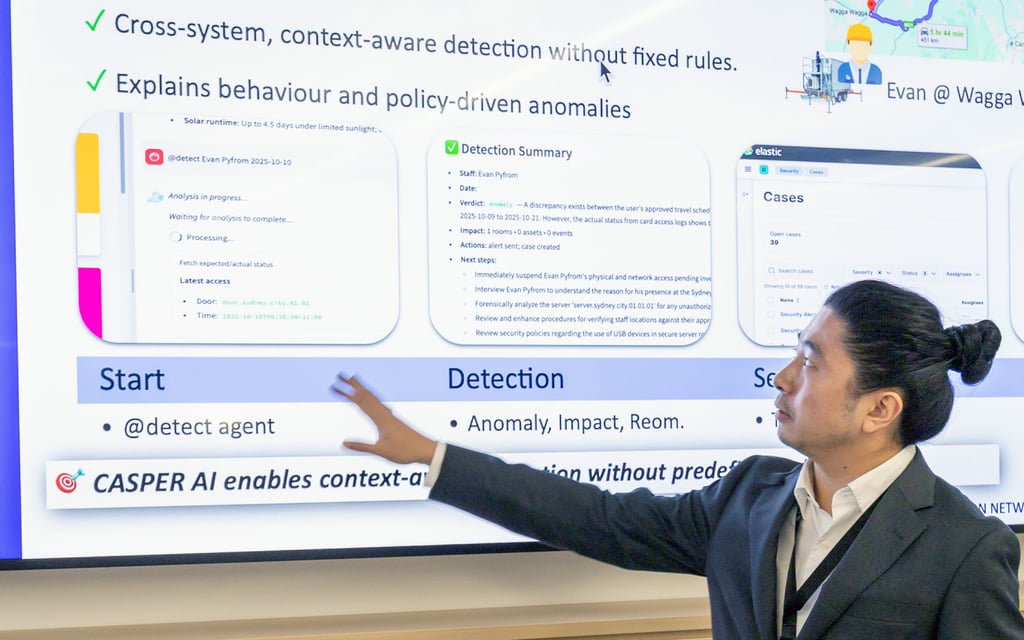
Professor Liu said the CASPER AI assistant was also suitable for personal use, with its capacity to detect unusual activity and provide explanations and recommendations in plain language.
“This flexible system is intended to monitor different services at once, connecting the dots to provide clear and easy-to-understand recommendations and keep people safe online,” Professor Liu said.
“CASPER AI as a virtual assistant can help people with lower levels of digital literacy and tech experience avoid being caught up in cybercrime, such as phishing and ‘smishing’ (SMS-based) scams.
“It’s designed to keep government accounts safe by detecting unusual login attempts or activity, protect people’s identities by connecting information across services to flag potential misuse and stop scams by giving people a simple way to check if a text, email or call is genuine before they respond.”
Launched in 2021, the Connectivity Innovation Network is an initiative of the New South Wales Government. Jointly led by the UTS and the University of Sydney, the CIN brings together national and globally recognised expertise, researchers and industry to solve connectivity challenges and deliver improved digital outcomes for NSW citizens.