


- Posted on 3 Nov 2025
- 3-minutes read
Transformative mentorship and contributions enhance a world class and diverse team of researchers in Telecommunications Engineering.
On October 27, 2026, Dr Bevan Jones, an Adjunct Professor a tUTS’ Global Big Data Technologies Centre (GBDTC) was awarded a prestigious honour, a Fellow of the the University of Technology Sydney (UTS).
The Honorary Award of Fellow of the University is given to outstanding leaders in business, industry, government, or the arts and who have made a significant contribution to the UTS’ strategic priorities. As co-founder and innovation lead of Argus Technologies, a globally influential base station antenna vendor, Dr Jones designed ultra-wideband cellular antennas that earned great industry acclaim for Argus.
In 2015, Dr Jones joined GBDTC as an Adjunct Professor. With a strong background in antenna design, radar technology, and telecommunications systems, he brought valuable expertise from industry into the academic sphere. His involvement with GBDTC has helped strengthen the Centre’s unique blend of theoretical and applied research.
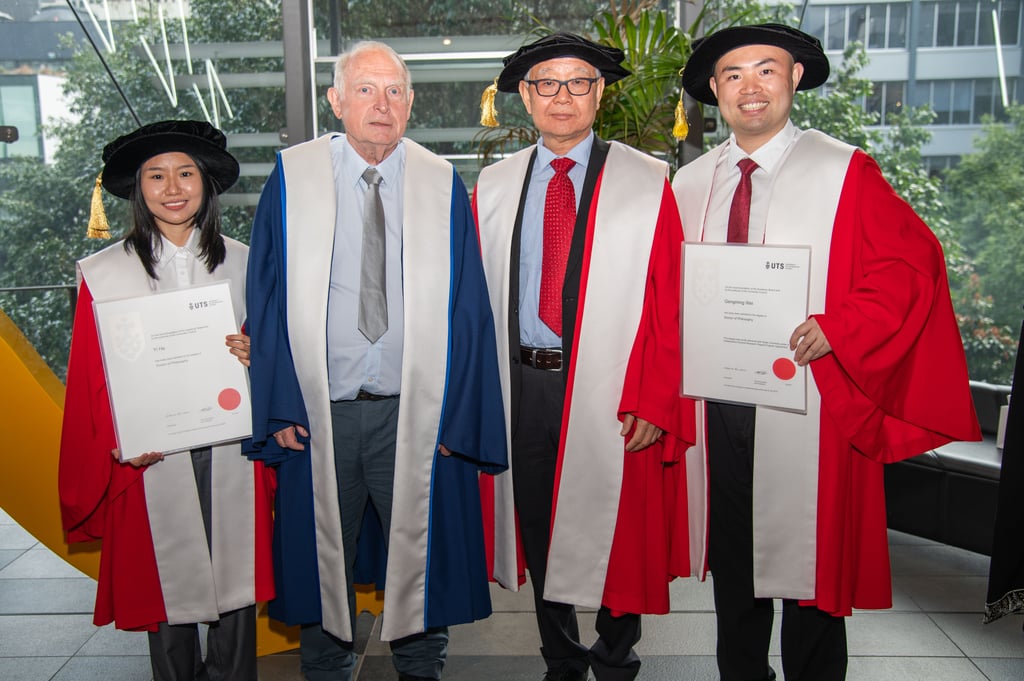
Supporting GBDTC to Grow Future Antenna Research Leaders
Under the leadership of GBDTC Director, Distinguished Professor Jay Guo, the Centre has become one of Australia's leading research institutions in wireless communications and antenna technologies. Through collaborative supervision and mentorship, Dr Jones has supported a number of high-performing PhD students and postdoctoral. The industry challenges he brought to GBDTC, and his engineering insights have significantly benefited the early career researchers he co-supervised. His ability to bridge complex theoretical research with real-world applications has enriched student learning experiences and supported the development of viable industry solutions.
Mentoring the next generation
With co-supervision and mentorship from Dr Jones, several GBDTC postdoctoral graduates have accelerated their careers in industry and academia. These include:
Dr Haihan Sun completed significant research on the suppression of cross-band antenna scattering in base station antennas, a well-known industrial challenge, resulting in high-impact publications and best paper awards. These papers pioneered the research subfield of de-scattering techniques for base station antennas. Dr Sun’s achievements at GBDTC contributed to her appointment as an Assistant Professor at the University of Wisconsin-Madison in 2023
Dr Stanley Chen, a lecturer at GBDTC, worked closely with Dr Jones to explore novel approaches to reconfigurable and leaky-wave antennas as a PhD student. Dr Chen’s contributions have received widespread recognition, resulting in multiple awards and high impact publications in leading journals. He received a 2025 Australian Research Council (ARC) Discovery Early Career Researcher Award (DECRA).
Dr Maral Ansari’s research on metamaterial lens antennas under the co-supervision of Dr Jones, led to several well-regarded publications and competitive grants. Thanks to her publications, she was named a Rising Star by the Australian Research Magazine in 2024. Her research at GBDTC played a key role in securing a position as a Research Engineer at CSIRO through the “Impossible Without You” program.
Dr Jones’ advice to university graduates is to “start your own company,” or join mobile operators and technology companies like Nvidia.
UTS’ Global Big Data Technologies Centre is known for its strong industry engagement and focus on delivering impactful technologies in wireless communications and antenna systems. Dr Jones has complemented this vision by bringing in his deep industry knowledge and understanding of the markets. His participation in joint research initiatives and industry-facing projects has further elevated UTS’s profile as a hub for innovation, contributing to national priorities and enhancing international recognition.

News
Dr Xu Wang recognised at Defence & National Security Workforce Awards 2026
The Global Big Data Technology Centre (GBDTC) recognises the achievement of Dr Xu Wang, who has been named Best Cyber Technician or Specialist Under 35 at the...

News
GBDTC researcher Dr Lizhao Song awarded an ARC Discovery Early Career Researcher Award (DECRA)
Dr Lizhao Song of the Global Big Data Technologies Centre (GBDTC) has been awarded a prestigious ARC DECRA grant for 2026 for her project, “Adaptive Multi-Beam...

News
CASPER AI: the friendly ghost in the machine to keep you safe online
A virtual assistant that applies artificial intelligence to detect, interpret and respond to cybersecurity threats has been publicly unveiled at UTS.
News
The Australian names UTS the country’s top research institution in seven fields
The University of Technology Sydney has been recognised for its leadership in seven research fields of national importance in the 2026 Research magazine...
News
Dr Xu Wang recognised at Defence & National Security Workforce Awards 2026
The Global Big Data Technology Centre (GBDTC) recognises the achievement of Dr Xu Wang, who has been named Best Cyber Technician or Specialist Under 35 at the...
News
GBDTC researcher Dr Lizhao Song awarded an ARC Discovery Early Career Researcher Award (DECRA)
Dr Lizhao Song of the Global Big Data Technologies Centre (GBDTC) has been awarded a prestigious ARC DECRA grant for 2026 for her project, “Adaptive Multi-Beam...
News
CASPER AI: the friendly ghost in the machine to keep you safe online
A virtual assistant that applies artificial intelligence to detect, interpret and respond to cybersecurity threats has been publicly unveiled at UTS.
News
The Australian names UTS the country’s top research institution in seven fields
The University of Technology Sydney has been recognised for its leadership in seven research fields of national importance in the 2026 Research magazine...