


- Posted on 22 Oct 2025
- 2-minutes read
Split Unlearning introduces a new paradigm for privacy in the age of AI
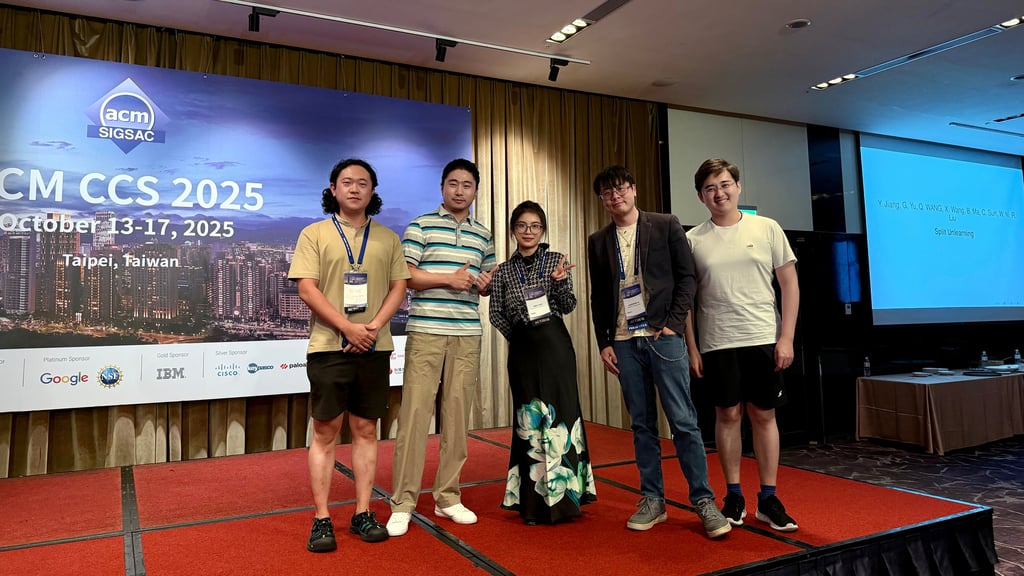
The GBDTC Cyber team is proud to announce that their paper “Split Unlearning” has received the Distinguished Paper Award at the ACM Conference on Computer and Communications Security (CCS) 2025—one of the world’s top-tier and flagship conferences in cybersecurity and privacy.
Redefining Machine Unlearning in Collaborative AI Systems
Split Unlearning, authored by Yanna Jiang, Saber Yu, Xu Wang, Baihe Ma, and Ren Ping Liu (GBDTC), in collaboration with Wei Ni and Qin Wang (Data61, CSIRO), introduces a novel unlearning framework tailored for Split Learning (SL)—a collaborative learning paradigm where clients and servers train different parts of a model without sharing raw data. Split Unlearning enables efficient and privacy-preserving removal of user data from SL models, achieving 0% accuracy on forgotten labels while improving retained performance by 8%.
Responding to Privacy Laws: GDPR, Privacy Act 1988
As AI becomes embedded in everyday decision-making, ensuring individuals can exercise their “right to be forgotten”—as defined in the EU’s General Data Protection Regulation (GDPR) and Australia’s Privacy Act 1988—is increasingly critical. However, most machine learning systems, especially collaborative frameworks like SL, lack efficient mechanisms for compliant unlearning.
Split Unlearning offers a practical and scalable response to this challenge. It enables models trained under Split Learning frameworks to forget specific user data—even when the users are no longer online or accessible—while preserving the integrity and performance of the remaining system. This represents a major step forward in making privacy-compliant AI both technically and operationally feasible.
Measurable Impact and Real-World Applications
Split Unlearning demonstrates strong performance across diverse data distributions and tasks, effectively removing targeted user information while preserving the overall utility of the model. Its low and consistent communication and computation overhead makes it especially suitable for real-world deployment.
Potential application scenarios include:
- Healthcare AI: Removing patient data from diagnostic models upon consent withdrawal
- Financial services: Ensuring client trace data is erasable from investment prediction models
- Edge computing: Supporting fast local forgetting on resource-constrained devices
- Cross-organisational collaboration: Empowering federated learning with trust and regulatory compliance
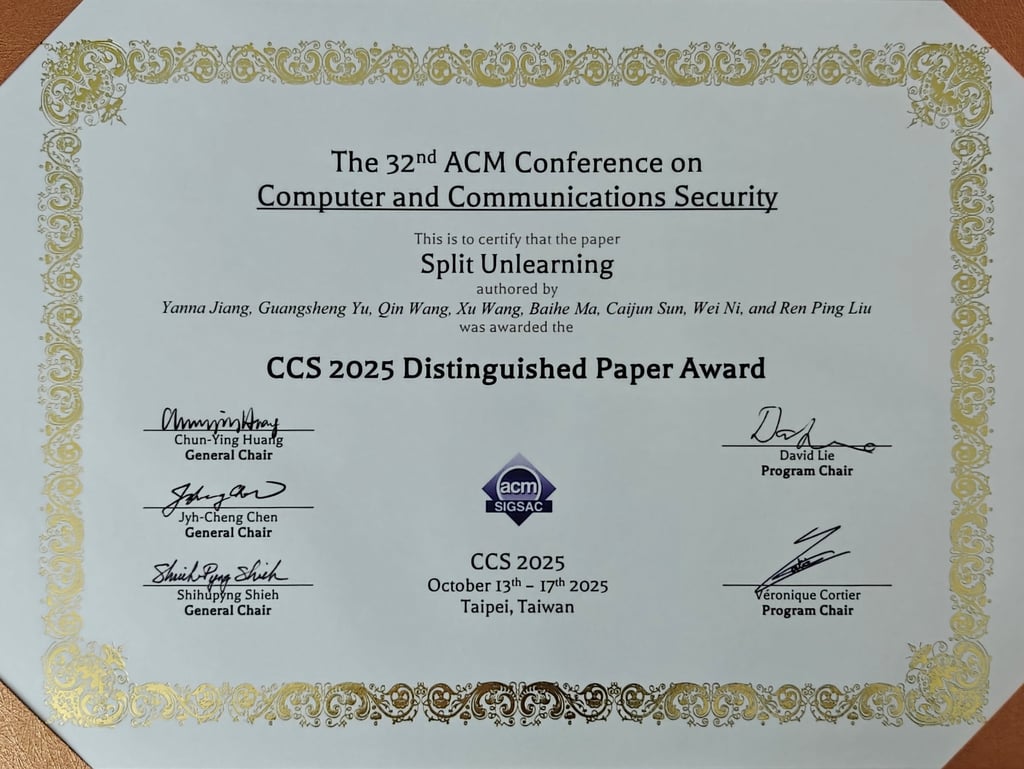
With an acceptance rate of just 13.9% in 2025 (316 out of 2,278 submissions), ACM CCS is widely regarded as a flagship and top-tier conference in cybersecurity, known for its high standards and global impact. The Distinguished paper award marks the first time UTS has received the Distinguished Paper Award at CCS, highlighting GBDTC’s World-leading expertise and excellence in privacy-preserving AI.
Written by Dr Leesa Smith
Centre Operations Manager, GBDTC

News
Dr Xu Wang recognised at Defence & National Security Workforce Awards 2026
The Global Big Data Technology Centre (GBDTC) recognises the achievement of Dr Xu Wang, who has been named Best Cyber Technician or Specialist Under 35 at the...

News
GBDTC researcher Dr Lizhao Song awarded an ARC Discovery Early Career Researcher Award (DECRA)
Dr Lizhao Song of the Global Big Data Technologies Centre (GBDTC) has been awarded a prestigious ARC DECRA grant for 2026 for her project, “Adaptive Multi-Beam...

News
CASPER AI: the friendly ghost in the machine to keep you safe online
A virtual assistant that applies artificial intelligence to detect, interpret and respond to cybersecurity threats has been publicly unveiled at UTS.
News
The Australian names UTS the country’s top research institution in seven fields
The University of Technology Sydney has been recognised for its leadership in seven research fields of national importance in the 2026 Research magazine...
News
Dr Xu Wang recognised at Defence & National Security Workforce Awards 2026
The Global Big Data Technology Centre (GBDTC) recognises the achievement of Dr Xu Wang, who has been named Best Cyber Technician or Specialist Under 35 at the...
News
GBDTC researcher Dr Lizhao Song awarded an ARC Discovery Early Career Researcher Award (DECRA)
Dr Lizhao Song of the Global Big Data Technologies Centre (GBDTC) has been awarded a prestigious ARC DECRA grant for 2026 for her project, “Adaptive Multi-Beam...
News
CASPER AI: the friendly ghost in the machine to keep you safe online
A virtual assistant that applies artificial intelligence to detect, interpret and respond to cybersecurity threats has been publicly unveiled at UTS.
News
The Australian names UTS the country’s top research institution in seven fields
The University of Technology Sydney has been recognised for its leadership in seven research fields of national importance in the 2026 Research magazine...