


- Posted on 27 Oct 2025
- 2-minutes read
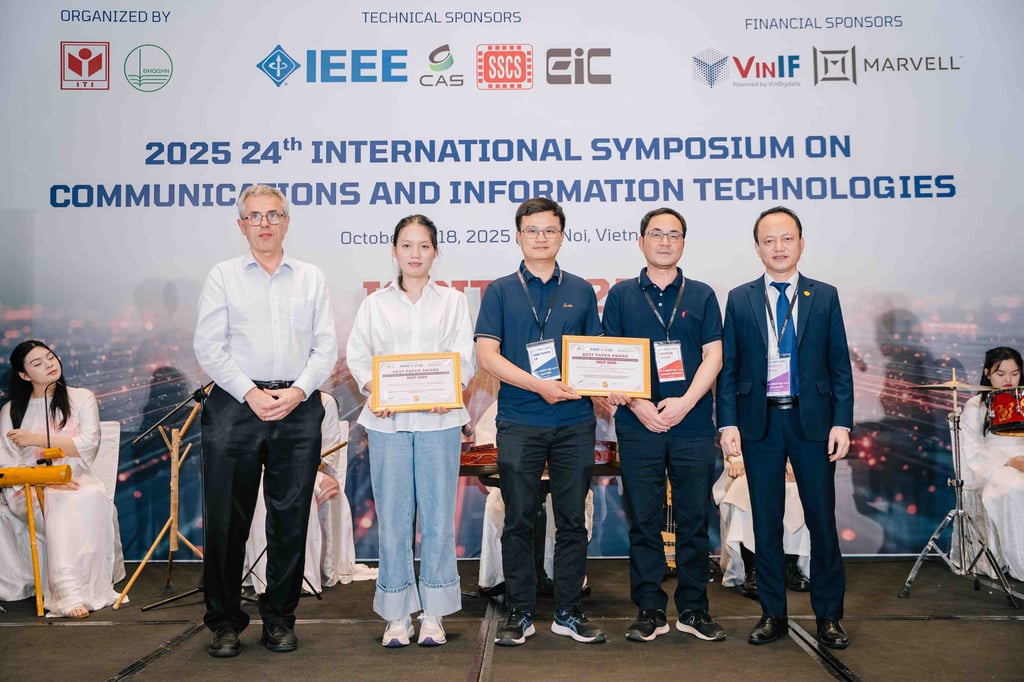
Dr Anh Tuyen Le wins the prestigious prize at the ISCIT 2025 Conference held in Hanoi, Vietnam in October
The 24th International Symposium on Communications and Information Technologies (ISCIT 2025) provided a forum for exchanging ideas, discussing research and presenting chip, circuit designs and applications in communications and information technologies. The event was held in Hanio, Vietnam, organised by IEEE CAS Vietnam Chapter and hosted by VNU Information Technology Institute.
The paper presented was titled “Antenna-Independent Deep Learning for Self-Interference Cancellation in in-Band Full-Duplex MIMO Systems”. Full-duplex wireless systems promise a major leap in mobile technology by allowing devices to send and receive signals at the same time. This capability could significantly increase data speeds and improve the efficiency of wireless networks.
However, there is a major challenge: when signals are transmitted and received simultaneously, the system can interfere with itself, a problem known as self-interference. The issue becomes even more complicated when multiple antennas are involved, which is common in modern high-speed networks.
Traditional approaches to cancelling self-interference struggle to keep up as the number of antennas increases, making them impractical for future networks such as 6G. Solving this problem is crucial to enable 6G mobile networks with both high-speed communication and radar-like sensing capabilities, which could support applications like smart transport, disaster monitoring, and advanced industrial automation.
To address this challenge, we have developed a new method that uses deep learning in the “beam” domain. In this context, a beam corresponds to the signal directed toward each user. Unlike antennas, which can number in the dozens or hundreds; the number of active users (and therefore beams) is much smaller. By focusing on beams rather than antennas, the system can efficiently learn interference patterns and model complex interactions without measuring every channel individually.
The results are impressive. By working in the beam domain, the method keeps computational demands low, scales well with larger antenna arrays, and achieves strong interference cancellation. This innovation brings practical full-duplex wireless networks one step closer, paving the way for the high-speed, sensing-enabled 6G systems of the future.
World leading expertise in antennas, propagation and signal processing
Such acknowledgement of research excellence and contribution to the broader international community is a testimony to the technological expertise of the GBDTC.
UTS is a top-ranking university in Telecommunications Engineering, both Nationally and Internationally, with exciting opportunities beyond your degree to join our teams working in the Telecommunications and Connectivity sector on groundbreaking projects with Industry.
If you’re an individual looking for the next step in your career and want to shape the future of advanced telecommunications, UTS offers Masters and PhD programs including a Master of Engineering in Telecommunications and Electronics and research degree programs (PhD and Masters) in Engineering. PhD scholarships are available." Please see Engineering for all relevant undergraduate study options at UTS.
Written by Dr Leesa Smith
Centre Operations Manager, GBDTC
News
Dr Xu Wang recognised at Defence & National Security Workforce Awards 2026
The Global Big Data Technology Centre (GBDTC) recognises the achievement of Dr Xu Wang, who has been named Best Cyber Technician or Specialist Under 35 at the...

News
GBDTC researcher Dr Lizhao Song awarded an ARC Discovery Early Career Researcher Award (DECRA)
Dr Lizhao Song of the Global Big Data Technologies Centre (GBDTC) has been awarded a prestigious ARC DECRA grant for 2026 for her project, “Adaptive Multi-Beam...

News
CASPER AI: the friendly ghost in the machine to keep you safe online
A virtual assistant that applies artificial intelligence to detect, interpret and respond to cybersecurity threats has been publicly unveiled at UTS.
News
The Australian names UTS the country’s top research institution in seven fields
The University of Technology Sydney has been recognised for its leadership in seven research fields of national importance in the 2026 Research magazine...
News
Dr Xu Wang recognised at Defence & National Security Workforce Awards 2026
The Global Big Data Technology Centre (GBDTC) recognises the achievement of Dr Xu Wang, who has been named Best Cyber Technician or Specialist Under 35 at the...
News
GBDTC researcher Dr Lizhao Song awarded an ARC Discovery Early Career Researcher Award (DECRA)
Dr Lizhao Song of the Global Big Data Technologies Centre (GBDTC) has been awarded a prestigious ARC DECRA grant for 2026 for her project, “Adaptive Multi-Beam...
News
CASPER AI: the friendly ghost in the machine to keep you safe online
A virtual assistant that applies artificial intelligence to detect, interpret and respond to cybersecurity threats has been publicly unveiled at UTS.
News
The Australian names UTS the country’s top research institution in seven fields
The University of Technology Sydney has been recognised for its leadership in seven research fields of national importance in the 2026 Research magazine...