


- Posted on 8 Aug 2025
- 2-minutes read
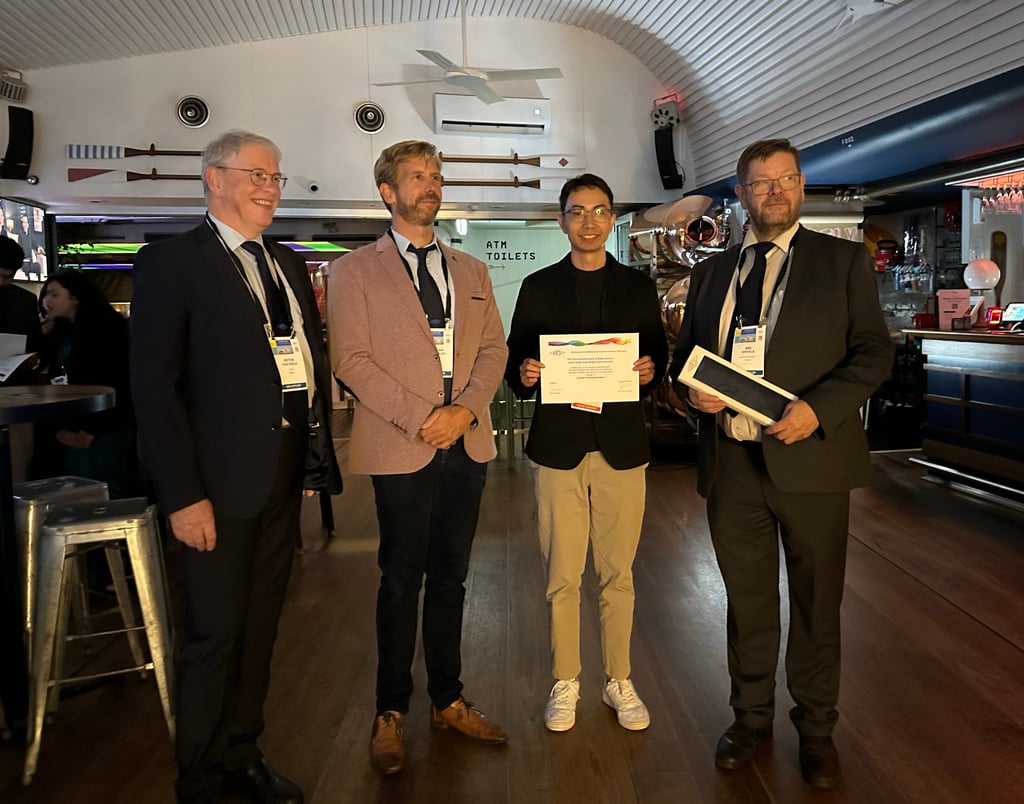
Dr Ming Li has received the prestigious award at the 2025 Asia-Pacific Radio Conference (AP-RASC)
The International Union of Radio Science (Union Radio-Scientifique Internationale (URSI)) Young Scientist Awards recognise an international group of individuals who have made innovative contributions and discoveries in multidiscipline research related to electromagnetic fields and waves. To qualify for the award the applicant must be under 35 years old and is the principal author for a presentation at a regular session of the AP-RASC.
Dr Ming Li has won the award for his paper titled “Beam Distortion in Generalized Joined Coupler Matrices: Analysis and Resolution” at the URSI Asia-Pacific Radio Science Conference held in Sydney in August this year.
This paper focuses on a special type of microwave circuit called the Generalized Joined Coupler (GJC) matrix, which is used to send out or receive multiple beams or signals simultaneously in antenna systems.
The GJC matrix is like a smart traffic controller for radio waves. It decides how signals should move through an antenna array so that multiple beams can be created and pointed in different directions. These beams are essential for communication (talking to many users at once) and sensing (like radar) in 5G/6G wireless systems, where signals need to reach many users at once.
Most traditional systems can only send out one beam at a time or have limited flexibility. But the GJC matrix allows multiple beams to be created independently, meaning each beam can be aimed wherever it’s needed, without affecting the others. This is useful when a device needs to talk to several users or scan its surroundings.
But there is a problem; if two or more of these beams try to go in the same direction, they start to interfere with each other. Instead of forming one clear beam, they split and become distorted. This is called beam splitting.
This issue is especially serious in joint communication and sensing (JCAS) systems that need to both communicate and sense their environment, like those used in smart vehicles. In these systems, a sensing beam often needs to look in the same direction as the communication beam. If the beams get distorted, it can mess up both communication and sensing, reducing the effectiveness of that device.
The paper outlines the developed method to overcome this problem – the use of reconfigurable components in the GJC matrix (tuneable couplers) and smart algorithm optimisation that considers multiple beam steering angles. This approach mitigates bean distortion when beams overlap and allows for continuous beam steering across the entire angular coverage region.
This is the first time that continuous multi-beam steering has been successfully achieved in a GJC matrix system. Our method helps unlock the full potential of the GJC matrix for 5G/6G wireless systems.

News
Dr Xu Wang recognised at Defence & National Security Workforce Awards 2026
The Global Big Data Technology Centre (GBDTC) recognises the achievement of Dr Xu Wang, who has been named Best Cyber Technician or Specialist Under 35 at the...

News
GBDTC researcher Dr Lizhao Song awarded an ARC Discovery Early Career Researcher Award (DECRA)
Dr Lizhao Song of the Global Big Data Technologies Centre (GBDTC) has been awarded a prestigious ARC DECRA grant for 2026 for her project, “Adaptive Multi-Beam...

News
CASPER AI: the friendly ghost in the machine to keep you safe online
A virtual assistant that applies artificial intelligence to detect, interpret and respond to cybersecurity threats has been publicly unveiled at UTS.
News
The Australian names UTS the country’s top research institution in seven fields
The University of Technology Sydney has been recognised for its leadership in seven research fields of national importance in the 2026 Research magazine...
News
Dr Xu Wang recognised at Defence & National Security Workforce Awards 2026
The Global Big Data Technology Centre (GBDTC) recognises the achievement of Dr Xu Wang, who has been named Best Cyber Technician or Specialist Under 35 at the...
News
GBDTC researcher Dr Lizhao Song awarded an ARC Discovery Early Career Researcher Award (DECRA)
Dr Lizhao Song of the Global Big Data Technologies Centre (GBDTC) has been awarded a prestigious ARC DECRA grant for 2026 for her project, “Adaptive Multi-Beam...
News
CASPER AI: the friendly ghost in the machine to keep you safe online
A virtual assistant that applies artificial intelligence to detect, interpret and respond to cybersecurity threats has been publicly unveiled at UTS.
News
The Australian names UTS the country’s top research institution in seven fields
The University of Technology Sydney has been recognised for its leadership in seven research fields of national importance in the 2026 Research magazine...