


- Posted on 7 Aug 2025
- 2-minute read
After receiving a USRI (International Union of Radio Science) Young Scientist award at AP-RASC this month, GBDTC postdoctoral researcher Dr Ming Li has just received the best paper award at IEEE iWEM 2025.
This is another recognition of Ming's scientific excellence and to the centre’s 5G and 6G multibeam antenna research.
The 2025 IEEE International Workshop on Electromagnetics (iWEM) was held in Hong Kong on August 4-6. iWEM provides an international platform for scientists and engineers to exchange their ideas, as well as a place for young scholars and students to demonstrate their innovative results. The workshop has a strong focus on student innovations and runs a research competition to nurture future young leaders.
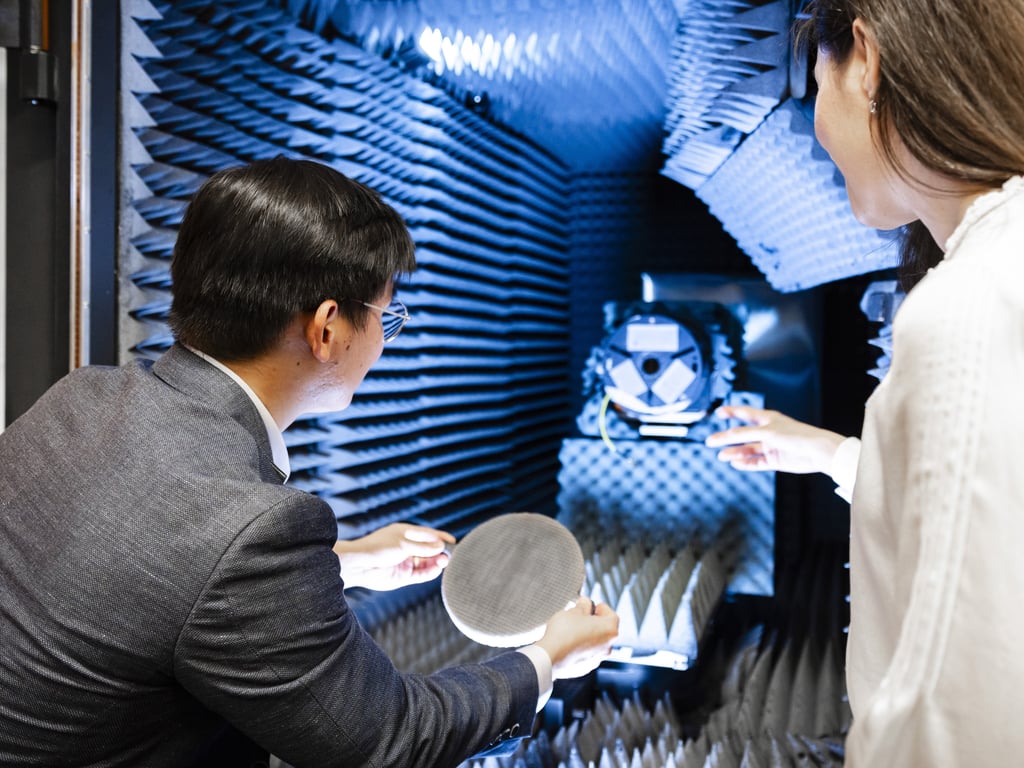
Ming’s award-winning paper “Multibeam Pattern Synthesis Techniques for 5G and Beyond Wireless Communications” was co-authored with Dr Shun-Lin (Stanley Chen) and Distinguished Professor Jay Guo. Multibeam antennas are regarded as a critical technology for 5G and beyond technologies, with this paper focusing on synthesizing multibeam radiation patterns – antenna signals that can point in several directions at once.
Such capabilities are essential for modern systems like 5G and beyond wireless communications, which must simultaneously serve many users and devices in different locations. There are two main ways to produce multibeam patterns:
- Single-excitation multibeam – Using one set of array excitations to generate a radiation pattern with multiple main lobes (beams) which is generally used in broadcasting
- Multi-beamforming matrix approach – Using a beamforming network to generate multiple independent beam patterns at the same time. This approach is more versatile and is considered highly promising for future applications.
This work presents two dedicated optimization methods for efficiently creating high-performance patterns in each of these scenarios. The first method allows precise and efficient adjustment of multiple beam directions and power levels for RIS and other antenna arrays. The second method efficiently optimizes both couplers and phase shifters in the GJC matrix to yield multibeam patterns with low sidelobe levels and nulls.
- Beam-Partitioned Iterative Fourier Transform (BP-IFT): For RIS or other large antenna arrays, we split the multibeam pattern into separate single beams, optimize each individually, and then recombine them. This step-by-step approach is conducted iteratively, which gives much better control over each beam’s peak direction and power.
- Sequential Coupler and Phase Optimization (SCPO): For the GJC matrix in BFNs, we use particle swarm optimization (PSO) to tune couplers and phase shifters one after the other, rather than all at once. Such sequential optimization process effectively explores the high-dimensional design space with low computational complexity. The SCPO can greatly reduce sidelobe levels and nulls comparing to coupler-only optimization method.
Why is this important?
Better multibeam synthesis means future wireless systems can cover more users and areas at once, with fewer performance losses. It helps reduce interference, makes more efficient use of the wireless spectrum, and supports advanced applications like RIS-assisted communication and high-capacity 5G/6G networks.
These improvements are key for meeting the growing demand for faster, more reliable, and more flexible wireless services.
World-leading expertise in antennas, propagation and signal processing
Such acknowledgement of research excellence and contribution to the broader international community is a testimony to the technological expertise of the GBDTC.
UTS is a top-ranking university in Telecommunications Engineering, both Nationally and Internationally, with exciting opportunities beyond your degree to join our teams working in the Telecommunications and Connectivity sector on groundbreaking projects with Industry.
If you’re an individual looking for the next step in your career and want to shape the future of advanced telecommunications, UTS offers Masters and PhD programs including a Master of Engineering in Telecommunications and Electronics and research degree programs (PhD and Masters) in Engineering. PhD scholarships are available.
Please see Engineering for all relevant undergraduate study options at UTS.

News
Dr Xu Wang recognised at Defence & National Security Workforce Awards 2026
The Global Big Data Technology Centre (GBDTC) recognises the achievement of Dr Xu Wang, who has been named Best Cyber Technician or Specialist Under 35 at the...

News
GBDTC researcher Dr Lizhao Song awarded an ARC Discovery Early Career Researcher Award (DECRA)
Dr Lizhao Song of the Global Big Data Technologies Centre (GBDTC) has been awarded a prestigious ARC DECRA grant for 2026 for her project, “Adaptive Multi-Beam...

News
CASPER AI: the friendly ghost in the machine to keep you safe online
A virtual assistant that applies artificial intelligence to detect, interpret and respond to cybersecurity threats has been publicly unveiled at UTS.
News
The Australian names UTS the country’s top research institution in seven fields
The University of Technology Sydney has been recognised for its leadership in seven research fields of national importance in the 2026 Research magazine...
News
Dr Xu Wang recognised at Defence & National Security Workforce Awards 2026
The Global Big Data Technology Centre (GBDTC) recognises the achievement of Dr Xu Wang, who has been named Best Cyber Technician or Specialist Under 35 at the...
News
GBDTC researcher Dr Lizhao Song awarded an ARC Discovery Early Career Researcher Award (DECRA)
Dr Lizhao Song of the Global Big Data Technologies Centre (GBDTC) has been awarded a prestigious ARC DECRA grant for 2026 for her project, “Adaptive Multi-Beam...
News
CASPER AI: the friendly ghost in the machine to keep you safe online
A virtual assistant that applies artificial intelligence to detect, interpret and respond to cybersecurity threats has been publicly unveiled at UTS.
News
The Australian names UTS the country’s top research institution in seven fields
The University of Technology Sydney has been recognised for its leadership in seven research fields of national importance in the 2026 Research magazine...