


- Posted on 31 Mar 2025
- 5-minute read
The UTS-Ericsson Network Slicing Demonstrator
We all know about the speed benefits that 5G networks have brought over its predecessors, but did you know that 5G has other key features to improve network Quality of Service (QoS) like 5G network slicing that are often underutilised in commercial networks?
In 2019, the University of Technology Sydney (UTS) collaborated with Ericsson to conduct a proof-of-concept (PoC) project demonstrating the capabilities of 5G network slicing. This initiative aimed to test the performance of network slicing in supporting multiple logical networks simultaneously. Specifically, the project was designed to assist Ericsson in developing 5G network slicing solutions for Telstra.
The Global Big Data Technologies Centre (GBDTC) at UTS played a key role in building a PoC demonstrator that showcased the advantages of network slicing and its impact on Quality of Service (QoS) in real-world applications.
Understanding Network Slicing
Network slicing is a key feature of 5G technology that enables multiple virtual, independent, secured networks to operate on a shared physical network infrastructure. This allows for customised network services with specific performance characteristics tailored to different applications and users.
Two major types of network slices include:
- Ultra-Reliable Low Latency Communications (URLLC): Designed for mission-critical applications such as remote surgery, industrial automation, and self-driving vehicles, URLLC targets 99.999% reliability with latency in the range of low single-digit milliseconds.
- Enhanced Mobile Broadband (eMBB): Focuses on high-speed data rates and capacity, making it ideal for applications like video streaming and high-bandwidth internet services where latency is less critical.
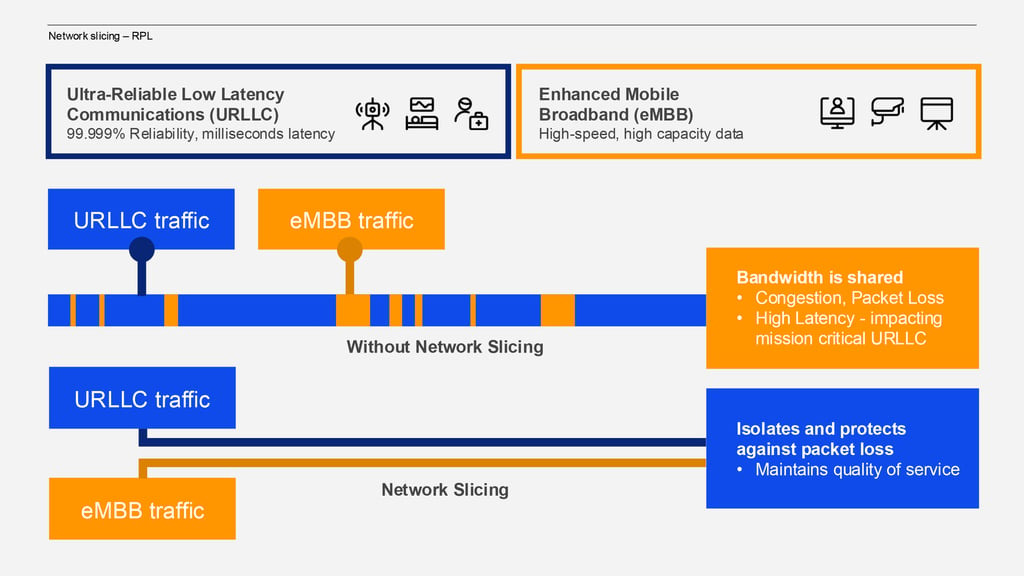
5G Network slicing infographic
The UTS Proof-of-Concept Project
The UTS demonstrator successfully established two distinct network slices within a single physical network—one for URLLC and one for eMBB. The objective was to test whether slicing could effectively preserve the QoS of URLLC traffic even under heavy network congestion.
Key findings
- The results confirmed that network slicing effectively isolates and protects critical traffic, ensuring that URLLC maintains its stringent reliability and latency requirements even as eMBB traffic increases.
- This successful demonstration played a pivotal role in Ericsson’s collaboration with Telstra, leading to further trials and advancements in real-world 5G network deployment.
- In February 2024, Ericsson and Telstra announced the upcoming rollout of network slicing technology, marking a significant milestone in commercial 5G innovation.
UTS and Industry Collaboration: Driving Real-World Impact
The Global Big Data Technologies Centre (GBDTC) at UTS has a strong track record of successful industry partnerships. In this project, early-stage proof-of-concept validation not only confirmed theoretical models but also contributed to Ericsson’s business case for further development.
This project is one of many successful collaborations between UTS and the telecommunications industry, demonstrating how academic institutions can play an important/key role in driving technological innovation.
“The success of the UTS-Ericsson PoC network slicing proof-of-concept was a pivotal milestone, providing a strong foundation for our business case.
This achievement has enabled us to accelerate the development of a commercial 5G network slicing product in close collaboration with Telstra, bringing us one step closer to delivering new, differentiated services for enterprises and consumers alike.
— Emilio Romeo, CEO, Ericsson Australia and New Zealand
UTS is a preferred university partner for Ericsson, built on three key pillars:
- Talent Engagement – Hosting hackathons to attract and develop future talent.
- Investment in Diversity and Inclusion – Supporting initiatives such as the Ericsson-UTS Women in Engineering and IT Scholarships.
- Joint Innovation and Research – Partnering in advanced research and development.
Study and partner with us
In a world where organisations increasingly depend on telecommunication networks for mission-critical applications, technologies like 5G network slicing offers innovative ways for telecommunications providers to meet the growing data demand needs.
UTS continues to be a leading Australian institution in industry partnerships, delivering tangible, real-world outcomes. The collaboration with Ericsson on 5G network slicing is a testament to the university’s ability to drive cutting-edge research, real-world applications, and commercialisation of next-generation telecommunications solutions.
Collaborate
If you’re a company with a telecommunications focus and would like to explore how a research collaboration with UTS might address challenges you are facing, you can learn more about the Global Big Data Technologies Centre and get in touch with us at gbdtcadmin@uts.edu.au
Study
UTS is a top-ranking university in Telecommunications Engineering, both Nationally and Internationally, with exciting opportunities beyond your degree to join our teams working in the Telecommunications and Connectivity sector on groundbreaking projects with Industry.
If you’re an individual looking for the next step in your career and want to shape the future of advanced telecommunications, UTS offers Masters and PhD programs including a Master of Engineering in Telecommunications and Electronics and research degree programs (PhD and Masters) in Engineering, following a Bachelor of Engineering scholarships are available.

News
Dr Xu Wang recognised at Defence & National Security Workforce Awards 2026
The Global Big Data Technology Centre (GBDTC) recognises the achievement of Dr Xu Wang, who has been named Best Cyber Technician or Specialist Under 35 at the...

News
GBDTC researcher Dr Lizhao Song awarded an ARC Discovery Early Career Researcher Award (DECRA)
Dr Lizhao Song of the Global Big Data Technologies Centre (GBDTC) has been awarded a prestigious ARC DECRA grant for 2026 for her project, “Adaptive Multi-Beam...

News
CASPER AI: the friendly ghost in the machine to keep you safe online
A virtual assistant that applies artificial intelligence to detect, interpret and respond to cybersecurity threats has been publicly unveiled at UTS.
News
The Australian names UTS the country’s top research institution in seven fields
The University of Technology Sydney has been recognised for its leadership in seven research fields of national importance in the 2026 Research magazine...
News
Dr Xu Wang recognised at Defence & National Security Workforce Awards 2026
The Global Big Data Technology Centre (GBDTC) recognises the achievement of Dr Xu Wang, who has been named Best Cyber Technician or Specialist Under 35 at the...
News
GBDTC researcher Dr Lizhao Song awarded an ARC Discovery Early Career Researcher Award (DECRA)
Dr Lizhao Song of the Global Big Data Technologies Centre (GBDTC) has been awarded a prestigious ARC DECRA grant for 2026 for her project, “Adaptive Multi-Beam...
News
CASPER AI: the friendly ghost in the machine to keep you safe online
A virtual assistant that applies artificial intelligence to detect, interpret and respond to cybersecurity threats has been publicly unveiled at UTS.
News
The Australian names UTS the country’s top research institution in seven fields
The University of Technology Sydney has been recognised for its leadership in seven research fields of national importance in the 2026 Research magazine...