


Centreing the workplace experiences of Indigenous Australians
Gari Yala 2 (Speak the Truth) provides one of the most comprehensive and current examinations of Aboriginal and/or Torres Strait Islander people’s workplace experiences in Australia.
Six years on from the inaugural 2020 report, more than 1,100 Indigenous employees have again spoken truth about what is happening inside Australian workplaces today.
Their message is clear: organisations have made some progress, but not enough.
Racism and lack of cultural safety remain widespread, and without organisations deeply committing to truth-listening and truth-acting, meaningful change will remain out of reach.
This research was again proudly sponsored by the NAB Foundation in 2025.
Download our reports and infographics
Explore our research in detail.
You can also access accessible versions of the reports via the links or the Report Infographic.
Key Findings
This research drew on the insights and experiences of 1,158 Aboriginal and/or Torres Strait Islander workers and compared the experiences shared in 2020 by 1,033 Indigenous workers.
Just 40% of Indigenous employees reported that their workplaces were culturally safe.
The persistence of racism
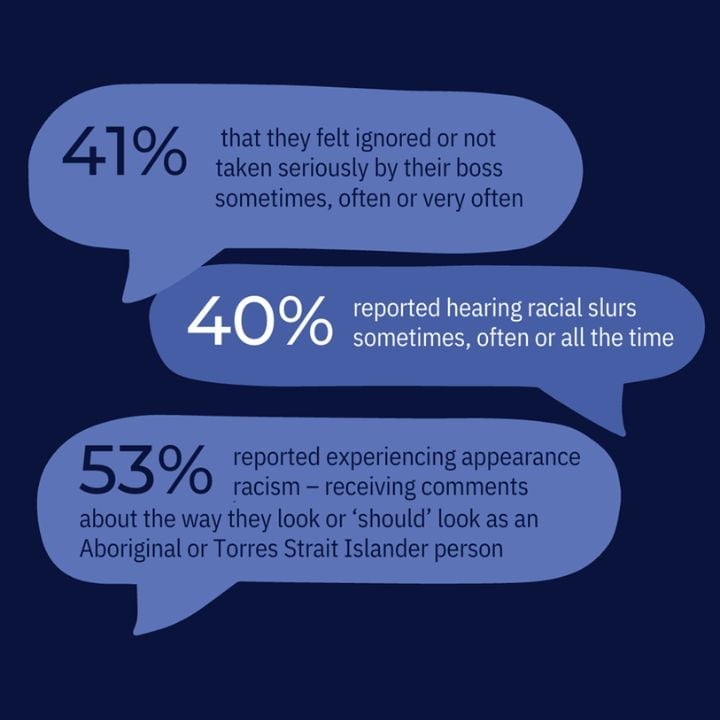
The lack of cultural safety in workplaces is emphasised by the commonality of racism:
Anti-racism action remains significantly low
Most organisations are unprepared to prevent or respond to racism at work.
- Nearly two thirds of Indigenous employees (63%) say their workplace provides no antidiscrimination training that addresses racism towards Indigenous peoples.
- Even more concerning, 69% said their workplace does not have a racism complaint procedure.
- Not surprisingly, only 38% of Indigenous workers who experienced racism felt they had the support they needed when unfair treatment and/or racial slurs or jokes at work occurred.
These gaps matter. Where organisations had both a racism complaint procedure and compliance training in place, racism was significantly lower – 40% of Indigenous employees in these workplaces experienced racism very often, often, or sometimes, compared to 66% in organisations with neither.
Unpaid, unseen, and unfair: The ‘hidden year’ of unpaid work
A major finding of this report is the quantification of unpaid workplace demands – formerly referred to as the cultural or colonial load. Aboriginal and/or Torres Strait Islander employees are frequently expected to perform additional, uncompensated tasks such as educating colleagues, managing Reconciliation Action Plans (RAPs), and organising cultural events.
- Nearly two thirds (64%) of Aboriginal and/or Torres Strait Islander employees experience high levels of cultural load arising from this type of unrecognised and unrewarded work.
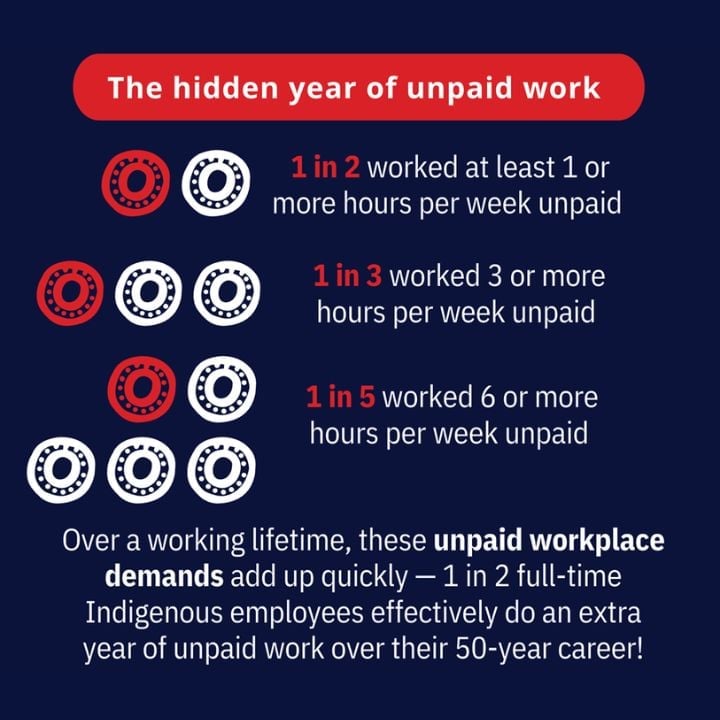
These demands accumulate significantly over a career. We estimate that 1 in 2 full‑time Indigenous employees effectively do an extra year of unpaid work over their 50-year career.
Despite this, 75% said that their organisation did not formally recognise or remunerate cultural load (48%) or that they did not know if their organisation did (27%).
Five years on - what’s changed since 2020?
Six years on, the picture is mixed.
- There are small gains. More employees feel safe to share their identity (79% versus 72%), and seven of nine forms of racism have eased slightly (by between 0.4% and 1% per year).
- But racism remains stubbornly high. One in two (53%) Indigenous employees still experience inappropriate race-based comments and assumptions. Key markers like unfair treatment (38% in both years), high cultural load (63% versus 64%), and antiracism structures (only 21% of workplaces offering both training and a complaint process in both years) show no progress.
- A century to silence overt racism.
- At the current rate of change, without further policy or legislative change, we estimate it could take another 118 years[1] for Aboriginal and/or Torres Strait Islander workers to never hear racial slurs and jokes at work.
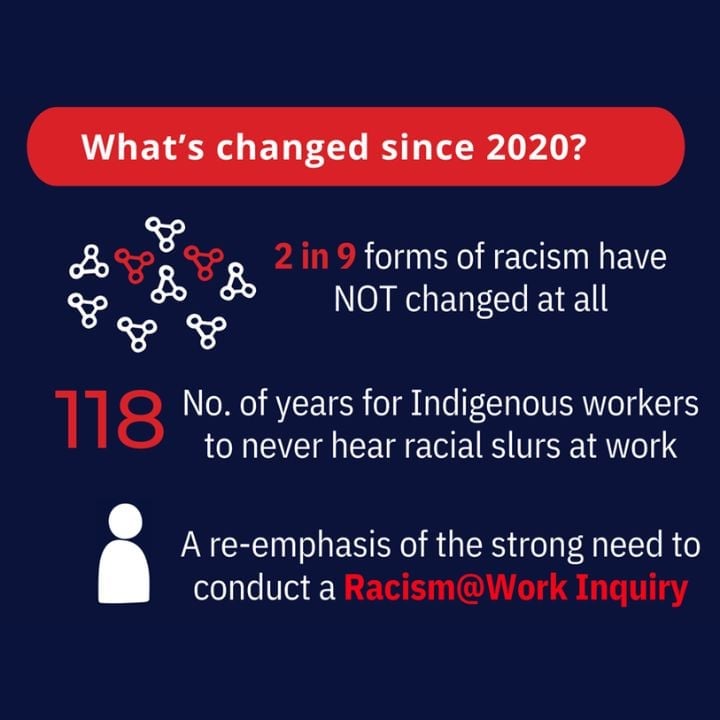
It is clear to us that the path forward does not require new mandates, but rather a reaffirmation of our original 10 Truths for organisational action and a deeper commitment to the practice of truth-telling.
In Gari Yala 2, we call on Australian employers to move beyond ‘marking the days’ and commit to truth-listening and truth-acting.
This means confronting uncomfortable realities, dismantling systems that enable racism, resourcing Indigenous leadership, and building environments where Aboriginal and/or Torres Strait Islander people can thrive without carrying a disproportionate burden.
Want to use our research?
Materials contained in this document are © Copyright of the Jumbunna Institute, 2026. If you wish to use any content contained in this report, please contact the Centre for Indigenous People and Work Director at nareen.young@uts.edu.au to seek consent.
Where you wish to refer to our research, it must be correctly attributed to the Centre for Indigenous People and Work.
Formal attribution is required where references to research material are in a written format.
Citing the Centre for Indigenous People and Work as a source will suffice where the reference is made in a verbal format.
Suggested citation: Centre for Indigenous People & Work (Young, N., Gilbert, J., Evans, O. and O’Leary, J.) Gari Yala 2 (Speak the Truth): Centreing the Work Experiences of Aboriginal and/or Torres Strait Islander Australians in 2025-2026, Sydney, CIPW
[1] 118 years estimate was calculated by using two survey observations – 26% of Indigenous workers reporting they never heard racial slurs in 2020, rising to 29% in 2025. We estimated the average improvement at +0.6 percentage points per year. Applying this rate as a linear trend would mean it would take another 118 years (71% divided by 0.6%) to reach 100% of Aboriginal and/or Torres Strait Islander workers reporting they never heard racial slurs. This illustrative trajectory: is of only one form of racism (i.e. racial slurs) not of workplace racism generally; is based on only two data points in time as no other chronological data points were available; and assumes uniform change though we’re conscious real world change can be non linear, being policy dependent.

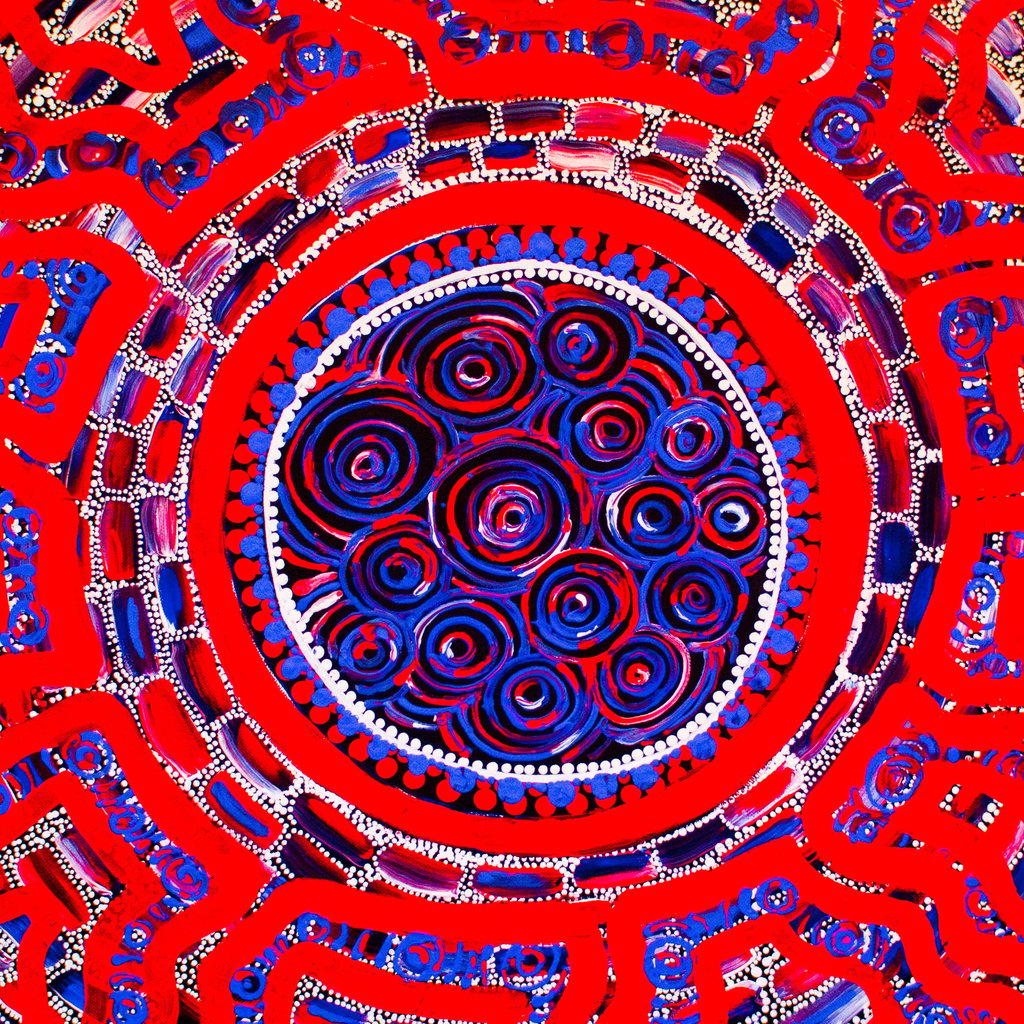
About the artwork
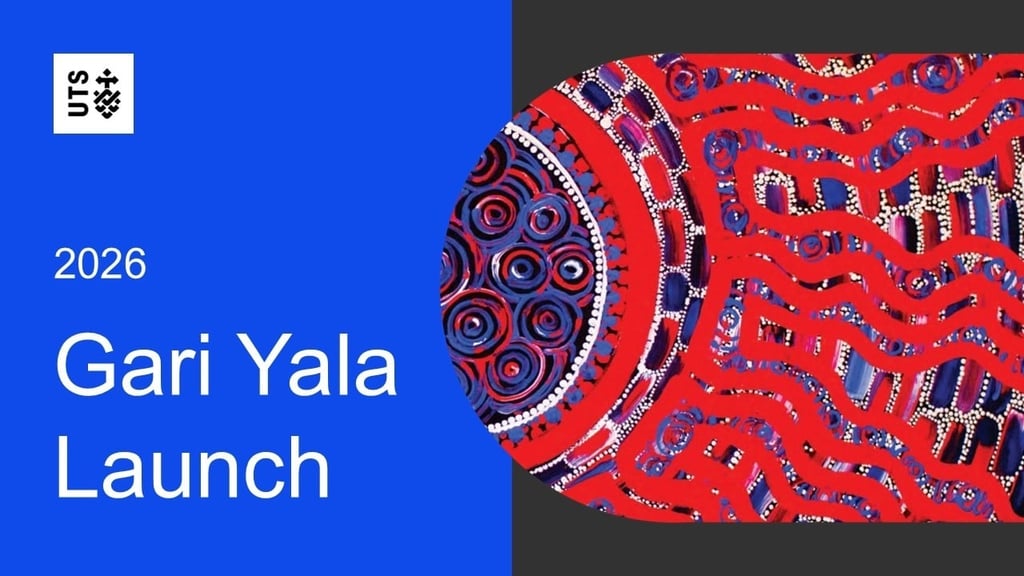
Kirsten Gray is a Yuwalaraay/Muruwari woman living on Dharawal country and raising two small children. Her artworks are a contemporary and vibrant reflection of her passion for her Aboriginal culture.
‘Speaking truth’ explores the nature and extent of the contributions made by Aboriginal and Torres Strait Islander peoples in this land for millennia. Long before the birth of the Australian nation, our people were already making significant contributions to their families and communities.
It was the contributions of Aboriginal and Torres Strait Islander people upon the arrival of the British, which helped transform our country into what it is today. Much of this labour was often unpaid, unrecognised and undertaken in discriminatory and harsh conditions. Nonetheless, it is these ongoing contributions of our people which keep each other, our communities and this country, strong.