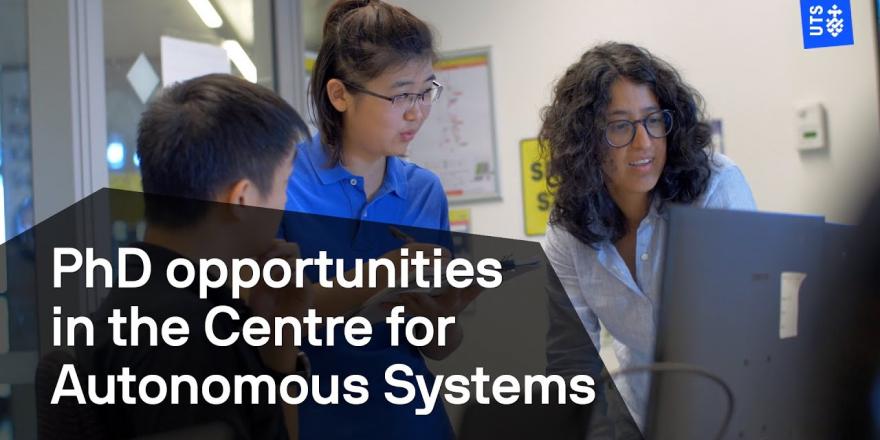
The world is advancing rapidly. Modern and emerging societies face new demands.
Why choose engineering or IT at UTS?
We’re renowned for practical innovation. Research in Engineering, and Information and Computing Sciences at our faculty has been acclaimed for high impact in a national Engagement and Impact Assessment by the Australian Research Council. Amongst other accolades
For example, our award-winning SharkSpotter is being deployed on NSW and Queensland beaches to prevent shark attacks and save lives.
We’re also acclaimed for “Well above world standard” research in artificial intelligence and image processing, and biomedical engineering in an Excellence in Research for Australia evaluation.
What does this mean? You’ll be working with global experts in these fields.
Best of the best facilities
You need environments that inspire. Our world-class Engineering and IT Building's state-of-the-art features include modern laboratories and the UTS Data Arena, an immersive, 360 degree interactive data visualisation facility that changes the way data is presented and manipulated.
The UTS Tech Lab brings engineering and IT researchers, government and industry partners together in a large-scale facility to collaborate on multidisciplinary projects and innovate.
Housing Australia’s largest collection of cutting-edge 3D printers, ProtoSpace promotes partnerships for new manufacturing opportunities, and supports the future of advanced manufacturing in NSW and Australia.
Authentic work experiences
You won’t be working in a bubble. We’re renowned for industry engagement on real-world projects. You could be addressing rising congestion on a train network, optimising the performance of an underwater vehicle with a team of students, or developing customer service solutions for a global telecom company
Skills for life
We want your learnings to stay with you—and be useful. Skills to collaborate in and manage teams. Entrepreneurship and launching startups. Transformative problem solving via design thinking. Take them into the workforce and help shape the future.
Degrees
Doctor of Philosophy
Courses
- Doctor of Philosophy (Engineering)
- Doctor of Philosophy (Computer Systems)
- Doctor of Philosophy (Software Engineering, Analytics, Information Systems)
- Doctor of Philosophy (Artificial Intelligence)
Course duration
3–4 years, full-time equivalent
Entry requirements
Minimum requirement for PhD admission:
- Bachelor honours degree with first class or second class / division 1 honours, or
- Recognised equivalent qualification, or
- Recognised equivalent professional qualification(s) and relevant research and/or work experience, and
- Course-specific English language requirements
Course structure
Candidates are required to complete a thesis under the supervision of appropriate academic staff. A formal course of study or other work may also be prescribed.
There are three stages to the doctoral program to frame and support candidate progress and study. The program includes the formalisation and/or introduction of a number of introductory and advanced modules, including subjects covering research preparation and methods, and professional development.
Progress is supported and reviewed through a Doctoral Study Plan (DSP). Students design their own DSP in consultation with their supervisor(s). In the first stage, the DSP is based on the student's academic and professional background and goals. The second and third stages are based on study progress. Candidates are assessed prior to advancing to the next stage of their studies and submit, in consultation with their supervisor(s), a progress review at the end of each session.
Course
Course duration
2 years, full-time equivalent
Entry requirements
- Bachelor degree or recognised equivalent qualification and/or a graduate certificate or diploma to demonstrate the capacity to pursue graduate studies at this level
- Recognised equivalent professional qualification(s) and relevant research and/or work experience
- Course-specific English language requirements
Course structure
Candidates are required to complete two subjects covering technology research preparation and technology research methods, respectively (some candidates may be exempt from completing these subjects).
The degree is examined through presentation of a thesis.
All candidates are required to submit, in consultation with their supervisor(s), a progress report at the end of each session.
A UTS Industry Doctorate Program and a Collaborative Degree Program are also available within the Faculty.
Additionally, a is open to all graduate-level research students enrolled in a master’s by research or PhD at any recognised university or college. Research candidates who wish to visit UTS can apply to stay for up to 48 months. Discuss your plans with your home university supervisor. Once approved, establish contact with an appropriate supervisor at UTS. An application can be submitted through the standard how to apply guidelines.
Fees
Fees and costs related to enrolment in a research degree at UTS differ depending on if you are a domestic or international candidate. Further information is available from Fees.
Scholarships
A number of competitive scholarships
To apply, indicate that you would also like to be considered for a competitive scholarship on your online application for admission to a research program.
Other scholarships available include:
- Faculty of Engineering and IT-funded scholarships
- UTS scholarships by application
- External scholarships by application
PhD industry project
A team of research students worked with two UTS industry partners to develop a fully autonomous ocean monitoring system with underwater gliders. The team tackled two major challenges: to design a system that has reliable navigation with autonomous decision-making.
The project has provided positive outcomes for the industry partners by providing reliable navigation which is required for autonomous coast-to-coast operations. The results enable motion planning for underwater gliders at a large spatial and temporal scale. This will be demonstrated in a world-first fully autonomous glider operation from Sydney to Brisbane. The positive results from the project are expected to generate future interests from potential industry partners.