

There is growing concern among stakeholders that developers of cancer clinical trials tend to default to patient-reported outcome measures (PROMs) used in previous similar trials when deciding on which PROMs to include. This may not provide optimal measurement of quality of life (QoL) issues relevant for each new trial’s specific research questions, populations, treatments, contexts, and stakeholder interests [1–3].
Thus, driven by the twin imperatives of improving relevance and reducing PROM burden – important goals for patients, CCTG investigators and other stakeholders alike – there has been growing interest in a “modular approach” to PROM selection [4].
What is the modular approach?
Serrano and colleagues (2024) have defined the modular approach as: “collecting non-exhaustive but patient-relevant and clinically relevant domains from existing multi-domain PROMS within a given context of use that is independently scored, interpreted, and psychometrically validated for administration in each clinical trial. Modularization may require a subset of subscales [measuring domains] from a given instrument or a mix of subscales from different measures.”
Within that definition, domains/subscales can be multi- or single-item, depending on the PROM they are taken from.
A modular approach is illustrated by an example using the 27-item Functional Assessment of Cancer Therapy – General (FACT-G) in figure 1 (below).
The term modular approach was likely popularised in the PROM context through the European Organisation For Research And Treatment Of Cancer's (EORTC's) strategy of adding disease- or treatment-specific questionnaire modules to a core questionnaire [5]. However, in this resource and recent literature, we refer to an approach where the individual domains or subscales are treated as modules.
Figure 1. Administration of select subscales of the FACT-G using a modular approach
Abbreviations: COAs = clinical outcome assessments (including clinician, observer and performance outcomes, as well as patient-reported outcomes)
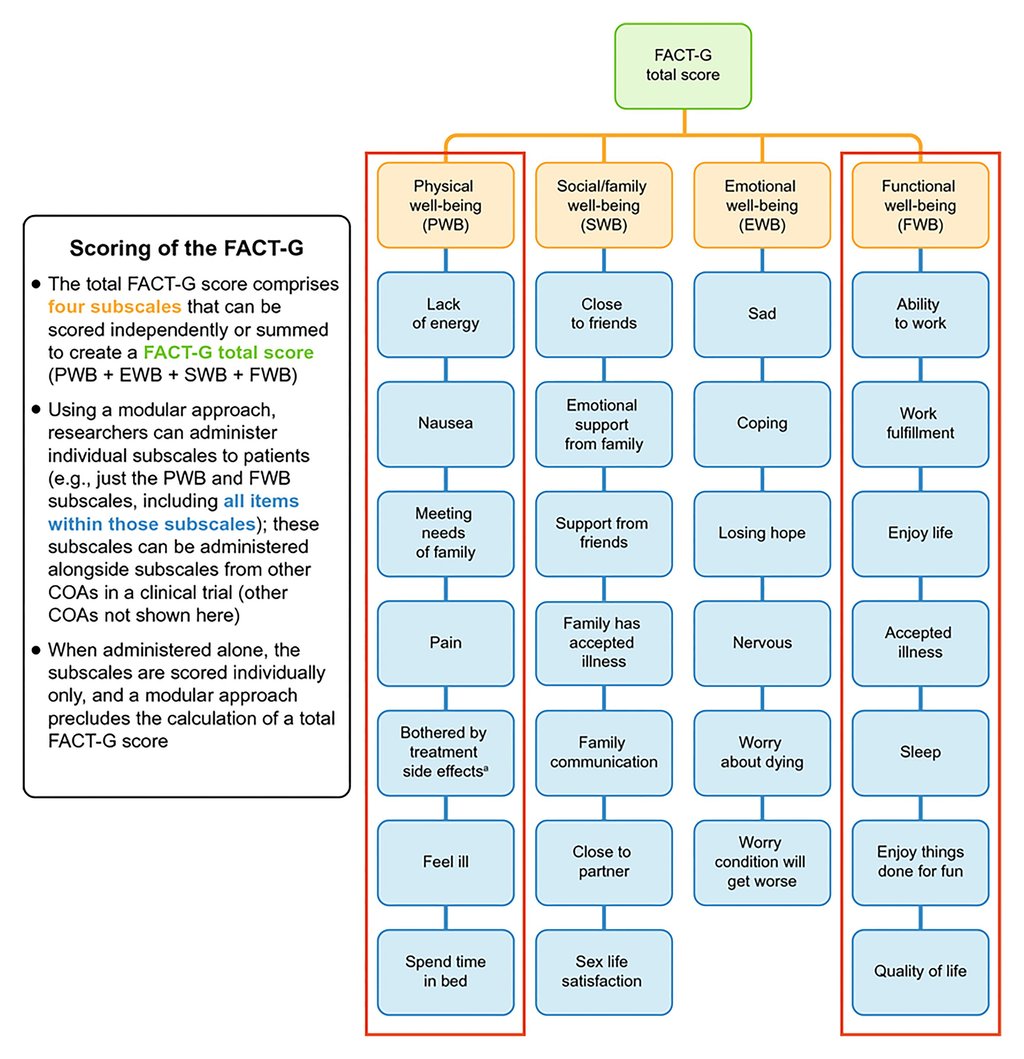
From ‘Administering selected subscales of patient-reported outcome questionnaires to reduce patient burden and increase relevance: a position statement on a modular approach’, by Serrano, D. et al., 2024, Quality of Life Research, 33, 1076-1084. Copyright 2024 the authors without changes.
Accessible diagram description
Perspectives for and against a modular approach
In CQUEST's latest publication (Ng et al., 2025), we build upon recent guidance from the USA's Food and Drug Administration (FDA) and PROM developers, as well as position statements from various international stakeholders, to provide considerations on the use of the modular approach. We also provide practical examples of how to apply the modular approach and demonstrate how it can improve PROM data quality [6].
This article has been published by the Medical Journal of Australia and can be accessed at Using patient-reported outcome measures in clinical trials: perspectives for and against a modular approach.
We have also presented this topic at various CCTG conferences. View our poster (PDF, 455 kB).
The abovementioned resources describe three suggested applications of the modular approach for PROMs:
- Developing a study-specific conceptual framework, incorporating dedicated PROMs and/or domains to measure relevant health-related quality of life (HRQoL) concepts
- Using a full-length PROM, removing domains less relevant to the study context
- Using a full-length PROM, substituting domains that are primary or key secondary outcomes with dedicated PROMs or domains
Approaches described in parts 2 and 3 can be informed by the conceptual framework developed in part 1.
Deciding whether to use a modular approach for a PROM strategy
When deciding whether your study's PROM strategy may benefit from the modular approach, first identify the patient-reported outcomes (PROs) that are relevant and important in the intended population and intervention contexts.
CQUEST recommends developing a conceptual model to support the identification and organisation of health-related QoL (HRQoL) concepts that are likely to be relevant and important to patients' experiences in your study context. For further guidance on developing a study-specific conceptual framework, refer to this CQUEST resource.
Using the conceptual model and/or list of PROs of interest, determine which PROM(s) most appropriately assesses these concepts. The ISOQOL checklist for selecting PROMs (PDF) may support your decision-making regarding the choice of PROM(s).
When selecting PROMs and/or PROM domains to include in your study, consider:
- Are there any PROM domains, or items within domains, that are irrelevant or less relevant to the patient experience in the study context?
- Are there any domains that are overlapping between PROMs (e.g., two questionnaires that both assess pain)?
- Consider the outcomes of interest in your study and the outcome hierarchy. If PROM(s) are being used for your primary or key secondary outcome(s), is there a risk that they do not assess these outcomes in sufficient depth?
- Are there any patient-reported constructs that are relevant to the patient group in your study context but are missing from the PROM strategy?
- Determine if the PROM strategy is potentially burdensome to respondents through pilot testing with a representative group of consumers, and reviewing the total length of the questionnaires and time likely taken to complete all items. Is the PROM strategy likely to incur respondent burden at any assessment timepoint?
A modular approach may be useful if your answer to any of the above questions is “yes”.
Prior to applying the modular approach, also consider whether an economic evaluation is planned in your study. If so, assess whether any of the included PROM(s) are intended to be used as preference-based measure(s) to obtain utility values (e.g., QLU-C10D derived from the EORTC QLQ-C10). This is important because removing specific PROM domains may result in a measure that no longer contains the full set of items required to estimate utility values for economic evaluations. As the acceptability of the modular approach for economic evaluations submitted to health technology agencies is currently unclear, we recommend consulting the PROM developer's user guidelines for specific guidance.
Reporting the use of the modular approach
Given the relative novelty of the modular approach, its acceptability may vary across stakeholders. Thus, steps must be taken to ensure that the PROM strategy remains patient-centered and valid for the intended context of use.
Methods used to select or omit PROM domains should be transparently reported to ensure that all relevant QoL constructs are appropriately identified and measured. This is particularly important where PROM items or domains have not been previously validated in a specific population, and it is necessary to demonstrate that the resulting assessment remains comprehensive, understood, and meaningful to patients. Appropriate methods to ensure the content validity of the resulting PROM strategy (i.e., the degree to which the content of an instrument is an adequate reflection of the construct to be measured) include consulting the available literature and involving a representative group of consumers, healthcare professionals and other relevant stakeholders.
Accordingly, a clear and well-justified rationale should be documented (e.g., in study protocols, ethics applications, dissemination materials) to support the use of a modular approach.
References
- Campbell R, Bultijnck R, Ingham G, et al. A review of the content and psychometric properties of cancer-related fatigue (CRF) measures used to assess fatigue in intervention studies. Support Care Cancer. 2022;30(11):8871-83.
- King-Kallimanis BL, Howie LJ, Roydhouse JK, et al. Patient reported outcomes in anti-PD-1/PD-L1 inhibitor immunotherapy registration trials: FDA analysis of data submitted and future directions. Clinical Trials. 2019;16(3):322-6.
- Rutherford C, Patel MI, Tait M-A, et al. Assessment of content validity for patient-reported outcome measures used in patients with non-muscle invasive bladder cancer: a systematic review. Support Care Cancer. 2018;26(4):1061-76.
- Aiyegbusi OL, Cruz Rivera S, Roydhouse J, et al. Recommendations to address respondent burden associated with patient-reported outcome assessment. Nat Med. 2024;30(3):650-9.
- Aaronson NK, Cull A, Kaasa S, et al. The EORTC Modular Approach to Quality of Life Assessment in Oncology. Int J Ment Health. 1994;23(2):75-96.
- Ng C-A, Roydhouse J, Luckett T, et al. Using patient-reported outcome measures in clinical trials: perspectives for and against a modular approach. Med J Aust. 2025;n/a(n/a).
Contacts
For support regarding the suitability, application or reporting of the modular approach, contact CQUEST at cquest@uts.edu.au.
For support on applying the modular approach in PROMs used to generate evidence for use in an economic evaluation, contact the Cancer Research Economics Support Team (CREST) at crest@uts.edu.au.