


Abstract
Modern engineering and scientific systems often utilize numerous sensors to gather high-dimensional time series data for monitoring and operations. The success of DeepSeek for large language models highlights the effectiveness of low dimensional learning, particularly when computational resources and data volume are limited.
This talk introduces a latent low dimensional dynamic predictor framework that concurrently achieves dimension reduction and optimal dynamic prediction. The dynamic latent variables, termed principal predictors, form low dimensional parsimonious predictor models for high-dimensional time series data.
The solution process involves iterations to extract both dynamic and static subspaces. A maximum likelihood framework is employed to develop an iterative solution. The connection between principal predictors and DeepSeek low-dimensional approximation is explored.
Examples from engineering and industrial manufacturing processes will be used to demonstrate the advantages of the proposed framework. This low-dimensional dynamic modeling approach has potential applications in prediction, control, and anomaly diagnosis.
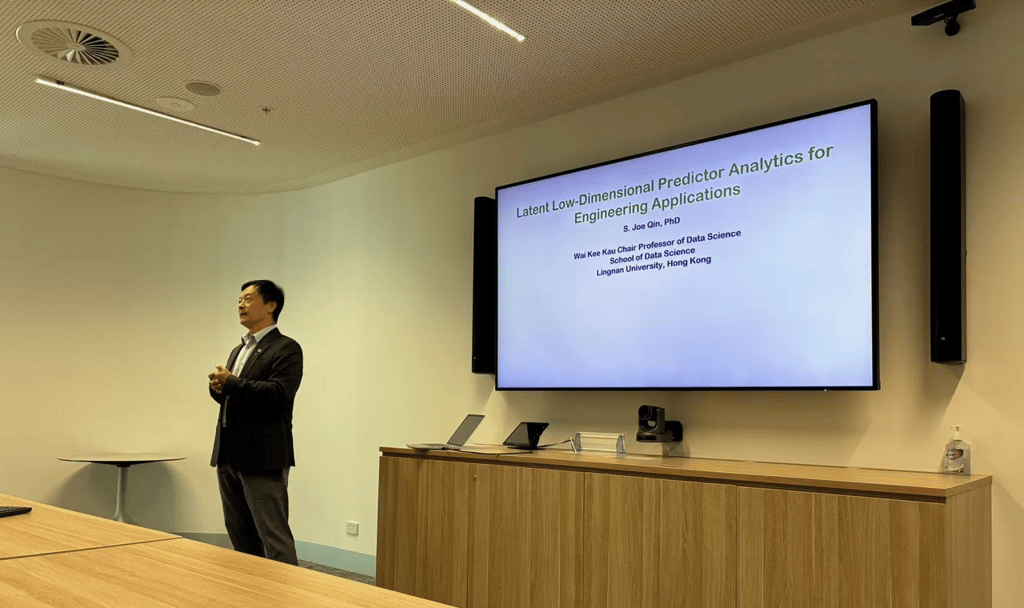
Speaker
S. Joe Qin is the Wai Kee Kau Chair Professor of Data and President of Lingnan University in Hong Kong. He obtained his B.S. and M.S. degrees in Automatic Control from Tsinghua University in Beijing and his Ph.D. degree in Chemical Engineering from University of Maryland at College Park.
Qin’s research interests include data science and analytics, statistical and machine learning, industrial AI, process monitoring, model predictive control, system identification, smart manufacturing, and smart energy management.
Dr. Qin is a member of the European Academy of Sciences and Arts and Fellow of the Hong Kong Academy of Engineering, the U.S. National Academy of Inventors, IFAC, AIChE, and IEEE.
He is the recipient of the 2022 AIChE CAST Computing Award, 2022 IEEE CSS Transition to Practice Award, the Changjiang Professorship, and the U.S. NSF CAREER Award. He was inducted into the Process Automation Hall of Fame in 2026 by Control Global.