


Abstract
Density matrix exponentiation (DME) is a general procedure that converts a (unknown) quantum state into the Hamiltonian evolution.
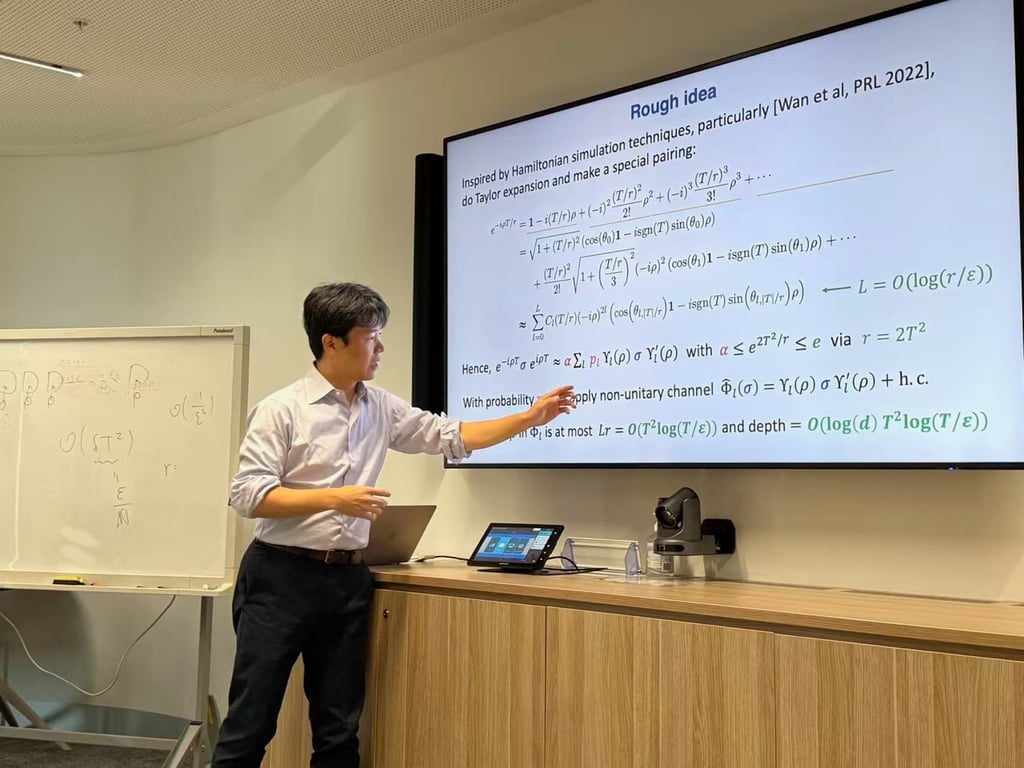
The issue of DME is that it requires at least 1/epsilon state copies in error epsilon. I’ll present a method [1] that goes beyond this lower bound and achieves O(log(1/epsilon)) state copies, by limiting the final step of quantum circuit involving DME to computing mean values. This can realize a general-purpose quantum algorithm for property estimation, that achieves exponential circuit-depth reductions over existing protocols across various tasks. As examples, I will present quantum principal component analysis and efficient von Neumann entropy computation.
References:
[1] Wada, Kato, Harada, Yamamoto, State-to-Hamiltonian conversion with a few copies, arXiv:2509.14791, 2025
Speaker
Naoki Yamamoto is the Chair of the Keio Quantum Computing Center. At KQCC, his research centers on hybrid quantum-classical optimization and machine learning algorithms for use on noisy intermediate-scale quantum devices, and on methods for analyzing the performance and fidelity of such machines. Naoki Yamamoto received his B.S. in Engineering (1999), his M.S. (2001) and Ph.D. (2004) in Information Physics and Computing from the University of Tokyo in Japan.
From 2003 to 2007, he was a Research Fellow at the Japan Society for the Promotion of Science. He was a postdoctoral fellow at the California Institute of Technology from 2004 to 2007, and at the Australian National University from 2007 to 2008.
He is currently a Professor at the Department of Applied Physics and Physico-Informatics, Keio University. His current research interests are in quantum engineering including control, system identification, and filtering in the quantum information context.