


- Posted on 24 Jul 2026
- 20-minute read
By Mark Beeson
share_windows This policy brief appeared in the Toda Peace Institute's Policy Briefs and Reports series on July 24 2026.
This policy brief details APEC’s evolution, paying particular attention to the pivotal roles of Australia and Japan. From its inception, APEC’s primary focus on trade liberalisation always looked like a hard sell in East Asia, where state intervention and the preservation of sovereignty remain important. However, the forthcoming APEC Summit in Shenzhen offers an opportunity to rethink and expand APEC’s role. When the Trump administration is increasingly seen as a source of chaos rather than stability, China has a chance to model responsible and creative state behaviour and even leadership. If China can convince Australia, Japan and other middle powers that it can work constructively to tackle common economic, security and environmental problems, it could make APEC a focus of cooperation and policy coordination into the future.
AUTHOR

Mark Beeson
Adjunct Professor, Australia-China Relations Institute, University of Technology Sydney
News
Australia-China Weekly Brief: November 2026 issues
The Australia-China Weekly Brief by the Australia-China Relations Institute at the University of Technology Sydney (UTS:ACRI) tracks key developments in...
News
Can AUKUS submarines protect Australiaʼs maritime trade?
Nuclear-powered submarines offer Australia only limited protection for its maritime trade, and the cost of acquiring them crowds out better economic-security...
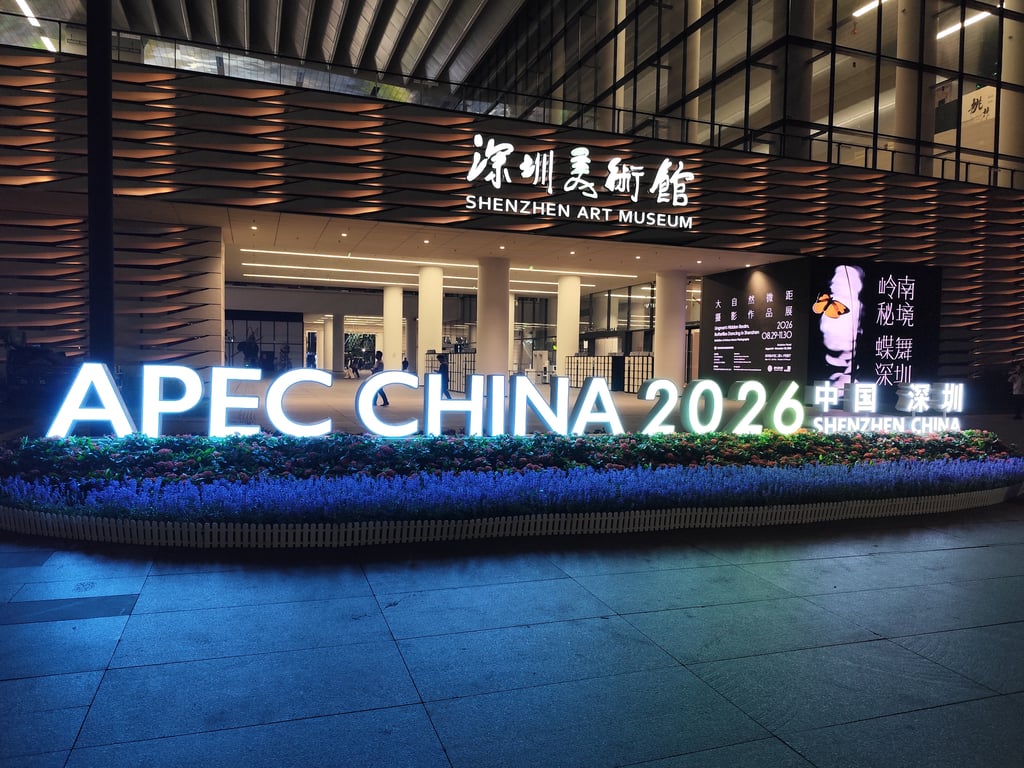
News
APEC finally delivers, just not what we hoped for
Xi, Trump and Putin will meet in Shenzhen while the forum’s Australian architects watch on from the sidelines.

News
Shenzhen is the message: China’s unwritten APEC communiqué
The choice of Shenzhen as the venue for the annual APEC Economic Leaders’ Meeting is intended as a deliberate reminder of China’s tech prowess. Marina Yue...
News
Australia-China Weekly Brief: November 2026 issues
The Australia-China Weekly Brief by the Australia-China Relations Institute at the University of Technology Sydney (UTS:ACRI) tracks key developments in...
News
Can AUKUS submarines protect Australiaʼs maritime trade?
Nuclear-powered submarines offer Australia only limited protection for its maritime trade, and the cost of acquiring them crowds out better economic-security...
News
APEC finally delivers, just not what we hoped for
Xi, Trump and Putin will meet in Shenzhen while the forum’s Australian architects watch on from the sidelines.
News
Shenzhen is the message: China’s unwritten APEC communiqué
The choice of Shenzhen as the venue for the annual APEC Economic Leaders’ Meeting is intended as a deliberate reminder of China’s tech prowess. Marina Yue...