


- Posted on 31 Oct 2025
By Marina Yue Zhang
At a a glance
An industry networking day in Canberra this week laid bare a simple truth. Politics is still beating economics in Australia’s China policy. Facing a rapidly evolving global economy shaped by technology, competition and complex geopolitics, Australia’s China policy must make the case for engagement, with guardrails.
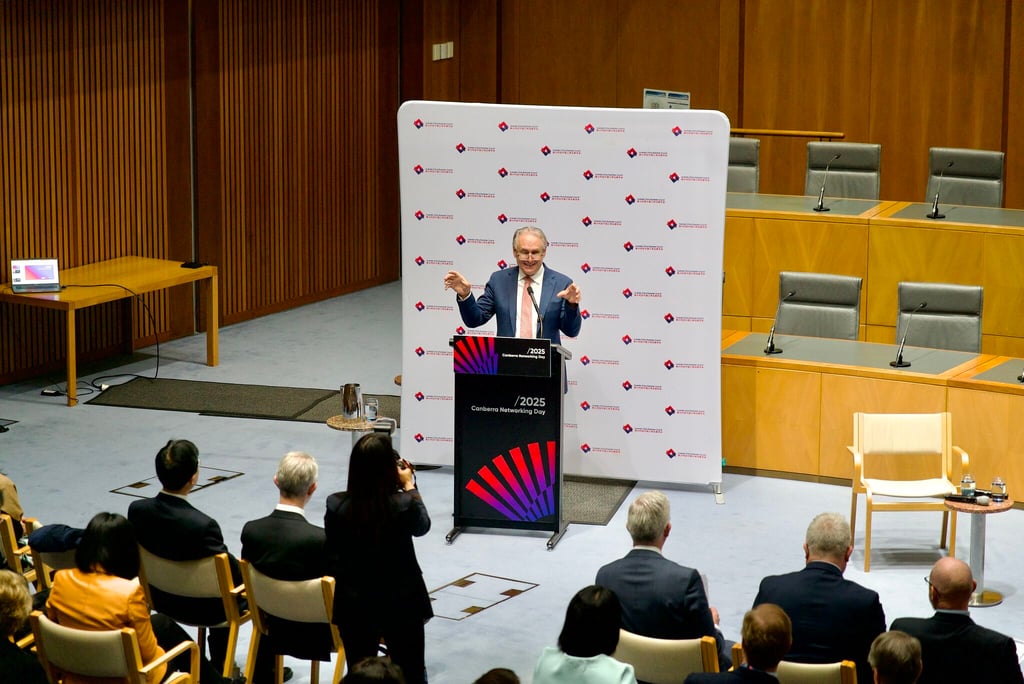
This week, I attended the Australia-China Business Council’s (ACBC) annual Canberra Networking Day. For over two decades, the ACBC has brought together miners, universities, agricultural exporters, tourism operators and others who depend on trade with the People’s Republic of China (PRC), with the aim of bridging the gap between commercial reality and political theatre. That gap has, however, never been wider. This year’s theme, Between borders and bandwidth: Innovation, trade and Australia’s economic future, captured the current tension: can Australia navigate great power competition without compromising prosperity?
The speaker list also reflected this tension. Trade Minister Don Farrell and Opposition Leader Sussan Ley attended. So did Special Envoy for Indian Ocean Affairs Tim Watts, Assistant Minister for Foreign Affairs and Trade Matt Thistlethwaite, Shadow Trade Minister Kevin Hogan and Minister-Counsellor Li Fanjie from the PRC Embassy. All agreed on one point: a healthy Australia-PRC relationship matters for both countries’ prosperity.
Yet agreement on principle masked a deeper problem. Australia’s understanding of the PRC – its language, culture and institutions – is declining. It does not match the scale of bilateral trade. Within the Australian government, there is recognition of this. As one response to the issue, it is advancing an ‘Asia Capability’ initiative to rebuild expertise. But capability-building will take years. Politics moves faster.
On this point, two moments from the event stood out.
McGowan speaks freely
Mark McGowan led Western Australia as premier for six years. Before that, he spent two decades serving the Western Australian parliament. He knows what demand from the PRC built: jobs, royalties, schools, hospitals. Western Australia ran budget surpluses because the PRC bought iron ore. Simple economics.
McGowan retired in 2023. This matters. He no longer needs votes. At the executive dinner before the formal discussion sessions, his speech drew the most sustained applause of the night, over premium Tasmanian beef. To the ears of the industry-filled room, here was a public figure saying what serving politicians cannot.
McGowan’s argument was data-driven but personal. Who buys Australian products? Where do jobs come from? Where do international students come from? These questions demand clear answers, yet politicians steer clear of direct responses, tending towards treating the PRC relationship as a political liability. In doing so, they respond to fear rather than evidence.
McGowan offered a pragmatic blueprint: use measured rhetoric; reject xenophobia; defend national interests without politicising trade; work with the PRC on climate and ocean protection; support student exchanges and tourism; and continually explain to the public where national prosperity derives.
His intervention resonated with the business-oriented audience but carries wider relevance. Politicians are letting fringe arguments creep into the mainstream. They strike preference deals with extremist parties and weaponise national security concerns to erode economic engagement. This is not strategy, it is timidity masquerading as principle.
Farrell demurs
The next morning, McGowan’s warnings came to life. At Parliament House, David Speers questioned Trade Minister Farrell about the critical minerals deal recently signed by Prime Minister Anthony Albanese and US President Donald Trump.
Getting straight to the point, Speers asked, does the US-Australia deal serve our interests? Farrell acknowledged the geology: critical mineral deposits are deep, scattered and short-lived. Australia needs partners. ‘We aim to be reliable suppliers to the world,’ he said.
Speers pressed harder. Will the world buy Australian critical minerals if they cannot compete on cost and speed? Farrell talked about reliability and partnerships. He evaded the issues of cost and speed. He did not mention the PRC, on which Australia’s miners rely for processing before materials can be made into end products, and which remains the largest buyer.
The question hung in the air. Was this deal about economics or optics? Did Albanese trade minerals sovereignty to secure a Trump meeting and calm commentators and voters nervous after his July 2025 visit to Beijing?
Farrell’s avoidance answered the question.
Why politicians bend
Votes beat value. That is the simple truth. Fear travels faster than facts. A tough sound bite beats a spreadsheet. Ministers tend to read polls, not feasibility studies.
Since 2017, the fear of looking soft on the PRC has driven political calculation. Broad public wariness about the PRC, as shown by successive polls makes tough rhetoric ostensibly appear the safer choice. Explaining the economics of rare-earth processing loses to simple soundbites. The risks of appearing weak feel immediate and personal for politicians. The gains from complex trade deals remain distant and impersonal.
This is where McGowan’s warnings bite hardest. If we cannot say clearly who will buy our products and why the numbers matter, we fall back on politics. We talk alliance optics, not purchase orders. We sell the notion of ‘reliability’ while the PRC sets pace and price in the markets of current and future relevance, such as EVs, wind turbines, electronics.
The Australia-US critical minerals deal has two fatal problems. First, it bypasses the world’s dominant processor and consumer. The PRC controls refining because it invested early, accepted lower margins and bore enormous environmental costs. If Australia cannot compete on cost and speed, buyers will return to the PRC regardless of diplomatic summits.
As I wrote recently in The Australian Financial Review, this risks becoming a massive subsidy for a market that does not yet exist. The government can provide finance and infrastructure. It cannot conjure demand. If our processing cannot beat the PRC’s, buyers will walk.
Second, the deal suggests Albanese chose short-term political cover over long-term economic logic. He met Xi Jinping in July. Voters grew nervous. A minerals agreement with the US provided balance. The optics worked. The economics remain uncertain.
What Australia needs
McGowan offered a blueprint: economic pragmatism first. Do not conflate trade with strategic alignment. The PRC’s demand for clean energy minerals is growing. American partnerships should complement Chinese markets, not replace them.
Second, build institutional frameworks to manage disputes. The recent stabilisation of diplomatic ties shows this works. Revive people-to-people contact through tourism, students and cultural exchange. This counters misperceptions.
Third, frame engagement as security: more trade with clear rules; more students with better safeguards; more joint work on climate and oceans. Remind voters that prosperity funds defence, not the other way around.
Australia has always balanced economic integration with strategic autonomy. It does not have to choose between US security and PRC markets. It can have both, if politicians find the courage to simply say so.
The path forward
All in all, the ACBC Canberra Networking Day revealed Australia at a crossroads. One path leads to reactive policy driven by anxiety. The other leads to resilience grounded in national interest.
McGowan’s message is urgent. Australia is a trading nation on Asia’s doorstep. It cannot retreat into a fortress mentality. It cannot afford to follow fringe voices or chase political safety at the expense of economic sense.
The government knows this. Farrell’s demurrals proved it. Critical minerals without competitiveness are effectively worthless. Bypassing the PRC risks failure. He cannot say so publicly. That would require defending unpopular truths to skeptical voters.
This is the gap that troubles me: between economic reality and political theatre; between McGowan’s plain speaking and Farrell’s platitudes.
Australia needs leaders who will stand firm on core principles and defend them loudly. It needs policy driven by the national interest, which includes economic prosperity, not by marginal seats. Unless that changes, Australia will keep choosing votes over prosperity. That is a choice the nation cannot afford.
AUTHOR

Associate Professor - Research, Australia-China Relations Institute, University of Technology Sydney
News
Australia-China Weekly Brief: October 2026 issues
The Australia-China Weekly Brief by the Australia-China Relations Institute at the University of Technology Sydney (UTS:ACRI) tracks key developments in...
News
Whose security counts in the Pacific?
While climate-related spending gets criticised, billions forked out for security and strategic engagement gets framed as for the “national interest”.
News
Australia-China Weekly Brief: September 2026 issues
The Australia-China Weekly Brief by the Australia-China Relations Institute at the University of Technology Sydney (UTS:ACRI) tracks key developments in...
News
If we asked the Americans to leave, would they?
Canada is looking for ways to protect its independence from Washington. Australia has embedded itself so deeply in the US military system that it risks being...
News
Australia-China Weekly Brief: October 2026 issues
The Australia-China Weekly Brief by the Australia-China Relations Institute at the University of Technology Sydney (UTS:ACRI) tracks key developments in...
News
Whose security counts in the Pacific?
While climate-related spending gets criticised, billions forked out for security and strategic engagement gets framed as for the “national interest”.
News
Australia-China Weekly Brief: September 2026 issues
The Australia-China Weekly Brief by the Australia-China Relations Institute at the University of Technology Sydney (UTS:ACRI) tracks key developments in...
News
If we asked the Americans to leave, would they?
Canada is looking for ways to protect its independence from Washington. Australia has embedded itself so deeply in the US military system that it risks being...