


- Posted on 9 Mar 2026
- 5-minute read
By Wanning Sun
share_windows This article appeared in Crikey on March 9 2026.
Writing for Crikey last week on the third anniversary of the Nine newspapers’ Red Alert series, Paul Keating did not miss the irony of the timing of the US-Israel attack on Iran. As March followed February, the US, not China, launched its large-scale offensive against Iran, kicking off what may turn out to be a protracted war in the Middle East.
In response, some politicians outside the three major parties (Labor, the Coalition and One Nation — yes, One Nation) are worried that Australia’s haste to “gushingly endorse” the attack is likely to make us a military target, due to Pine Gap and other locally based intelligence facilities, with some observers fearing we may become more vulnerable to terrorist attacks.
The Red Alert series, published in The Sydney Morning Herald and The Age, started with an editorial asking, “Are we prepared for war? The public has a right to know.” It cited an expert panel whose members asserted that “fighting could come as early as 2026”. The next day, another instalment dropped, predicting that “Within 72 hours of a conflict breaking out over Taiwan, Chinese missile bombardments and devastating cyberattacks would begin pummelling Australia.” This was followed by a joint expert statement from the panel that included 22 recommendations for action, with item 17 beginning “Australia should exploit the technological promise of the AUKUS agreement”.
Upon its publication three years ago, Red Alert was met with scathing criticism from some commentators, including former prime minister Paul Keating. What is less known is that many people in the various Chinese- Australian communities were also offended.
Prominent Chinese figures such as Anthony Pun, then the chair of National President of the Chinese Community Council of Australia (CCCA), accused The Sydney Morning Herald of “fear-mongering”. Dr Ka Sing Chu, senior advisor to CCCA, appealed to all politicians to advocate peace instead of warmongering. Robert Chong, a councillor of the Whitehorse City Council in Victoria, wrote an open letter to the prime minister, criticising the SMH and its reporters over its “baseless and irresponsible” reporting.
A 2023 survey I conducted on behalf of UTS’s Australia-China Relations Institute reflected a fear among Chinese-Australian communities that sensational war talk could lead to growing suspicions about, or racist attacks on, Chinese Australians. They were concerned that how the PRC government is portrayed in the media is correlated with negative attitudes toward Chinese diaspora communities among the general public.
In response to these criticisms, then-SMH editor Bevan Shields wrote: “Some of you didn’t like the series and others viewed it a brave assessment of the threats posed by the Chinese Communist Party and of Australia’s lack of preparedness to prevent these threats from spilling over into war.” Tory Maguire, then the executive editor of the SMH and Age, described the series as “thought-provoking”.
But it would be unfair to single out the Nine newspapers for warmongering. Few mainstream Australian media outlets want to be left out of the war-drum game. In fact, it was the Nine Network that got the ball rolling. “Poking the Panda”, also entitled “Prepare for Armageddon: China’s warning to the world”, was screened in 2021, and is one of the many such programs that have aired on 60 Minutes.
Not wanting to be left out, the ABC soon followed suit. In a 2022 Four Corners episode, “War Games”, the premise of a likely war with China regarding Taiwan was established, proclaiming: “It’s increasingly becoming a question of when — not if — China will launch an assault. Experts say it could be as early as 2025.”
On August 11, 2025, Sky News Australia broadcast “The War Cabinet”, a special one-hour program screened live from the Cabinet Room of Old Parliament House in Canberra, from where former prime minister John Curtin had guided Australia through World War II. Widely promoted across News Corp’s platforms, the program was described as “an exclusive event” in which the reporter asks a panel of experts the pressing question: “Are we ready for war?”
Despite the US currently showing signs of de-escalation with China, and despite a vibe shift among the American public identified by some China watchers, and despite European leaders lining up to go to Beijing to reset their respective bilateral relationships, the China threat narrative is not dying down in Australia. There are a number of reasons for this.
First, the government’s bipartisan position with the Coalition towards the US and China has not changed. Australia seems to demonstrate its middle power status not by forming its own independent foreign policy, but by lending legitimacy to one particular superpower. AUKUS is “on track” and will go “full-steam ahead”.
Second, for the media, the threat of an attack from China is a profitable line of reporting — war and Chinese spy narratives make good television. For instance, “Poking the Panda” has so far attracted over 14 million views on YouTube, while another 60 Minutes episode, “War with China”, has almost 16 million (compare these with the figures for domestic stories from around the same period — for instance, the 2022 60 Minutes investigation into an Australian church’s attempts to infiltrate politics, which has received only about 29,000 views).
Finally, the symbiotic alliance of securitisation is not going away. In the context of discussing the agenda-setting role of the 2017 Four Corners episode “Power and Influence: How China’s Communist Party Is Infiltrating Australia”, international relations scholar Andrew Chubb identifies what he calls a “securitising coalition” that involves security officials, politicians and journalists. He observes: “Once convinced of the threat, they [journalists] became active securitisers, driving threat perceptions downward and outward to mass audiences.”
While the US tariffs may well be hitting some industries hard, the “war with China” industry looks set to survive and thrive. However, this narrative now has to compete with the wall-to-wall coverage of the real war currently being waged by the nation that our foreign affairs minister identifies as our “closest ally, and our principal economic and strategic partner”.
Author

Deputy Director, Australian-China Relations Institute, DVC (International & Development)
News
Australia-China Weekly Brief: October 2026 issues
The Australia-China Weekly Brief by the Australia-China Relations Institute at the University of Technology Sydney (UTS:ACRI) tracks key developments in...
News
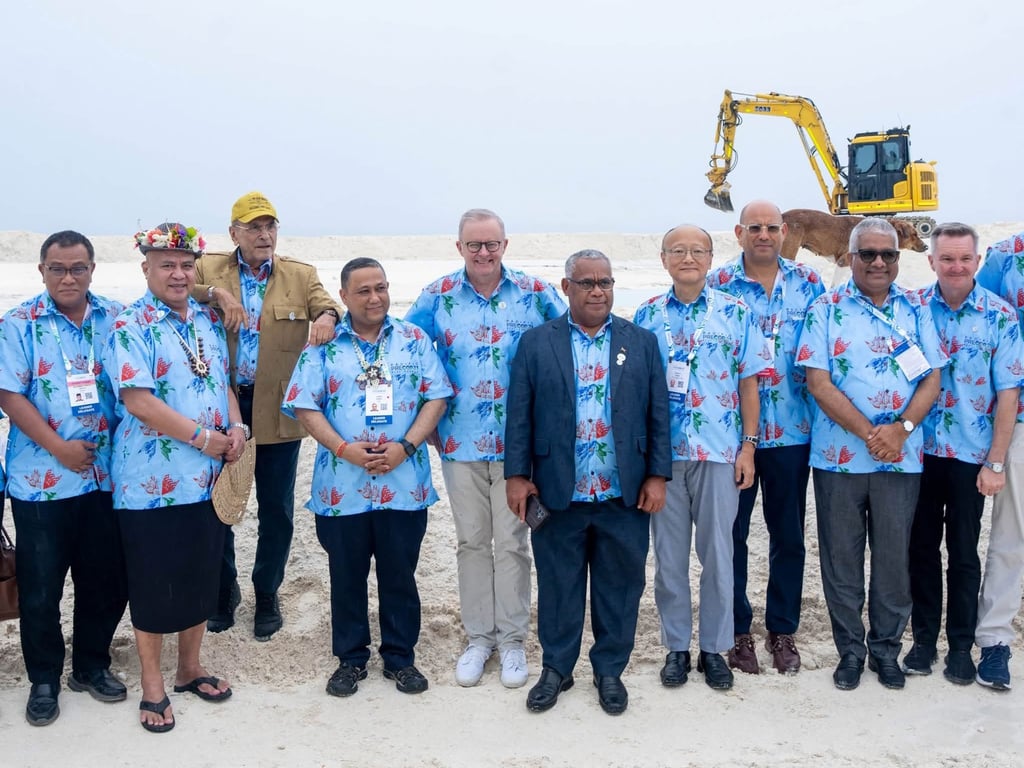
Whose security counts in the Pacific?
While climate-related spending gets criticised, billions forked out for security and strategic engagement gets framed as for the “national interest”.
News
Australia-China Weekly Brief: September 2026 issues
The Australia-China Weekly Brief by the Australia-China Relations Institute at the University of Technology Sydney (UTS:ACRI) tracks key developments in...
News
If we asked the Americans to leave, would they?
Canada is looking for ways to protect its independence from Washington. Australia has embedded itself so deeply in the US military system that it risks being...
News
Australia-China Weekly Brief: October 2026 issues
The Australia-China Weekly Brief by the Australia-China Relations Institute at the University of Technology Sydney (UTS:ACRI) tracks key developments in...
News
Whose security counts in the Pacific?
While climate-related spending gets criticised, billions forked out for security and strategic engagement gets framed as for the “national interest”.
News
Australia-China Weekly Brief: September 2026 issues
The Australia-China Weekly Brief by the Australia-China Relations Institute at the University of Technology Sydney (UTS:ACRI) tracks key developments in...
News
If we asked the Americans to leave, would they?
Canada is looking for ways to protect its independence from Washington. Australia has embedded itself so deeply in the US military system that it risks being...