


- Posted on 25 Jan 2021
- 5-minute read
Plastic pollution world-wide is growing and creating significant ecological, social and economic impacts.
In the absence of strong political leadership, businesses, in partnership with the not-for-profit sector, are driving change.
As a country with high rates of economic and population growth, relatively few formal waste collection and recycling systems, heavy reliance on the informal waste sector and as a major contributor to marine plastic pollution, India has a substantial challenge ahead to tackle domestic plastic pollution.
Promising initiatives are already underway at a global and national level, but the pace and scale of change need to increase significantly. The business sector has a vital role to play in the transformation to a more sustainable, circular plastics economy.

Woman collecting discarded packaging on a Goa beach, India (Photo: istock)
Indian businesses have an opportunity to join collaborative initiatives at a global or national level to address plastic pollution. They can also take unilateral action to address plastic packaging sustainability within their own supply chains, in design and materials use.
In order to address these issues, Stewart Investors working in partnership with the Institute for Sustainable Futures convened the 25 July Forum on Addressing Plastic Pollution in India - bringing together some of the largest local and multi-national consumer goods companies in India, and allowing them the opportunity to share knowledge, and develop actions aimed at reducing plastic packaging pollution in India.
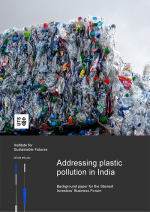
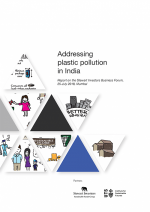
Two papers were developed for the forum - a Background Paper which provided information on the plastics waste problem and some of the actions being taken to address it, both in India and globally, and a Forum Report presenting the outcomes of the forum.
Forum background
The plastics industry is an important part of the Indian economy - employing 4 million people at present, with the industry expecting to grow at an annual rate of approximately 20 per cent, driven by population growth, economic development and urbanisation.
Plastic pollution is widespread on a global basis, but particularly acute in India due to the limited availability of formal waste management systems. India's informal waste sector handles 4.7 Mt of plastics annually, compared to 0.2Mt handled by the public waste system. As a result, the leakage of plastic into the environment is a major issue – the Ganges and Indus Rivers are two of a series of 10 global rivers, contributing 90 per cent of plastics that reach the ocean.
This growth in industry and India's heavy reliance on the informal waste sector creates a substantial challenge: how to respond to domestic plastic pollution.
Although much is already happening to address plastic pollution – such as the business-led coalition India2022, which aims to develop new models for growth with reduced environmental impact and increased social impact – the pace and scale of change need to significantly increase in order to address plastic pollution.
The business sector has a vital role to play in the transformation to a sustainable, circular economy for plastics, either through collaboration or unilateral action.
As a result, the Forum was convened by Stewart Investors and ISF, in order to facilitate further Indian business collaboration on these issues.
Forum findings
The forum revealed a strong sense of shared purpose, a desire to work collaboratively to address the issues of plastic pollution in India, and a clear agree to work collaboratively on a set of priority activities.
The priority activities were developed through envisaging how plastics would be effectively managed in the future, and testing these 'preferred futures' by considering potential challenges, drivers for change and barriers to effective action.
Some of the priority actions include:
- creating a peak industry body to proactively address plastic packaging waste
- implementing a national communications campaign, educating on proper use and disposal of plastic packaging
- encouraging companies to work with common waste service providers
- developing a common vision for plastic packaging waste management.
The next challenge posed by the Forum is ensuring the goodwill and commitment demonstrated at the Forum results in action. The summary list of actions currently provide a strong starting point for the development of an industry-led strategy, but will require further consultation, refinement and action from companies within the field.
About the report
Stewart Investors’ Sustainable Funds Group invests in companies that contribute to and benefit from sustainable development. In addition to the environmental impacts, Stewart Investors sees plastic pollution as a key investment risk, due to changing consumer preferences and regulatory risks. Stewart Investors recognises the urgent need for transformation of the global plastics economy, and the vital role that business can and should play in leading this transformation.
Research outputs
Addressing plastic pollution in India - Background paper (2018)
Researchers

Research Director, DVC (Research)

Program Lead - Business, Economy And Governance, DVC (Research)

Associate Professor, DVC (Research)

Adjunct Professor, DVC (Research)
SDGs
This project is working towards UN Sustainable Development Goal 12.
Explore Business and economies
Research Centre
Year
- 2018
Client
- Stewart Investors

Bringing their own power? Options for data centres and renewable energy
Australia is experiencing a wave of investment in data centres. The emergence of data centres arrives at a pivotal moment in Australia’s energy transition. The...

Primary Exploration, Mining and Metal Supply Scenario (PEMMSS)
The energy transition is driving demand for many mineral commodities, but where will this mineral supply come from?

Salmon farming disclosures
We examined climate-related disclosures for Tassal, Huon and Petuna and identified four key gaps between disclosures and existing climate science and other...

MekongELEVATE Research Partnership
MekongElevate is a four-year, multi-country initiative under the Mekong–Australia Partnership that seeks to strengthen the climate resilience of marginalised...
Bringing their own power? Options for data centres and renewable energy
Australia is experiencing a wave of investment in data centres. The emergence of data centres arrives at a pivotal moment in Australia’s energy transition. The...
Primary Exploration, Mining and Metal Supply Scenario (PEMMSS)
The energy transition is driving demand for many mineral commodities, but where will this mineral supply come from?
Salmon farming disclosures
We examined climate-related disclosures for Tassal, Huon and Petuna and identified four key gaps between disclosures and existing climate science and other...
MekongELEVATE Research Partnership
MekongElevate is a four-year, multi-country initiative under the Mekong–Australia Partnership that seeks to strengthen the climate resilience of marginalised...