


- Posted on 23 Nov 2026
A new demand forecasting model developed by the UTS Institute for Sustainable Futures (ISF) is helping water utilities across New South Wales and Victoria plan for the future in more detail and with greater confidence.
Major utilities in both states are now using the updated Demand Forecasting and Options (DFO) Model, including those serving Greater Melbourne.
One model, tailored to local conditions
The DFO Model builds on the Integrated Supply Demand Planning (iSDP) model, which ISF and partners developed in 2010, giving water utilities a consistent modelling framework to better understand increasingly complex urban water use.
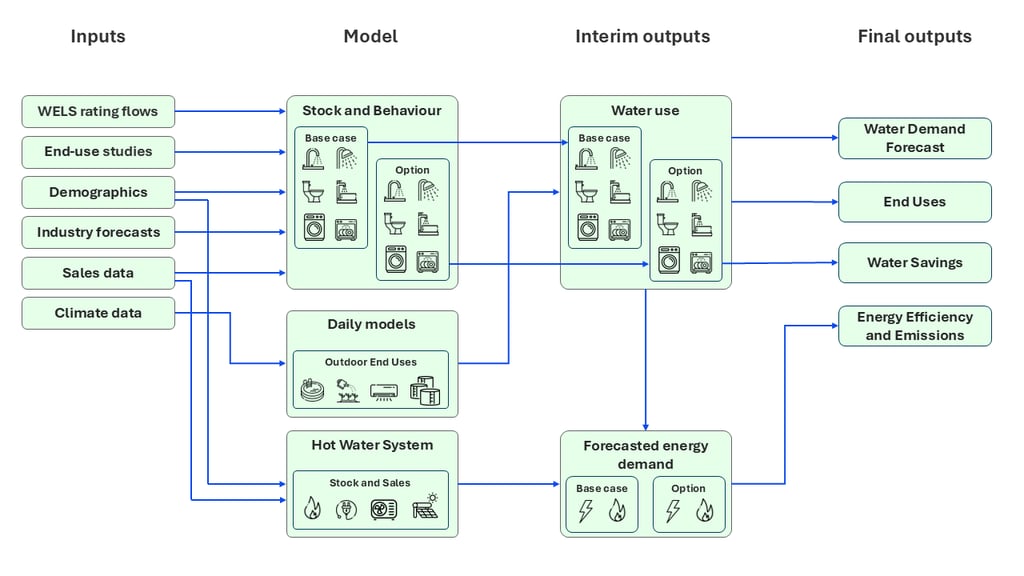
Key inputs such as utility billing data, population, dwelling counts, climate data, behavioural assumptions and non-residential customer information can all be tailored to each utility's unique service area. This enables utilities to use the same method while still reflecting the conditions in their own region.
From household habits to future scenarios
At its core, the DFO Model is a bottom-up, or end-use based, model. It estimates demand by simulating the activities, technologies and behaviours that drive residential water use.
Demand is split into indoor end uses (showers, baths, toilets, taps and whitegoods) and seasonally affected or outdoor end uses (evaporative air conditioning, pools, landscapes, and rain tanks).
Stock models sit behind the major indoor end uses. They track how efficient the fixtures and appliances installed in homes are, and how that changes over time. Older products are gradually replaced with newer, more water-efficient fixtures, and the stock models draw on sales data, ownership patterns and product lifespans to show this.
As a result, the DFO Model can directly test the effects of appliance efficiency standards and water efficiency programs at a detailed level.
Demographics drive the indoor calculations, while climate inputs such as temperature, evaporation, rainfall and evapotranspiration drive the outdoor components.
Indoor and outdoor demand are then combined to produce both climate-dependent and climate-independent forecasts.
Planning with a confidence range
A new feature of the model is its uncertainty component. It builds on a collaborative project with the UTS Mathematics Department. Rather than relying on simulation methods, the model uses distribution arithmetic to calculate uncertainty, so results update in real time.
This gives planners a confidence range around each forecast instead of a single estimate, so they can plan for the range of demand that could realistically occur.
Driving smarter planning decisions
The model can also be used for options analysis. Utilities can test how different demand management, supply augmentation and policy scenarios might affect residential demand. Planners can then compare alternative pathways, weigh up trade-offs and identify strategies that support long-term water security under a range of future conditions.
The model maps and analyses water use across single residential, multi-residential, commercial, industrial and institutional customers. It brings together multiple data sources in a single framework that can be adapted to local conditions, giving utilities a flexible, practical, evidence-based tool to help better understand and manage their water services.
Researchers
Research Principal, DVC (Research)
Research Assistant, DVC (Research)
Research Consultant, DVC (Research)

Program Lead - Water Futures, DVC (Research)

Taskforce for Nature-related Financial Disclosures (TNFD)
First Sentier MUFG Sustainable Investment Institute’s report, authored by UTS assesses the state of nature-related reporting against the TNFD’s 14 Core...

Closing policy gaps in the circular economy for clothing in Australia
Helping close policy gaps and accelerate Australia’s transition to a circular, sustainable clothing system.
Bringing their own power? Options for data centres and renewable energy
Australia is experiencing a wave of investment in data centres. The emergence of data centres arrives at a pivotal moment in Australia’s energy transition. The...
Primary Exploration, Mining and Metal Supply Scenario (PEMMSS)
The energy transition is driving demand for many mineral commodities, but where will this mineral supply come from?
Taskforce for Nature-related Financial Disclosures (TNFD)
First Sentier MUFG Sustainable Investment Institute’s report, authored by UTS assesses the state of nature-related reporting against the TNFD’s 14 Core...
Closing policy gaps in the circular economy for clothing in Australia
Helping close policy gaps and accelerate Australia’s transition to a circular, sustainable clothing system.
Bringing their own power? Options for data centres and renewable energy
Australia is experiencing a wave of investment in data centres. The emergence of data centres arrives at a pivotal moment in Australia’s energy transition. The...
Primary Exploration, Mining and Metal Supply Scenario (PEMMSS)
The energy transition is driving demand for many mineral commodities, but where will this mineral supply come from?