

Our approach is centred on people, and framed by outcomes and impact.
Download the UTS Research Strategy (pdf, 503kb)
It takes our focus on the excellence of our academic inputs and outputs, and connects them with the tools of knowledge exchange and research translation.
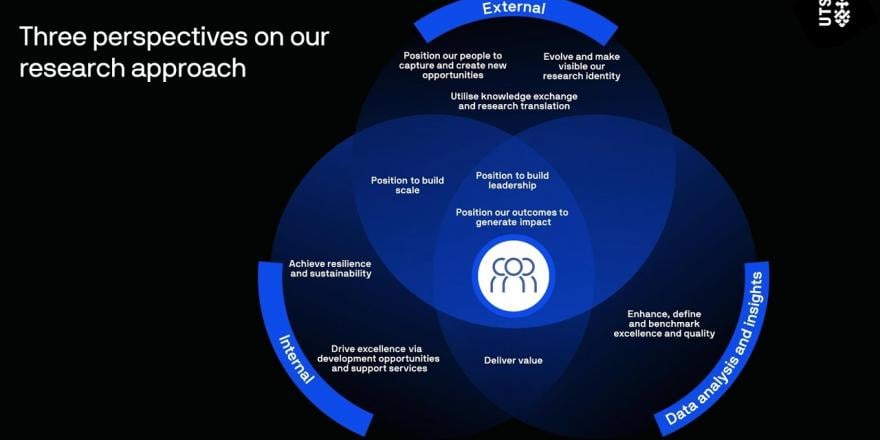
Our people-centred approach is framed from three different perspectives—external, data and analysis, and internal.
Our goals
uts-research-strategy D a t a a n a l y s a n d s h t s i s n i g i I n t e r n a l E x t e r n a l A c hi e v e r e silience and sustainability Dr i v e e x cel l ence v ia d e v e l opment opportuniti e s and support ser v ic e s Enhanc e , d e fine and ben c hmark e x cel l ence and qu a lity Utilise know l ed g e e x c han g e and r e s e a r c h t r ansl a tion E v o lv e and ma k e v isib l e our r e s e a r c h i dentity P osition our peop l e to captu r e and c r e a te new opportuniti e s P osition to bui l d l e a de r ship P osition our outcom e s to g ene r a te imp a ct P osition to bui l d sc a l e Del i v er v a lueOur focus areas
External
Our focus will be on the following three areas:
- The national and international academy
- Our partnerships, networks and collaborations with industry, government, not-for-profit organisations and key stakeholder communities
- The creation of national and global social benefit
Data analysis and insights
The analysis undertaken and the insights gained will be used to:
- Support the scholarly endeavour
- Make our researchers and graduate research students and our capabilities, both internally and externally more visible through our use of better profiling
- Create and strengthen our connectedness—networks, teams and collaborations (trans/multidisciplinary)
- Provision deeper, evidence-based understanding and better decision-making
Internal
Our focus on the following will allow us to support our individuals and the university to enhance our culture of excellence:
- Professional and career development (motivation, aspiration and inspiration)
- Research environment—support services, systems and processes, infrastructure (physical and digital), and institutional, sector and research data
- Connectedness—networks, teams, collaborations
- Distinctiveness (reputation and leadership)—focus areas, critical mass and credibility, research characteristics
Next: High performing research culture
Previous: Eight characteristics of research at UTS