


- Posted on 28 Jun 2024
- Updated on 28 Jun 2024
- 4-minute read
When you can’t find the answers you’re seeking, work them out yourself like AFP Forensics Officer and Master’s by Research graduate Matthew Bolton.
Can bullets be identified after being in a decomposed body?
It might not be a question that many of us ask, but after years working with firearms in the Australian Defence Force, NSW Police and Australian Federal Police (AFP), it’s safe to say that the questions Matthew asks may be very different to the general population.
And, he has a lot of them.
A career’s worth of questions
“The majority of the questions that I've had throughout my career have all come out of case work,” Matthew reflects.
“When I was at NSW Police I did more field-based work, so I attended crime scenes where people have been killed and the post-mortems that follow on from the scene. A lot of questions would be raised by the detectives or the pathologists, and some of which I didn't know the answer to, and couldn't find the answer anywhere.”
When UTS invited Matthew and his AFP colleagues for a tour of its unique body donation facility dedicated to the study of forensic taphonomy (the study of what happens to a human body after death), he decided to satisfy his curiosity.
“As we were wandering around, I was just thinking of a thousand ideas. So, I approached UTS to ask if I could undertake this project.”
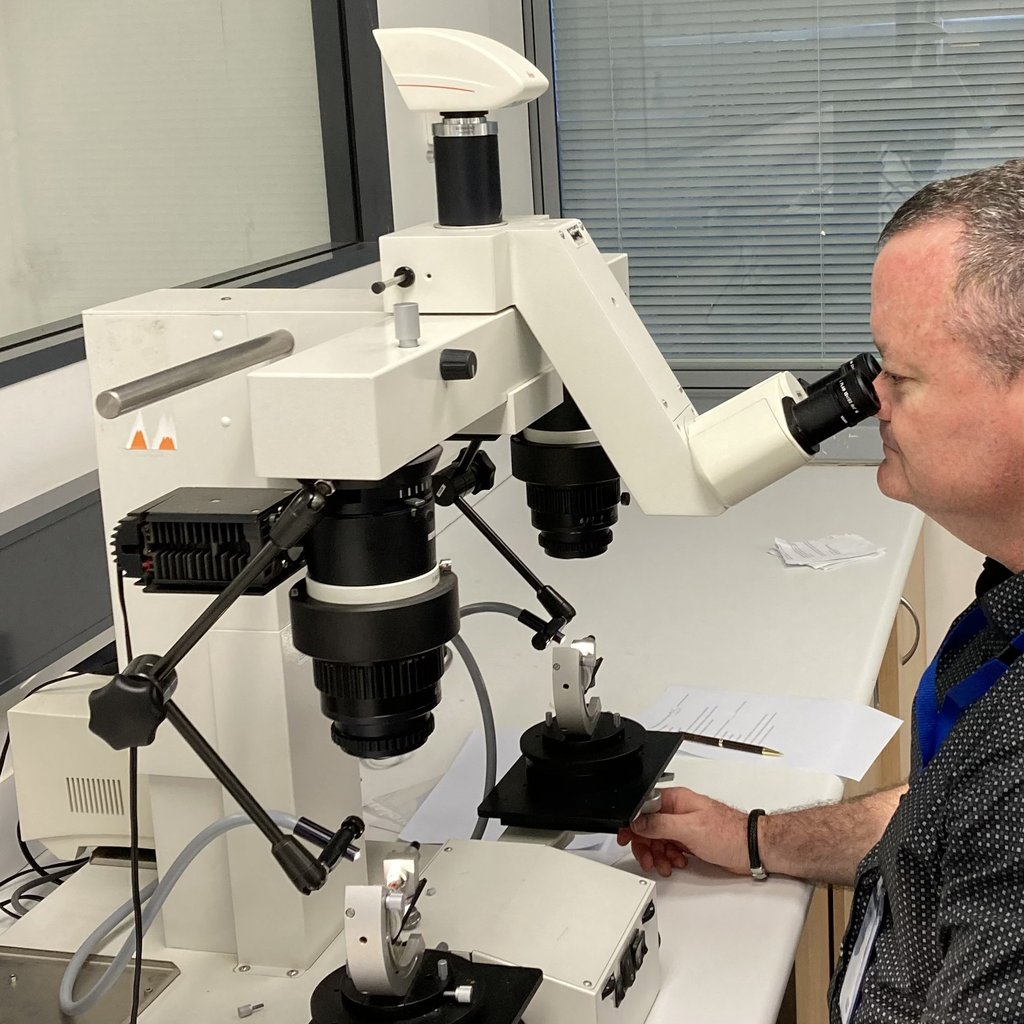
“I was interested in seeing if a bullet is subjected to decomposition. Does it corrode the bullet? At what point can you no longer identify the bullet?”
Matthew Bolton
Day-to-day Matthew works for a section of the AFP that helps the Australian Border Force to identify and classify firearms. His training for this role – which took over three years of study, written exams, practical assessments and a panel assessment – has deemed him to be a firearms expert by the National Institute of Forensic Science.
He’s one of fewer than 30 experts in Australia who have the credibility to classify firearms and toolmarks – the unique marks left on bullets when they’re shot from a gun.
“As the bullet travels down the barrel of the firearm, scratch marks, called striae, are made on the bullet. Each barrel leaves its own individual marks that we can identify,” Matthew explains.
With this knowledge, Matthew can identify which gun fired the bullet, which can significantly aid an investigation.
“I match the gun to the bullet. Then it’s up to the detectives to put that gun in someone’s hands.”
Answerless questions are answered
While at UTS’s facility Matthew started to wonder what would happen to the bullet, and its identifiable marks, once a body had decomposed.
“I was interested in seeing if a bullet is subjected to decomposition. Does it corrode the bullet? At what point can you no longer identify the bullet?”
Leveraging his network of firearm expert colleagues around Australia in a blind test, they were consistently able to microscopically identify the bullet with the firearm for up to three weeks after it was inserted in winter, and only three days in summer.
These results can help to provide detectives with the potential time the person may have died.
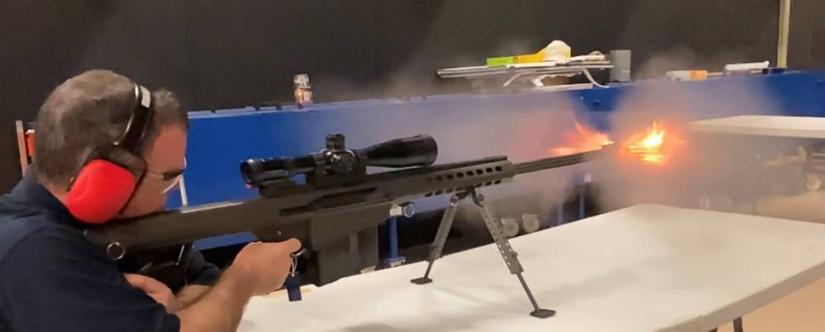
Firearms expert Matthew Bolton uses his unique blend of firearms and forensics knowledge to answer questions he’s had throughout his career.
Following curiosity to more knowledge
Concentrating on only one project was difficult for Matthew when there were many issues that need to be addressed in the discipline.
“I probably should get another hobby, but I just find there's so many questions that come up!”
With the support and resources of UTS, he also took on some mini projects that satisfied other questions that previously had no answers:
“I remember a pathologist once held up a portion of vertebrae with a bullet in it and asked how long they can keep it in the chemicals to soften the bone before the bullet is ruined?”
So, he used the same chemicals to corrode the bullet in a lab and assessed the damage.
Another time he ran a controlled experiment in the bush:
“Detectives thought that a suspect had test fired a firearm in the bush somewhere, and they located the fired cartridge cases that were ejected from the gun after firing. They wanted to know how long they’d been in the bush.”
While he’s wrapped up his main research, Matthew’s continuing work at the AFP means there’ll be no shortage of questions that need answering. As the AFP cracks down on 3D printing components that can be used to produce weapons, he’s looking at whether the marks left by 3D printers on the components it produces can be traced back to the specific printer.
“Once you're within the firearms field, there's actually so many different areas that you can investigate or research further,” Matthew reflects.

Webpage
Building a research legacy inside elite sport
Since 2017, the University of Technology Sydney (UTS) and the Oklahoma City Thunder have worked together to better understand what drives performance,...

Webpage
MekongELEVATE Research Partnership
MekongElevate is a four-year, multi-country initiative under the Mekong–Australia Partnership that seeks to strengthen the climate resilience of marginalised...
Webpage
Bioengineering Protein Nanocages into Multi-target Vaccines for Alzheimer’s Disease
Alzheimer's disease (AD) is characterised by the clumping of abnormal proteins in the brain, which increases over time and leads to worsening cognitive...
Webpage
Biotech start-up takes leap to regenerate Alzheimer’s damage
Australian biotechnology start-up Skin2Neuron found the perfect scientific and manufacturing partner to help their breakthrough cell-based treatment take root.
Webpage
Building a research legacy inside elite sport
Since 2017, the University of Technology Sydney (UTS) and the Oklahoma City Thunder have worked together to better understand what drives performance,...
Webpage
MekongELEVATE Research Partnership
MekongElevate is a four-year, multi-country initiative under the Mekong–Australia Partnership that seeks to strengthen the climate resilience of marginalised...
Webpage
Bioengineering Protein Nanocages into Multi-target Vaccines for Alzheimer’s Disease
Alzheimer's disease (AD) is characterised by the clumping of abnormal proteins in the brain, which increases over time and leads to worsening cognitive...
Webpage
Biotech start-up takes leap to regenerate Alzheimer’s damage
Australian biotechnology start-up Skin2Neuron found the perfect scientific and manufacturing partner to help their breakthrough cell-based treatment take root.