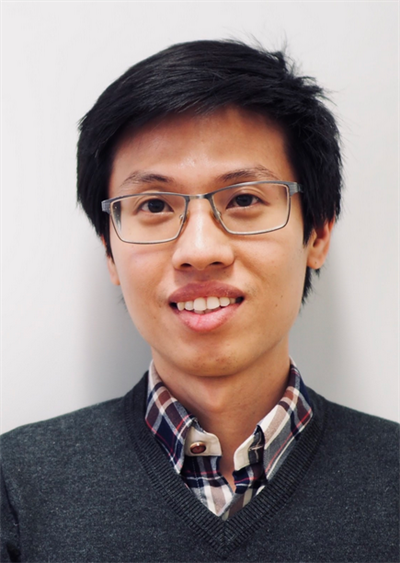
Dr Thinh Le from the FEIT Centre for Quantum Information and Software has been recognised for his outstanding work through the receipt of a prestigious ARC Future Fellowship.

Dr Le has secured $1,006,904 in ARC funding for his four-year project, ARC FT260100893: The periodic table of quantum correlations and applications, which will run from 2026 to 2030.

Employing techniques from algebraic geometry and nonlinear optimisation the research aims to develop the periodic table for quantum correlations and its applications in quantum computation and quantum communication. This work represents a paradigm shift in how we think, organise, teach and ultimately utilise quantum correlations.

Expected outcomes of this project are the development of a new conceptual framework to classify quantum correlations, enabling efficient and optimal protocols for quantum communication and quantum computing. Completing this project will provide significant cost-savings in the future design and implementation of quantum technologies, and a comprehensive battery of tests to assist the discovery and development of further theories of nature beyond quantum theory.

Quantum theory has led to groundbreaking technologies such as semiconductor electronics, solid-state lasers, magnetic resonance imaging and the global positioning system. The second quantum revolution promises to transform computing and communications in ways that can inform new drug discoveries and safeguard our critical cyber infrastructure. This project directly contributes to Australia's cybersecurity and national quantum strategy by addressing a key theoretical and technical obstacle providing a new conceptual and classification framework for quantum correlations in terms of their utility in various applications. These advances will translate into more efficient and precise control of quantum systems, leading to the creation of the next generation of information processing technologies.

Congratulations, Dr Le on this outstanding achievement which seeks to advance the frontiers of quantum research.


The UTS Centre for Quantum Software and Information

QSI is a world-premiere institution for quantum information and software research.

About Dr Thinh Le

I am a postdoctoral research associate at the Centre for Quantum Software and Information. My research is broadly quantum information science with focus on bridging the gap between theory and implementation. Currently, I am investigating the design and implementation of quantum computing devices: i) quantum error correction and fault-tolerant, ii) device-independent quantum tomography and characterization, and iii) quantum software stack.

Thinh Le

Postdoctoral Research Fellow, Faculty of Engineering & Information Technology

QSI - Centre for Quantum Software and Information - Research Centre Core

Share

Written by

Simon Devitt

Research Director, Faculty of Engineering & Information Technology

Related news

News

QSI PhD Student Chuanqi Zhang receives Best Student Paper award at ACNS 2026

The winning paper "(Partially) Blind Signatures from Cryptographic Group Actions” addresses the topic of post-quantum cryptography, and is a joint publication...

News

QSI Strengthens Australia–Finland Strategic Research Partnership in Future Communication Technologies

QSI joins international alliance, leveraging quantum expertise to drive innovation.

News

Scientists reveal it is possible to beam up quantum signals

New research shows it it feasible to send quantum signals from Earth to a satellite, paving the way for stronger quantum communication networks.

News

QSI Researchers Promote UTS Quantum Education at Quantum Future Talent: Open Day & Careers Fair

They highlighted the university’s quantum courses and research opportunities to students and industry.