A specialist small business bank, Judo Bank, recently flagged three business loans had turned bad and the market reaction was swift.

The shares lost 40% of their market value in a day as investors worried about the health of lending to the small business sector.

Small businesses have often reported challenges in getting access to finance, and in recent years have increasingly turned to non-bank lenders or specialist providers such as Judo. It’s not unusual for a small business owner to have to pledge a major asset, such as the family home, as collateral against a business loan.

In a report on small business, the Reserve Bank of Australia found the biggest obstacles to obtaining finance were

  • strict lending criteria
  • collateral requirements and
  • borrowing costs.

Yet in many other advanced economies, lending to support small business is not left up to the private sector. Governments are also involved. So, what do these alternative options look like, and what can Australia learn from overseas?

Small businesses are big employers

Small businesses employ around 42% of the private-sector workforce or 5.4 million people, and account for around 97% of all Australian businesses.

So when small businesses have trouble accessing finance, they invest less, hire fewer people and are less able to grow. That matters not only for entrepreneurs but for productivity across the economy.

Over the past five years, the value of Australia’s housing loans grew by around $650 billion.

Yet lending to small businesses (loan sizes less than $1.5 million) grew by just $58 billion — around one-tenth of the expansion in lending to housing.

About 50% of all small business loans are backed by residential property. Another 45% are secured by other forms of collateral, and fewer than 5% of loans are unsecured.

Meanwhile, non-bank lenders have nearly doubled their share of smaller business lending since 2019, reaching around 27% in 2025, as businesses turn to alternative sources of finance.
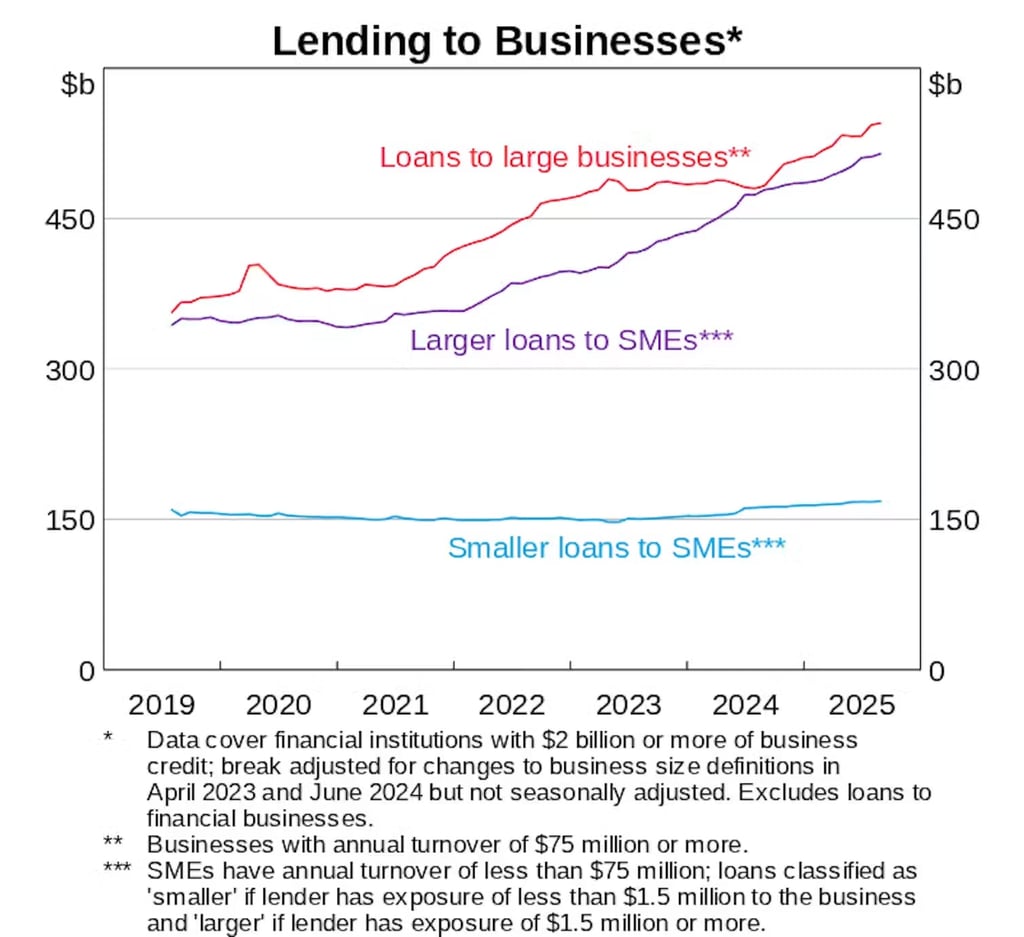
Chart showing lending to small and big business
Source: APRA, Reserve Bank of Australia.

Lending to small business is different

Lending to a small business is very different from lending to someone buying a home. If a homeowner can’t repay a loan, the bank can usually recover its money by selling the property.

A business is different. Its success depends on customers, sales, management and the state of the economy, and all of that can change quickly. So banks fall back on what they can count on. They can put a number on a house and know how to sell it if things go wrong. A business doesn’t give them that same certainty.

Many countries have concluded that leaving banks to bear all the risk can discourage lending, particularly during periods of economic uncertainty.

Where the government steps in

Governments in countries such as the United Kingdom, Germany and France have established permanent institutions that share part of that risk.

The United States relies on the Small Business Administration to guarantee a part of eligible business loans, up to US$5 million. Research found these guarantees expanded access to credit for small businesses that otherwise struggled to obtain conventional bank finance.

The United Kingdom’s economic development bank, the British Business Bank, supports lenders through government-backed guarantees and lower-cost funding in financial markets. A review found the guarantee enabled lending that 51% of borrowers otherwise would not have received.

Germany’s state-owned investment bank KfW lends to business alongside commercial banks to share the risk. France’s government-owned public investment bank, Bpifrance provides loan guarantees, making it easier for small businesses to borrow from banks.

An OECD review found that studies from countries including France and Italy showed public credit guarantee schemes increased small business lending, while reducing collateral requirements.

Different countries have chosen different models, but they all start from the same idea: when some of the risk is shared, banks are more willing to lend to businesses that have strong prospects, but limited collateral.

The big four banks dominate

Australia’s system has evolved differently. Compared with many advanced economies, Australia has relatively limited public institutions dedicated to sharing small business lending risk across the financial system.

Instead, most of the risk remains with commercial banks and specialist lenders. Because they carry most of that risk, lenders naturally place greater emphasis on collateral, particularly residential property.

It’s one reason many Australian business owners still need to secure business loans against their homes, even when their businesses are profitable and growing.

It also helps explain the growing role of specialist and non-bank lenders in serving businesses that fall outside traditional bank lending criteria.

That makes it particularly difficult for renters, younger founders and newer arrivals, who often have little or no property to pledge. A good business isn’t always enough without an asset behind it.

The share market reaction to Judo Bank’s news was triggered by three troubled loans. But it also highlighted a broader question about Australia’s financial system.

Small business lending will always involve risk. The question isn’t whether that risk exists – it always will. The answer shapes which entrepreneurs get financial backing: not because they lack a good idea, but because they lack property to offer as security.

The question is whether Australia is backing its best businesses, or simply the ones that have homes as collateral.The Conversation

Share

Authored by: 

Vibhu Arya, PhD Researcher in Payments, UTS Business School

Wen Helena Li, Senior Lecturer, UTS Business School

The Conversation

This article is republished from The Conversation under a Creative Commons license. 

Read original article

News

Why new Houthi threats in the Red Sea could spell trouble for global oil prices and inflation

The "Gate of Tears" will live up to its name if Houthi rebels in Yemen make good on an announced maritime embargo on Saudi Arabian shipping.

News

Chinese companies are taking over the EV market. What’s behind their meteoric rise?

In response, Australia must strengthen standards around data security, vehicle safety and battery recycling.

News

Kids do feel the cold. So why won’t they wear a jumper?

When you say ‘but aren’t you cold?’ what are you really asking? Kids will answer how they feel now; parents are planning ahead.

News

I’ve been reading The Odyssey my whole life. Nolan’s film version is exhilarating – but not perfect

Is Christopher Nolan’s adaptation a definitive film version of Homer’s Odyssey? No, it isn’t. In fact, it can’t be.