


- Posted on 9 Jun 2026
- 5-minute read
By Wanning Sun
Considering the government seems keen to avoid public debate about AUKUS, this inquiry could test the existence of any remaining appetite for the embattled project.
share_windows This article appeared in Crikey on June 9 2026.
Asked to provide a response to Greens Senator David Shoebridge’s criticism of AUKUS on ABC’s Insiders over the long weekend, Anthony Albanese simply rehashed the mantra that AUKUS is “full-steam ahead”.
The phrase “full-steam ahead” evokes a ship already underway, cutting confidently through the water, even though much of the debate revolves around whether the ship can even be built, crewed, financed or delivered at all. In this sense, the slogan functions as a political incantation: say it often enough and sincerely enough, picture it vividly enough, and perhaps the submarines will eventually appear over the horizon. Call it wishful thinking or a conjuring trick.
One does not need to read Lacanian psychoanalysis to sense the repeated insistence that AUKUS is “full-steam ahead” may not be just an attempt to counter the practical headwinds in the submarine program. In fact, saying “full-steam ahead” too many times seems to betray a deeper anxiety about the perceived lack of strategic security. In other words, submarines are not just boats to be built, but also the objects of desire that could promise to address this sense of lack. We can even go further to say that the more uncertain the strategic environment appears, the more impossible absolute security becomes, and the more emotionally invested political actors may become in the symbolic objects.
To the government in power — including both the Coalition that signed the deal in the first place and Labor that inherited and now owns it — discussions about AUKUS need only involve relevant stakeholders, and that means the government itself, industry, the military and defence, and certain scientists. As for the public, the message is clear: trust us — we know what’s best for our country; we know what we’re doing, and all you need to know is that it’s going full-steam ahead.
Like tired parents who have to deal with endless questions from their over-inquisitive children, Labor tends to consider anyone who asks questions about AUKUS to be irritatingly obtuse about Australia’s national security threats, or pathetically naïve about China’s intentions, or political gadflies (like David Shoebridge) who strike them as simply hell-bent on being oppositional.
This is why the announcement of a public inquiry into AUKUS is a landmark moment in Australia’s politics. The inquiry could become the biggest headache the government has had to deal with so far, in spite of, or perhaps because of, the fact that it is not a parliamentary inquiry.
Given tax-paying individuals are footing the AUKUS bill, it stands to reason that we should be given a chance to have a say in how the government spends our money. Yet the public still does not have an official seat at the submarine table, and our views have systematically been considered inconsequential. This inquiry at least gives the public an unofficial, entirely crowd-funded seat.
Being able to make submissions to the inquiry as a member of the public means that everyone has a chance to present their own views on what is in the national interest, rather than leaving it to politicians, who mostly speak on behalf of them. This has the potential to challenge the legitimacy of political discourse, which so far has been hegemonic, as evidenced in Labor’s ruthless crackdown on internal dissent, and the unshakable bipartisanship on AUKUS despite the inevitable inter-party point-scoring squabbles.
For the first time, voices in the margins — peace groups, civil society groups, grassroots Labor, and multicultural communities including Chinese-Australians — could have a legitimate platform. While Labor can say that it doesn’t need strategic advice from The Greens, according to Pat Conroy, it would be politically suicidal for them to say, at least on a rhetorical level, that the government does not need to take advice from the public.
It is clear from the public inquiry’s broad terms of reference that, unlike a government-initiated inquiry, it has the potential to do far more than examine procurement timelines or the technical merits of nuclear-powered submarines. At its heart lies a series of deeper questions about Australia’s place in the world.
Is Australia fundamentally an Asia-Pacific nation whose future is tied to its region, or is it an old-world Anglo power whose strategic instincts continue to point towards London and Washington? Will a fleet of nuclear-powered submarines produce the hoped-for deterrent effect and protect Australia’s sea lanes and maritime trade routes? More fundamentally, where do the greatest risks to Australia’s security actually lie? Does the main threat come directly from China, or could Australia’s deepening strategic integration with the United States itself expose the country to dangers and conflicts that it might otherwise have avoided?
Unless a public inquiry is conducted, this entire array of questions surrounding AUKUS is likely to remain unanswered. So far, the assumptions motivating the pact have been presented to the public as common-sense nostrums whose validity is as logical as night follows day. In this sense, the significance of public submissions lies not simply in the arguments they make, but in their capacity to reveal that what has often been portrayed by the government as a national consensus is in fact a position sustained by a relatively narrow political and policy elite.
Public submissions also provide an opportunity to test the social licence of the AUKUS project itself. If large numbers of Australians use the inquiry to express concerns or present under-reported facts about cost, sovereignty, strategic risk, nuclear stewardship, or Australia’s relationship with China, it would become harder to maintain the claim that AUKUS enjoys broad and unquestioned public support. For a government wishing to avoid public debate about AUKUS, an informed public could be a dangerous thing.
Perhaps most importantly, public submissions can bring into view competing perspectives that have largely been marginalised in mainstream commentary. If effectively executed, the inquiry will not be merely a forum for evaluating a defence acquisition program; it will also be a site of narrative contestation over Australia’s national identity and its future. If enough of these alternative voices are heard, the inquiry could become a moment when Australians collectively realise that the emperor actually has no clothes.
The inquiry may not change the fate of AUKUS, but it may puncture the fantasy that has been conjured up and presented to Australians — the fantasy that anything that has bipartisan support (or tripartisan if we include One Nation) must be the best possible option for the nation.
Author

Deputy Director, Australian-China Relations Institute, DVC (International & Development)
News
Australia-China Weekly Brief: October 2026 issues
The Australia-China Weekly Brief by the Australia-China Relations Institute at the University of Technology Sydney (UTS:ACRI) tracks key developments in...
News
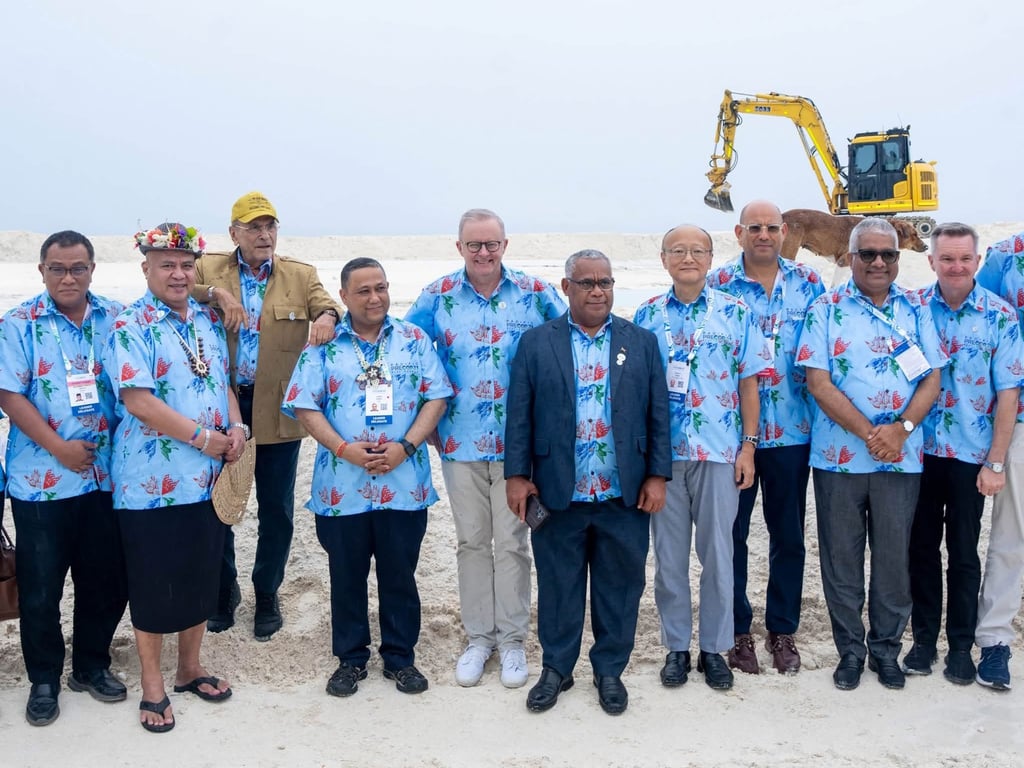
Whose security counts in the Pacific?
While climate-related spending gets criticised, billions forked out for security and strategic engagement gets framed as for the “national interest”.
News
Australia-China Weekly Brief: September 2026 issues
The Australia-China Weekly Brief by the Australia-China Relations Institute at the University of Technology Sydney (UTS:ACRI) tracks key developments in...
News
If we asked the Americans to leave, would they?
Canada is looking for ways to protect its independence from Washington. Australia has embedded itself so deeply in the US military system that it risks being...
News
Australia-China Weekly Brief: October 2026 issues
The Australia-China Weekly Brief by the Australia-China Relations Institute at the University of Technology Sydney (UTS:ACRI) tracks key developments in...
News
Whose security counts in the Pacific?
While climate-related spending gets criticised, billions forked out for security and strategic engagement gets framed as for the “national interest”.
News
Australia-China Weekly Brief: September 2026 issues
The Australia-China Weekly Brief by the Australia-China Relations Institute at the University of Technology Sydney (UTS:ACRI) tracks key developments in...
News
If we asked the Americans to leave, would they?
Canada is looking for ways to protect its independence from Washington. Australia has embedded itself so deeply in the US military system that it risks being...