


- Posted on 17 Apr 2026
Research led by the UTS Faculty of Engineering and Information Technology was showcased on the international stage this month, with the National Telecom Resilience Centre invited to present at the opening plenary of the European Emergency Number Association (EENA) Annual Conference 2026 in Riga, Latvia.
EENA is the leading global forum for organisations responsible for the design, operation and regulation of emergency‑calling systems, drawing approximately 700 delegates and more than 100 experts from over 50 countries. UTS was one of a small number of organisations invited to contribute to the opening plenary program, alongside international agencies including the European Space Agency.
This invitation reflects UTS’ role as a trusted, evidence-led authority in critical communications resilience, with research that is directly shaping policy, industry practice, and global standards.
The keynote address was delivered on Wednesday 15 April by Ms Clare Chapple, First Assistant Secretary of the Triple Zero Custodian Division at the Australian Department of Infrastructure, Transport, Regional Development, Communications, Sport and the Arts, and Chair of the National Telecom Resilience Centre (NTRC) Board.
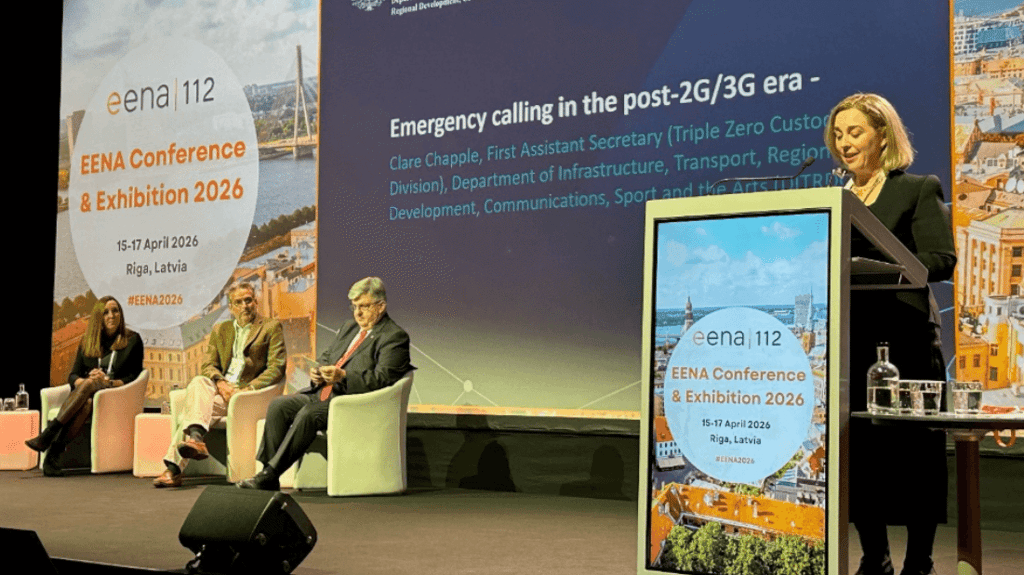
Ms Chapple was supported on stage by Professor Ray Owen, Director of the NTRC at UTS, with Ms Kathleen Silleri, Assistant Secretary for Consumer Safeguards, joining the session for questions from the international audience. Professor Peta Wyeth, Dean of the Faculty of Engineering and IT (FEIT), travelled with the UTS delegation to Riga.
Together, the delegation demonstrated how UTS is not only contributing research, but actively bridging government, industry, and academia to address national and global resilience challenges.
From national incident to global impact
The invitation to speak at EENA reflects a longer trajectory of work undertaken at FEIT following the 2023 national telecommunications outage, during which more than 2000 calls to Triple Zero failed to connect.
In response, UTS established the Controlled Test Facility – a world‑first, independent, operator‑neutral destructive testing environment in which handsets are tested under real network failure conditions.
Operating with the cooperation of Telstra, Optus and TPG, the Controlled Test Facility enables controlled testing that cannot be performed in live public networks.
The first testing campaign, completed in 2025, demonstrated that whether an emergency call succeeds during a deep network failure depends materially on the handset and its software, not solely on the network itself.
These findings have since prompted software updates from global device manufacturers, including Apple.
Apple’s iOS 26.2 software update in December 2025 introduced a targeted fix for iPhone 12 models to address a rare connection issue identified during specific network failure conditions.
Government investment enables next phase of NTRC research
In January 2026, the Australian Government awarded UTS up to $5.5 million to expand the NTRC research program, in addition to an initial $5.8 million committed in 2025. The expanded program extends the Centre’s work beyond identifying failure modes to addressing the challenge of system recovery, including:
- the interdependencies between electricity and telecommunications networks during major outages
- AI‑driven approaches to graceful degradation of mobile network services
- prioritisation of emergency calls via non‑terrestrial (low‑Earth‑orbit satellite) networks
- development of an end‑to‑end emergency‑call testbed at the UTS TechLab in Botany, co‑located with live Telstra, Optus and TPG production environments.
To support this expansion, the Centre is recruiting five post‑doctoral research fellows, three research engineers, and establishing a new undergraduate internship stream.

“Being invited to speak at the EENA annual conference reflects how far this work has travelled – from a national incident, to independent testing at UTS, and now into the global emergency‑communications conversation. It demonstrates that rigorous, evidence‑based research conducted within FEIT can directly influence how critical services operate worldwide.”
Industry Professor Ray Owen
Director, National Telecom Resilience Centre
Entering the international conversation
EENA 2026 marked a key moment in taking this body of work into the global emergency‑communications community. The evidence developed within FEIT is directly relevant to European network operators, device manufacturers and standards bodies, many of which are managing the same transition away from 2G and 3G technologies.
Discussions initiated in Riga, together with a bilateral meeting at the United Kingdom’s Office of Communications (Ofcom) in London, provide a foundation for shared testing protocols and comparable international evidence. These engagements will inform the Controlled Test Facility’s second major testing campaign later this year.
For FEIT, the journey from national incident to independent testing, to expanded research capability and international dissemination highlights the faculty’s growing role in strengthening the resilience of critical services on which public safety depends – in Australia and globally.

News
Schoolies starts this week – six things young people can get wrong about safety
While Schoolies can be great fun, it’s also a time of increased risk.

News
The Carbon Bubble Question: How Much Are Fossil-Fuel Companies Really at Risk?
New research challenges assumptions about the financial risks of the energy transition and offers important lessons for policymakers, companies and investors.
News
Rethinking wellbeing: Coaching for collective and ecological flourishing
A new approach to coaching looks beyond personal wellbeing to consider how collective and ecological flourishing can become part of what it means to thrive.

News
PERSPECTIVES | Garry Woodard: An appreciation
This article appeared in UTS:ACRI's Perspectives on November 16 2026. Perspectives is the commentary series of the Australia-China Relations Institute at the...
News
Schoolies starts this week – six things young people can get wrong about safety
While Schoolies can be great fun, it’s also a time of increased risk.
News
The Carbon Bubble Question: How Much Are Fossil-Fuel Companies Really at Risk?
New research challenges assumptions about the financial risks of the energy transition and offers important lessons for policymakers, companies and investors.
News
Rethinking wellbeing: Coaching for collective and ecological flourishing
A new approach to coaching looks beyond personal wellbeing to consider how collective and ecological flourishing can become part of what it means to thrive.
News
PERSPECTIVES | Garry Woodard: An appreciation
This article appeared in UTS:ACRI's Perspectives on November 16 2026. Perspectives is the commentary series of the Australia-China Relations Institute at the...