


- Posted on 16 Nov 2026
Positive psychology and positive organisational scholarship (POS) communities are broadening their focus from individual wellbeing to collective flourishing.
Traditional coaching and leadership development are often too narrowly focussed on the individual, and must evolve to address today’s social, organisational and environmental challenges.
These were the messages explored at the seventh annual webinar of the Australian Positive Organisational Scholarship Community of Practice (POS CoP), co-convened by UTS Business School’s Dr Rosemary Sainty and Positivity Institute Founder and Chief Executive Officer Dr Suzy Green.
The POS CoP represents more than 1000 academics and practitioners interested in fostering positive organisations.
Looking beyond the individual
Guest speaker Dr Peter Hawkins, Emeritus Professor of Leadership at Henley Business School, explored why traditional approaches to coaching and leadership development need to look beyond individual performance.
What we need is people who can coach not just individuals, but the connections between individuals; not just connections in teams but between teams, between divisions, between organisations, their stakeholders and the environment.
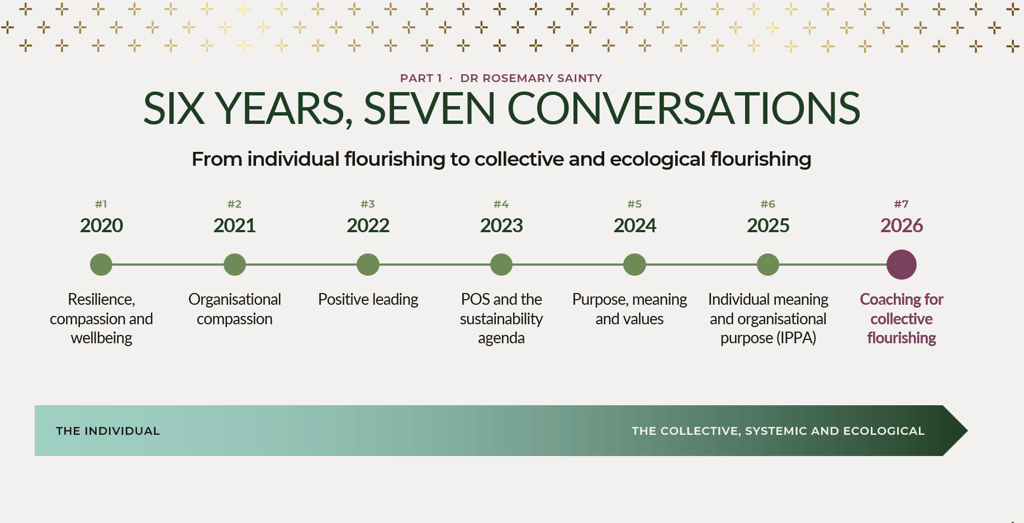
This represents the evolution of the POS CoP itself, from its early discussions on individual resilience and strengths, wellbeing at work (at the time of the pandemic), meaning and organisational purpose, to a regenerative approach, encompassing not only individuals and human contexts, but the living systems that sustain life.
For Dr Sainty, who teaches and researches organisational behaviour and sustainability at UTS, this represents an important convergence of positive psychology, positive organisational scholarship and environmental sustainability.
Rather than viewing wellbeing as something experienced in isolation, this approach asks us to consider how it is shaped by our relationships with other people, organisations, communities and the environment. The fundamental task for coaches, educators, leaders, and psychologists is supporting the movement from egocentric to eco-centric and life-centric awareness.
Coaching for a more connected future
Dr Suzy Green sees coaching as a practical way to turn these ideas into organisational change.
Drawing on her experience across positive psychology and coaching psychology, she has observed that coaching has moved more quickly towards relational and systems-informed approaches, while positive psychology has remained comparatively focused on the individual.
Central to her perspective is the importance of high-quality connections and adult development frameworks. Coaching is not simply a technique for individual development, but a relational practice that can foster connection, perspective-taking, the capacity to engage with complexity and systemic awareness, all of which contribute to wider flourishing.
Ultimately, the key message that emerges from Dr Hawkins’ book, Beauty in Leadership and Coaching, featured in the webinar, is that beauty lies in the echoing resonance of relationships, connections, and flow between people and systems.
As organisations navigate increasingly complex challenges, including the rapid development of artificial intelligence, the ability to understand these connections may become more important than ever.