


- Posted on 21 Nov 2025
- 3-minutes read
UTS is redefining what it means to be a civic institution – through collaboration, co-design, and community-led impact.
In the gardens, laneways, and community halls of inner-city Sydney, the University of Technology Sydney (UTS) is quietly reshaping what it means to be a good neighbour – and a truly civic university. This isn’t about charity or one-off extractive projects. It’s about a philosophy: universities as gateways to community.
At the UTS Centre for Social Justice & Inclusion (CSJI), this philosophy comes to life every day. We work closely with our neighbours in Pyrmont, Ultimo, Haymarket, and Glebe to help facilitate social good and change in society. Locals bring deep knowledge of what their communities need to thrive. UTS brings expertise, resources, and infrastructure to help turn those ideas into action.
Communities have lived experience and are full of expertise. Our role is simple: to uplift and support them. Through purposeful partnerships, research collaborations, and hands-on learning opportunities, CSJI connects students, academics, and community organisations to address complex social challenges together.
Why community engagement matters
Across Sydney’s inner-city neighbourhoods, UTS shows up differently. Where others might study communities from a distance, we walk alongside them – listening first, acting second, and building together.
One community partner put it best: ‘The difference is UTS is structured formally to engage with the community. When we meet and have workshops and work on projects, it’s a two-way exchange.’
This approach reflects a bigger idea: universities as public purpose institutions. It’s about using our expertise and infrastructure to amplify community strengths, not replace them. It’s about creating spaces where UTS students and staff work side by side with local leaders on issues that matter, including housing, sustainability, youth engagement, and social inclusion.
And it’s not just good for communities. It’s good for students, too. Today’s students want more than academic excellence – they want purpose. According to a recent QS survey, over 80% of students factor a university’s performance on social issues into their decision-making about where to study.

Students as changemakers: UTS SOUL Award
Through the SOUL Award, thousands of students have stepped beyond the classroom and into the community – volunteering, leading, and learning in ways that transform both themselves and the world around them.
So far in 2025, 2657 students enrolled, 383 graduated, and together they logged 24,322 hours of social impact action. The program also recently won the 2025 Engagement Australia Award for ‘Excellence in Community Engagement’.
‘Community-engaged learning programs like SOUL allow students to venture beyond their degree and into the community; to put the skills they learn in the classroom into practice,’ says Ruby Wawn, SOUL Program Lead.
For students like Joshua Chelashaw, the impact is personal. ‘SOUL has changed the way I see myself. There’s more to life than just a career. I can donate my skills and make meaningful change.’
And for Humna Khan, it’s about belonging. ‘SOUL gives me a sense of community within the university, and it connects me to the world outside. Even if you feel like you’re one person, the smallest gesture makes a difference.’
Partnerships in action: UTS Shopfront
Through UTS Shopfront, students collaborate with community organisations on real-world projects, bringing fresh ideas and professional skills to groups that often lack time or resources. In 2025, Shopfront worked with 114 organisations and 5500 students
One organisation was CPR Kids, a social enterprise teaching lifesaving first aid to parents and carers. UTS students redesigned their online course, audited their website for accessibility, and developed a digital marketing strategy to reach Gen Z parents.
Sarah Hunstead, Founding Director of CPR Kids, says the results speak for themselves: ‘We are already seeing the outcomes – more web traffic, more bookings, fewer drop-offs. The students really listened to our challenges and made such an impact.’
Innovation through collaboration: UTS Social Impact Lab
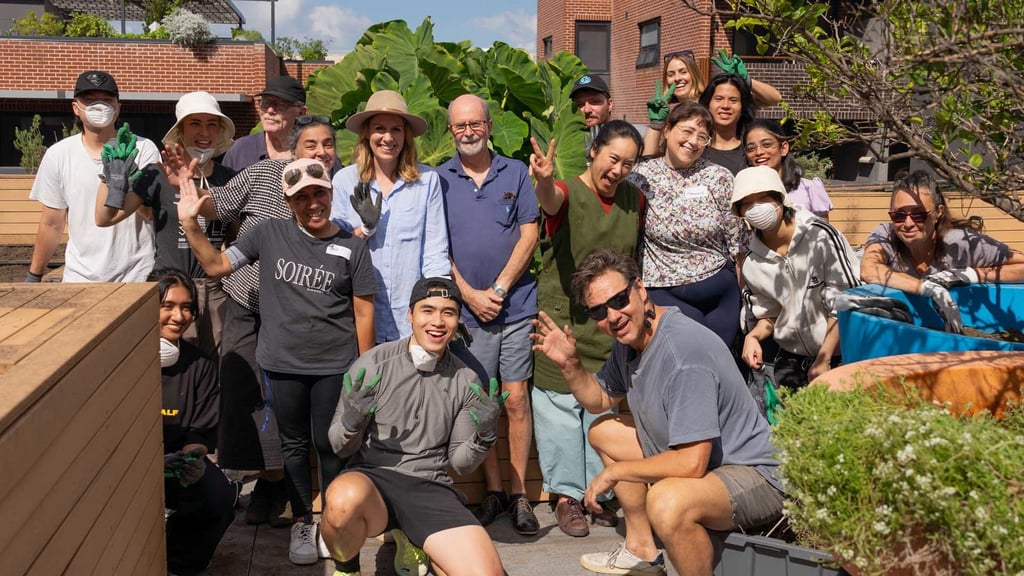
The UTS Social Impact Lab takes engagement deeper, working with local partners on place-based projects that strengthen community assets. In 2025, the Social Impact Lab collaborated with 80 community partners, 500 community members, 70 UTS staff and 40 students on initiatives spanning housing, sustainability, and capability development.
One standout project was Glebe Connections, a community newspaper co-created by UTS students and Glebe Youth Service. Journalism, creative writing, and design students staffed the newsroom to produce stories that amplify local voices and foster connection.
For students, the experience was transformative. ‘Research, interviewing, photography, writing, and editing skills were all applied. It was a great opportunity to experiment with style and learn about social issues firsthand,’ one student remarked.
Another project, Community-Led Sustainable Cities, explores the current and potential future states of neighbourhood sustainability – working alongside community members, UTS staff, and students to begin putting meaningful initiatives into action.
Sara Wilkinson, Professor of Sustainable Property, UTS School of Built Environment, has leant her expertise to one Community Partners Group.
‘Working with the team has been an enlightening experience. Hearing directly from community members has made our research richer and more meaningful. Together, we’re creating real-world learning opportunities for students and lasting positive change for communities.’ Sara said.
These initiatives are now being led by the community and support the UTS Climate Positive Plan, which extends beyond the walls of UTS and into the local precinct.
Looking ahead: a civic university in action
This is what a civic university looks like: one that treats the city as a classroom and community members as co-educators. But meaningful change takes time, trust, and consistency. Community partners are clear: they want UTS to stay, invest, and grow with them.
As UTS deepens its role as an anchor institution, the message is simple: when universities and communities grow together, they create something powerful – shared knowledge, shared ownership, and shared hope for the future.
Written by

Executive Manager, Community Engagement And Impact, Deputy Vice-Chancellor (Education and Students)

Research And Evaluation Manager, Deputy Vice-Chancellor (Education and Students)

Communications And Advocacy Officer, Deputy Vice-Chancellor (Education and Students)

News
Double win at national engagement awards
The UTS SOUL program and Dr Joshua Pate take out 2025 Engagement Australia Excellence Awards.

News
Tell us what we want
Centre for Media Transition newsletter - Tell us what we want, what we really really want | Issue 18

News
Embedded links
Michael Davis looks at the recently announced partnership between USA Today Co. and Palantir, whose reputation has the company’s reporters up in arms.

News
A'muse'ing
Harry Craigie looks at Meta’s newly released agentic AI system Muse, which like many AI products, gives us plenty of what we want, but likely at the price of...
News
Double win at national engagement awards
The UTS SOUL program and Dr Joshua Pate take out 2025 Engagement Australia Excellence Awards.
News
Tell us what we want
Centre for Media Transition newsletter - Tell us what we want, what we really really want | Issue 18
News
Embedded links
Michael Davis looks at the recently announced partnership between USA Today Co. and Palantir, whose reputation has the company’s reporters up in arms.
News
A'muse'ing
Harry Craigie looks at Meta’s newly released agentic AI system Muse, which like many AI products, gives us plenty of what we want, but likely at the price of...