


- Posted on 5 Aug 2025
This article appeared in UTS:ACRI's Perspectives on August 5 2025. Perspectives is the commentary series of the Australia-China Relations Institute at the University of Technology Sydney (UTS:ACRI), offering research-informed viewpoints on developments and debates in the Australia-China relationship.
In July 2025, Australian Prime Minister Anthony Albanese made his second official visit to the People’s Republic of China (PRC), meeting with the country’s three most senior leaders, President Xi Jinping, Premier Li Qiang and National People’s Congress Chairman Zhao Leji. Cooperation on clean technologies featured prominently on the agenda, reflecting a shared recognition that decarbonisation is both an environmental necessity and an opportunity for domestic industry.
However, despite the positive tone around potential collaboration in clean technologies, the disconnect between diplomatic ambition and investment reality is significant.
A recent KPMG study found that the total stock of PRC investment in Australia fell from US$16.2 billion in 2006 to a historic low of US$585 million in 2021. Despite the increase from US$613 million in 2023 to US$862 million 2024, 2024 had the third-lowest investment value and number of transactions since 2006, only higher than 2021 and 2023 (Figure 1). Moreover, according to the Australian Bureau of Statistics, the stock of PRC investment in Australia is now 20 percent less than three years ago. In other words, not only are inflows falling as per the KPMG study, but PRC capital in Australia is heading for the exits.
Investment proposals from PRC firms increasingly encounter protracted reviews by Australia’s Foreign Investment Review Board (FIRB), especially in sectors deemed strategically sensitive, such as energy and critical infrastructure. These regulatory hurdles have stalled numerous clean energy proposals, while anecdotal evidence suggests that some PRC investors now avoid the Australian market entirely, discouraged by perceived political and procedural risk.
Figure 1.
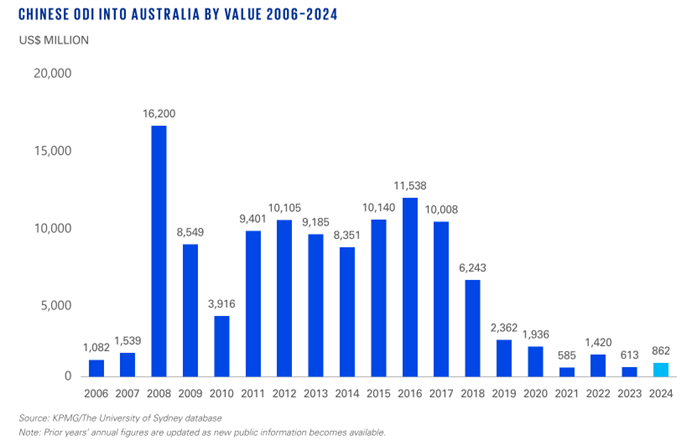
In parallel, while underpinned by different drivers, Australia’s direct investment in the PRC has also fallen, decreasing every year since 2019. The entire stock of Australian investment in the PRC is now down to $1.6 billion from a peak of $15.5 billion.
This retreat from cross-border investment illustrates the gap between high-level rhetoric affirming the importance of climate collaboration and the persistent policy and structural barriers that hinder progress on this front. If Australia is to secure a meaningful role in the global clean energy economy, and if the PRC is to diversify its green energy supply chains with secure, high-quality inputs, this must be addressed.
From a purely economic perspective, Australia and the PRC are natural partners in the low-carbon transition. Australia is among the world’s leading producers of critical minerals, while the PRC has a dominant position in processing and refining, manufacturing, for example, over 80 percent of the globe’s solar panels and roughly 76 percent of lithium-ion batteries. Combining Australia’s upstream strengths with the PRC’s mid- and downstream capabilities could yield a competitive and resilient supply chain.
Yet geopolitical tensions, tightened foreign investment controls and regulatory complexity in both nations have inhibited this cooperation.
For Australia, domestic challenges compound these barriers. Australia’s gross domestic expenditure on R&D stands at around 1.7 percent of GDP, well below the OECD average of 2.7 percent. Business R&D intensity has declined to a two-decade low, and 74 percent of business R&D is concentrated in just three sectors (professional services, finance and manufacturing), limiting Australia’s ability to diversify into nascent high-tech industries.
The Australian government’s 2024 Future Made in Australia policy correctly identifies the need to rebuild national industrial capability. However, without a clear strategy to connect Australia’s strengths to regional value chains, the policy risks becoming an unfocused exercise in onshore job creation, rather than positioning the country for global competitiveness.
Australia’s high labour costs, relatively small domestic market and geographic remoteness mean that large-scale manufacturing is unlikely to be a comparative advantage. Focusing on key component manufacturing, economic ownership, design, intellectual property (IP), financing and governance is more viable than relying on domestic assembly.
Toyota provides a useful analogy. Although most Japanese vehicles sold in Australia are manufactured in Thailand, their value and identity remain distinctly Japanese. The critical elements, such as quality standards and corporate governance, flow from Japan as opposed to the factory’s location.
Australia could adopt a similar model in clean energy industrial development. For example, it could co-own clean energy production facilities in Southeast Asia and partner with PRC firms on key technologies while adhering to Australian standards of corporate governance and safety. This approach would also benefit the PRC, whose investments into overseas projects have faced allegations of poor governance and environmental performance. Taking majority stakes in such ventures would allow Australia to retain control over IP and investment decisions, enabling economic participation without the constraints of full onshore production. By the same token, while majority ownership can enhance governance influence, meaningful oversight can also be exercised through other means such as contractual arrangements and technical expertise.
Full supply chain self-sufficiency, at least in manufacturing, is neither feasible nor desirable for a medium-sized and geographically remote economy like Australia. Instead, applying the concept of sovereignty bargaining in cross-border power connectivity suggests that countries achieve greater strategic stability when they are mutually dependent within shared value chains. Hence, Australia does not need to control every step from mine to module to recycling plant. It can specialise in high-value segments, such as battery management software, cyber-secure grid control systems or carbon-accounting platforms, and embed these into integrated regional production networks. Many of these segments are not constrained by geography, meaning Australia’s distance from major supply chains does not pose a significant disadvantage.
Electric vehicles (EVs) exemplify how value in the decarbonised economy is shifting from hardware to software-enabled systems. Advanced software rather than traditional hardware increasingly drive much of their value. Indeed, software and electronics could account for up to 50 percent of a vehicle’s value by 2030.
By embracing this shift, Australia can leverage its digital strengths to contribute critical software modules to a global EV production network, regardless of where the steel and battery cells are assembled. A partnership could pair Australian software with PRC hardware and assembly in Southeast Asia, allowing each party to play to its comparative advantage.
Clean energy cooperation with the PRC does not require full alignment of interests, but it does demand mutually reinforcing frameworks.
To seize the opportunity of the net-zero transition, Australia should pursue a framework which integrates these three approaches:
- Australian-made: targeting areas where domestic production is economically feasible, or in a few cases, economically marginal but essential for long-term resilience;
- Australian-owned: ensuring meaningful stakes and governance control in offshore ventures; and
- Australian-programmed: leading in software-defined energy systems and the intelligent control layers of clean technology systems.
Together, these approaches offer a way to align Australia’s industrial policy with geoeconomic and geopolitical realities, facilitate targeted clean energy cooperation with the PRC and improve Australia’s positioning within regional clean energy value chains.
AUTHOR

Research Principal, DVC (International & Development)
News
Australia-China Weekly Brief: October 2026 issues
The Australia-China Weekly Brief by the Australia-China Relations Institute at the University of Technology Sydney (UTS:ACRI) tracks key developments in...
News
The struggle over what China wants
China expertise is itself a field of epistemic struggle, shaped by competing convictions, dispositions and geopolitical perspectives. Doshi’s critique of Kang,...
News
Australia should turn critical minerals leverage into industrial capability
Australia’s Syerston Scandium Project is a test of whether critical minerals cooperation can make Australia not merely a supplier, but a critical capability...

News
PERSPECTIVES | Can Australia and China talk sensibly about AI Safety?
Australia will attend the APEC Economic Leaders’ Meeting in Shenzhen on November 18-19 2026 amid questions about the extent to which the two countries can, or...
News
Australia-China Weekly Brief: October 2026 issues
The Australia-China Weekly Brief by the Australia-China Relations Institute at the University of Technology Sydney (UTS:ACRI) tracks key developments in...
News
The struggle over what China wants
China expertise is itself a field of epistemic struggle, shaped by competing convictions, dispositions and geopolitical perspectives. Doshi’s critique of Kang,...
News
Australia should turn critical minerals leverage into industrial capability
Australia’s Syerston Scandium Project is a test of whether critical minerals cooperation can make Australia not merely a supplier, but a critical capability...
News
PERSPECTIVES | Can Australia and China talk sensibly about AI Safety?
Australia will attend the APEC Economic Leaders’ Meeting in Shenzhen on November 18-19 2026 amid questions about the extent to which the two countries can, or...