


Frederikke (Freddy) Thorup spent years wondering why she didn’t fit in. As a neurodivergent student disability advocate at UTS, she’s finally found her place.
If you met Bachelor of Business student Freddy Thorup today, you’d be hard-pressed to picture the struggles that defined her just a few short years ago. Freddy is bright, chatty and brimming with confidence, fully at home on the UTS campus. But her life hasn’t always looked like this.
Growing up, she often felt like she had to work extra hard to fit in. To avoid standing out, she spent her high school years on the fringes, carefully observing the people around her and trying to adapt her behaviour to match.
By the time she arrived at the National Art School to study fine arts, she was exhausted and lonely. She decided to take a different tack: instead of trying to disappear into the background, Freddy reimagined herself entirely.
She embraced bold fashion, dramatic makeup and a larger-than-life creative persona.
Suddenly, she was popular, surrounded by the friends she’d always longed for. But constantly performing a version of herself came at a cost. Before long, she was severely burnt out and couldn't understand why.
It wasn’t until she sought therapy that everything began to make sense.
After art school, I finally got an autism diagnosis. Before that moment, I wasn’t aware that I was neurodivergent.
Her diagnosis taught her some big lessons. Among them: that trying to disguise her true self was a form of masking, a way of fitting into a world that hadn't been designed with neurodivergent people in mind, and that caring for herself meant learning how her brain worked and advocating for what she needed to thrive.
Out of her shell, into the world
Freddy started at UTS just a few months after her diagnosis. Having shed her art student persona, she was ready to figure out who Freddy Thorup really was.
Her first step was contacting the UTS Accessibility Service, which provides support for students living with disability, chronic illness or ill-mental health. Reaching out for help felt strange after years of going it alone, but Freddy was determined not to repeat the patterns that had previously brought her undone.
“I wanted that help that I didn’t get the first time around so I could make sure I didn’t burn out again,” she says.
Support came from all directions. A UTS Accessibility consultant worked with Freddy to develop a personalised support plan, including accommodations that have allowed her to excel in her degree. At the Business School, an encouraging teaching team made her feel that she had an important perspective to offer.
As her first semester progressed, Freddy built a structured routine and settled into her degree. She studied in quiet spaces, called on her accommodations, which included additional time to complete exams and support communicating with her tutors, and started getting to know the students in her classes.
For the first time in a long time, she was finally on solid ground. But rather than sit back and enjoy the moment, she wanted to do more: to spread the word among other students with disability that they could find their place at university, too.
When an invitation came to join the UTS Student Learning Advisory Committee (SLAC), a student-led group that uses lived experience to inform and shape accessible university programs and initiatives, Freddy was off and running.
“Having that safety net of UTS support gave me the confidence to put my hand up,” she says.
“I know if things go south, it’ll be there.”
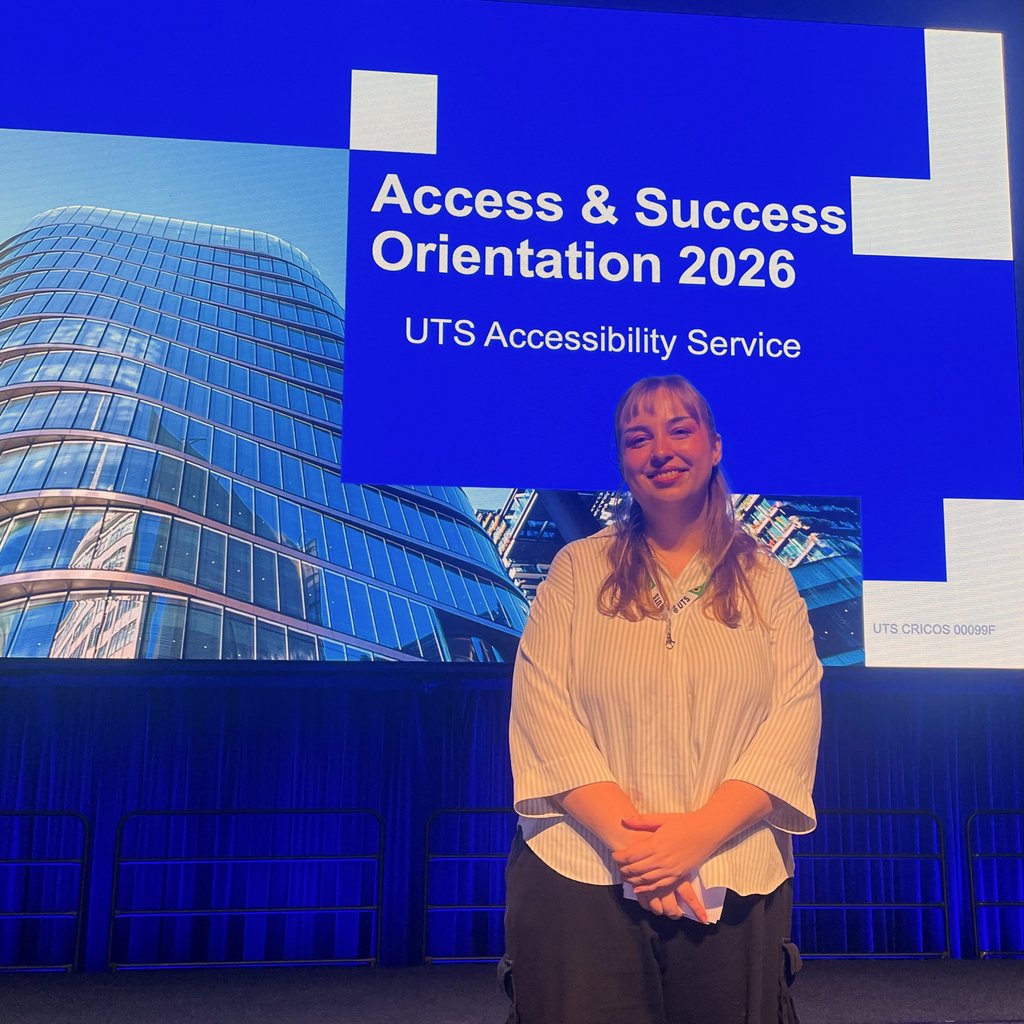
From burnout to breakthrough
Over the last three years, Freddy has become one of UTS’s most recognisable disability advocates, working to make the university more inclusive for every type of student.
As a SLAC member, she’s helped to improve the accessibility of the UTS website and student learning portal, and to develop a visual story that will support students with disability to navigate Orientation Week.
“The committee is made up of students from all different faculties, all different year groups, with lived disability experience,” she says.
“We work with a lot of stakeholders like learning designers and teachers, coming together each month to work on access and inclusion issues.”
The work, which draws on the lived experience of SLAC’s diverse membership, has been a fascinating reminder of the breadth of disability and the challenge of creating university experiences that meet all students where they are.
Beyond SLAC, Freddy has hosted Orientation sessions and market stalls that introduce the UTS Accessibility Service to incoming students. She wants all students with disability to see what becomes possible with the right supports in place.
I want to help create a future where people with disability feel empowered to unlock their potential.

She’s also an ambassador for the Hidden Disabilities Sunflower Initiative, a global movement that supports people with disability that aren’t always visible. By wearing a sunflower lanyard or pin, people can signal their need for additional support without having to tell their life stories.
When the program was rolled out at UTS, Freddy, a sometimes-wearer of the lanyard herself, was quick to jump on board, presenting to an audience of 200 people on her own Sunflower experiences. She has also spruiked the program at makeup store MECCA, where she works part time.
“My goal is to help people understand what invisible disability is,” she says.
“I’ve got a really big sense of purpose. To be able to share that with other people has been so tremendously positive for me.”
The satisfaction of helping to build a more disability-friendly world is immeasurable. So too is the experience of finally finding her people: where once disability felt like a yoke around her neck, it’s now helping Freddy build community.
Today, Freddy is thriving. She’s no longer trying to be anyone other than herself; no longer trying to push through the exhaustion that came with years of relentless masking.
In part, this transformation is the result of the disability programs that have supported her, and that she’s helped build, since arriving at UTS.
It’s also the realisation that the work she’s doing now has value in the wider world.
Recently, she completed a sought-after internship at the NDIS Quality and Safeguards Commission, which got her thinking about the opportunities of an accessibility career.
For now, though, Freddy’s UTS adventure continues. Next up is an exchange to Japan that will see her strike out in the world on her own.
She’s nervous, but she feels ready. The sum total of her experiences since arriving at UTS has taught her a lot about herself, including what she’s capable of.

“With everything I’ve done, I realised, wow, I’m not just a student. I can be a collaborator, I can be a leader, I can be so many things. I don’t have to put myself in a box.”
Frederikke (Freddy) Thorup
Bachelor of Business

What's your study style?
Find out how to get the most out of your study sessions with these tips from UTS students.

Finding support as a neurodivergent student
Think you need to ‘push through’ or go it alone? You don't. If you’re neurodivergent, support is available to help make your uni experience feel more...

How to study like an elite athlete
Associate Professor Blake McLean, sports scientist and Director of the High Performance Sport program at UTS, shares five lessons students can learn from elite...
Making the most of university... one yes at a time
When Leon arrived at UTS, he didn't have a detailed career plan. What he did have was curiosity, an open mind and a willingness to say yes to opportunities.
What's your study style?
Find out how to get the most out of your study sessions with these tips from UTS students.
Finding support as a neurodivergent student
Think you need to ‘push through’ or go it alone? You don't. If you’re neurodivergent, support is available to help make your uni experience feel more...
How to study like an elite athlete
Associate Professor Blake McLean, sports scientist and Director of the High Performance Sport program at UTS, shares five lessons students can learn from elite...
Making the most of university... one yes at a time
When Leon arrived at UTS, he didn't have a detailed career plan. What he did have was curiosity, an open mind and a willingness to say yes to opportunities.