


dRK8HfEyowI

Transcript

The Brennan Program is a free, voluntary program driven by the ideals of justice consciousness, idealism and a sense of service. In accomplishing this award, it develops students' capacity for professional and personal leadership and service. Since 2011, the Brennan Program has accrued over two thousand and fifty members. My favourite part of it was probably the connections that I made and the people that I met. My main goal in joining the Brennan Program was to get more involved in social justice. What I love about the Brennan Program is that I really got to meet so many different people and do a wide range of tasks. I was doing things from volunteering at an immigration centre to helping the elderly use IT. So if you're a UTS Law student, I would suggest that you just give it a go. It's a fun, engaging and diverse experience. Being surrounded by people who are driven and who really care about social justice issues really inspired me as well, and it just reminded me that it's possible to create a better world.

The Brennan Justice and Leadership Program was introduced in 2011 as a joint initiative of the UTS Faculty of Law and the UTS Law Students’ Society. It is named for Sir Gerard Brennan AC KBE GBS QC, former Chief Justice of the High Court of Australia and UTS Chancellor (1999-2005). His life and career exemplified the qualities of professional leadership, service and excellence that the Program seeks to nurture.

The Brennan Program is a free, voluntary program for UTS Law students that seeks to strengthen the justice consciousness, idealism and sense of service that they bring to their studies and later professional work. With over 1400 students and alumni currently registered, the program is indicative of UTS Law students’ interest in social justice and their desire to go beyond the academic curriculum.

The two main components of the program are:

  • Reflections on Justice in which students engage with the themes of justice and its social contexts through lectures and discussion groups; and
  • Leadership through Service where students contribute voluntary service (both legal and non-legal in nature) over the course of their studies.

In order to complete the program and qualify for the Brennan Justice and Leadership Award, students must earn 100 Reflections on Justice points, and Leadership through Service hours which are calculated according to the pro-rata allocation which takes into account their degree length. Details are available in the Brennan Program Handbook on the Program Resources webpage.

Law students participating in the Beyond UTS International Leadership Development (BUILD), the UTS: SOUL Award or the UTS Accomplish Award programs can receive dual recognition for some activities.

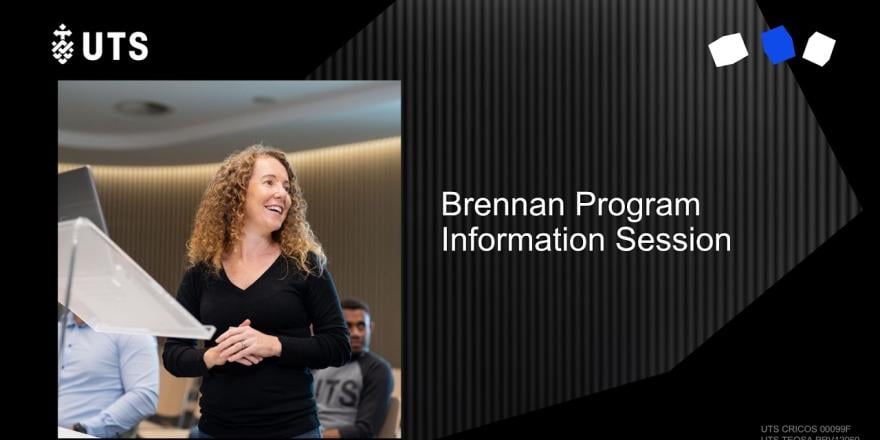
Brennan Program Information Session 

New to the Brennan Justice and Leadership Program or looking for a refresher? This session has everything you need to get started. Explore program components, learn how to earn and log ROJ points and Leadership Through Service hours, and discover inspiring LTS opportunities.
z_f6x3GcolE

Transcript

Welcome, everyone who has joined us. We're just letting some people in from the waiting room, but we will get going. It's wonderful to see so many of you here, and great to see the entrants in the Brennan Justice Program, from, I'm sure, some new and some more familiar students as well.

My name is Associate Professor Anthea Vogl. I am the Faculty Co-Director of the Brennan Justice Program, and I'm joined by Alexis De Zotti, who is one of the student co-directors this year, alongside Mel, who you'll probably meet sometime over the course of this year.

As you know, today's session is a more detailed opportunity to learn about the Brennan Justice Program, for us to present the program to you in a little bit more detail for those of you who attended orientation and heard a little bit about the program. It's also an opportunity for you to ask questions about the program or answer any of your queries, both about how the program runs and how you can get involved, as well as some of the opportunities you'll have access to throughout the course of the year.

Before we get into the session formally, I would like to begin with our Acknowledgement of Country. UTS Faculty of Law is situated on the land of the Gadigal people of the Eora Nation. We pay our respects to Elders, both past and present, and we acknowledge them as the traditional owners of the land. These have always been places of law, and we continue to exist and to teach you in these plural legal worlds.

I'm sure everyone is very familiar with Zoom, so there isn't too much housekeeping to do, but I would like to note that today's session is being recorded, but the recording will only be used for teaching and learning purposes, and you'll only appear on the recording if you speak at the end of the session when we have some time for Q&A, or turn your video on. We really do encourage you to turn your video on, particularly when you're asking a question. It's lovely to see your faces in the discussion time or before that.

And of course, for those of you who have already joined the Brennan Justice Program, you earn five Reflections on Justice points for attending this session. If you've joined the session using something other than your UTS account, please just send the Brennan Justice email a quick message after this, so we can make sure that we have your full name, because your ROJ points will be automatically accrued via your attendance of this session.

Throughout the time that Alexis and I are presenting, feel free to put your questions in the chat, and we'll come to them in the Q&A, so no need to wait to the very end to put the questions that you have as they occur to you. Alexis and I will both be presenting for the first part of the session, and after that, we'll move to our discussion time.

So, as some of you may already know, we'll begin by talking a little bit about what the Brennan Justice Program is. It's an entirely voluntary and co-curricular program for UTS Law students. The aim of the program is to really instil a sense of justice and service in UTS law students, and to really meet the desire of law students to engage in social justice issues.

I know many students, including myself when I began my law degree, began to study law because of an interest in the relationship between justice and the law. The Brennan Justice Program is a program that allows you to pursue that interest and get involved in both legal and non-legal organisations and activities and events that have to do with justice, equality and fairness right from the beginning of your degree.

The program is named after Sir Gerard Brennan. Some of you may know and will have read the judgments of Sir Gerard Brennan, who was a former Chief Justice of the High Court of Australia. One of his most well-known judgments was, of course, the Mabo judgment, which many of you would have read in your Foundations of Law subject and would have continued to reflect upon and learn about as you continue throughout your law degree in other compulsory and non-compulsory subjects.

Sir Gerard Brennan was also the UTS Chancellor, so he had a very close relationship with UTS and UTS Law. The program is named after him because it attempts to emulate and reflect the life of service and commitment to social justice that Sir Gerard exemplified throughout both his career as a jurist, but also beyond that in his service to the legal community and broader community.

There really is no other program like the Brennan Justice Program in other law schools in Australia. It is a really flexible and dynamic program, and responsive to everyday social justice issues, and we would like to think it's really accessible to UTS Law students, so you can get involved in the program and sign up and do as much or as little of the program as you would like.

UTS law students who complete the program, so those of you who might wish to take out the award and commit to meeting all of the points requirements that we'll talk about throughout this session, take out the Brennan Justice and Leadership Award. If you take out that award, it is recognised when you graduate. I know from experience and having acted as a referee for many Brennan Justice students and my own students, that the program is actually really well recognised within the legal profession now and across employers. So it really does give you an ability to communicate some of your interests and your experience when you are seeking employment. But of course, it's not just about your future employment, it's about the service that you provide and the learning that you are able to access as part of the program once you join.

These aren't the only things that you will get from the Brennan Justice Program as a student who joins the program. You can join the program in your very first year—that's a question we often get—and in doing so, you will be joining over a thousand of your other UTS Law students and peers who are part of the program and who actively engage in it.

Once you join the program, what you get access to immediately is our series of faculty-hosted talks and events. There's two to three of those every session, and they are both in person and online. They are very responsive to student interests, current issues, and also give you access to different people in the profession and beyond it who are working in the social justice space.

As I said, while we very much hope you do complete all the requirements of the program and make it a big part of your law degree once you join UTS, you don't have to complete all of the aspects of the program to be part of the Brennan Justice community. So you can enrol in the program now if you haven't already, and start to participate and get access to all of the Brennan Justice activities and opportunities, including volunteer opportunities and information about different events and activities that are going on around the law school and within the law school.

I think one of the best things about the program is its flexibility. We really appreciate how busy law students are. We know as your lecturers how demanding we are and how much work you have to do in your subjects, but beyond that, the pressures of working alongside studying, and of course, family and social lives, which are also very important. So the ability to engage on your own terms and be part of the community is something that is really positive.

If you complete the program, you get a letter of reference from the Dean, you're able to get recognition of the award, particularly on LinkedIn when you start to look for employment, and you also get recognition of the award on your testamur—so your final certificate when you graduate. You are invited to the Law Awards night once you've completed all parts of the program and you are officially given the award as part of the Brennan Justice cohort for your year.

So they're the really positive things that you get out of the award at the same time as really participating in and providing social justice and service to the different organisations that you will engage in through enrolling in the Brennan Justice Program.

I'm now going to hopefully play a short video which gives you a little bit of a sense of the Brennan Justice Program from a student who has completed the program and is sharing with us what he has gotten out of the program.

[Video plays. Student voiceover:] The Brennan Program is a free, voluntary program driven by the ideals of justice consciousness, idealism, and a sense of service. In accomplishing this award, it develops students' capacity for professional and personal leadership and service. Since 2011, the Brennan Program has accrued over 2,000 active members. My favourite part of it was probably the connections that I made and the people that I met. My main goal in joining the Brennan Program was to get more involved in social justice. What I love about the Brennan Program is I really got to meet so many different people and do a wide range of tasks. I was doing things from volunteering at an immigration centre to helping the elderly use IT. So if you're a UTS law student, I would suggest that you just give it a go. It's a fun, engaging, and diverse experience. Being surrounded by people who are driven and who really care about social justice issues really inspired me as well, and it just reminded me that it's possible to create a better world.

[Video ends.]

So, that gives you a little insight into the Brennan Justice Program. This is the Brennan Justice team, so you'll be able to see Alexis and I on the Zoom video now, but there's a wonderful team of law faculty staff who are here to support the program and support you in engaging in its opportunities. Crystal Meikle is currently on leave, but will be returning to us later in the year. Alongside Crystal, we have Siobhan Walker, Bec Keane, and Nalusha Kaur, who's not represented here on the slide, who is another member of the team. And of course, and probably most importantly for you all, your student co-directors, who are always available to support you and answer questions—so Alexis, but also Melanie Davis, who you'll meet throughout the course of the year.

I am now going to hand over to Alexis, who will talk to you a little bit more about how the program operates.

Alexis De Zotti: Thank you, Anthea. So, as she mentioned, I'm one of the Brennan student co-directors, and it's really great to see so many of you joining us today. Anthea gave you a sense of what the Brennan Program is and what you can get out of it. I'm just going to walk you through how it actually works in practice, and then how you can start getting involved from this session.

Before we get into the structure, I just wanted to briefly highlight where you'll be accessing everything, because I know how busy the semester gets, so it'll become really important once all those assignments and extra stuff starts creeping up at uni. A lot of this might actually already feel familiar to you. For example, CareerHub is what you all would have used to register for today's session, and it's the same platform that you'll use to register for all Brennan events and track your progress. You'll also receive regular emails from the Brennan team with updates and different opportunities, so it's definitely worth keeping an eye on those. In addition, platforms like the Brennan Collective Facebook group and Canvas Announcements I find are really useful for finding opportunities as they arise and signing up through that. You don't need to remember all of these now, but just keep in mind these are the main places that you'll be checking throughout the program, so maybe make note of them or come back and refer to these slides.

So, moving on, at its core, the Brennan Program is structured around two key components. The first being Reflections on Justice, or as we like to call it, ROJ, and Leadership Through Service, or LTS. ROJ focuses on engaging with ideas of justice, whether that's through different lectures, seminars, and discussions, and they really explore how justice operates in different contexts. LTS, on the other hand, is more the practical component—this is where you volunteer and contribute to the community, and you can also develop your initiative and leadership skills.

To complete the program, you'll work towards 100 ROJ points, as well as a set of LTS hours, and this will be dependent on your specific degree. But importantly, like Anthea mentioned before, there is very much flexibility in how you achieve this, so you can really choose opportunities that align with your interests and your capacity.

Right, so focusing now more specifically on Leadership Through Service: like I said, this is the volunteering component of the program, and a helpful way to approach it is to just aim for 30 hours per each year of your degree. Although there is now greater flexibility following the recent program update, which is good and means it's basically designed to fit alongside your academic and work commitments, I think our main advice to you all is to start early. Even just a small amount each semester makes the overall requirement much more manageable, and for those doing a four- or five-year degree, it really can add up if you're just doing a bit each semester.

Looking at CareerHub, when it comes to logging your progress, CareerHub is your central platform. There's a short video included in your welcome that walks you through how to claim both ROJ and LTS hours, so it's definitely worth taking the time to watch that. I'm going to hand back over to Anthea now, who's going to go a bit more into detail about the LTS hours.

Anthea Vogl: Thanks so much, Alexis. I think that video might be something that you can access via CareerHub, so we'll share with our attendees after the event. With Alexis having given a really lovely outline of the aspects of the program and Leadership Through Service, often students will ask, how do I get access to Leadership Through Service opportunities, and what counts as Leadership Through Service?

I really echo what Alexis said. It's really great to start thinking about small opportunities or ways you might begin to do a little bit of volunteering early on in your degree. You can accumulate all kinds of different Leadership Through Service opportunities throughout your degree, so it needn't be with one organisation.

When thinking about where you can do your Leadership Through Service hours, a really important point is it doesn't have to be law-related. There aren't only law organisations or organisations to do with social justice and the law. The main criteria that you have to focus on is that it's voluntary—so you don't do your hours for other academic credit or for money. You have to do your hours for a not-for-profit organisation. Sometimes students have questions about whether or not an organisation fits that criteria. You can always send us an email and we can help you understand if the organisation is for-profit or not-for-profit.

Your Leadership Through Service hours need to be spread across more than one year. So as Alexis said, that's another good reason to start early, because one thing that you can't do is simply do all of your hours in the final year of your degree. As I said, it can be single or multiple volunteer placements. It's an achievable number of hours to take out the award, but it's not a small amount of hours, so we do find that students tend to seek out experiences in different aspects of their social justice interests—you might be interested in climate change action, refugee issues, Indigenous justice, and you can volunteer across those different areas throughout your degree.

Important to note that credit for your hours will only accrue from when you're first enrolled in your law degree. Even if you have already got an excellent volunteer interest and you were engaging in those volunteer hours before the first year of your degree, you can only accrue hours from when you began your degree. That having been said, if you did some volunteer hours and didn't register or log them with us straight away during your degree, that's completely fine. You can then say, oh, actually, I forgot I was working for a homelessness shelter in the first year of my degree—can I accrue LTS hours for that? And we can assist you to log those hours and for them to accrue towards your Brennan Justice Award.

This next slide gives you some examples, and I've already mentioned some of these, of the areas in which our students start to volunteer. Some of those things have included providing services for homeless people, doing advocacy for different marginalised groups such as Indigenous organisations or refugees and asylum seekers. Other students have interned or acted as a research assistant at a faculty research centre, particularly when they're doing social justice engagement work—not just straightforward academic research, but doing work to assist community members. You can volunteer with an agency that has a service function—different kinds of services provided to different groups. There is the opportunity to undertake Leadership Through Service hours via the LSS and other student societies, again depending on the student society and if it has that important aspect of service to the community.

It's sometimes easier than other times to find a Leadership Through Service opportunity, and it does require you to take a little bit of initiative or think about the things that you might be interested in. We really encourage you to follow your own interests and associations so you can find opportunities in your local community. There might be a local group supporting the elderly close to where you live, or an initiative around uplift of the amenity and infrastructure in your council area, and they're seeking volunteers. Those kinds of opportunities are really great, and they can meet you where you are.

But we also, often enough, through the law faculty's relationships with a whole range of social justice organisations, will post Leadership Through Service opportunities via Canvas and in our Brennan Justice Facebook page. That's a really great thing to have access to if you join the program, because it means that you can go, oh, wait a minute, I am really interested in access to justice and access to justice organisations, and you might see a community legal centre seeking someone to volunteer for their annual conference. That gives you a really small and discreet opportunity that might fit alongside your study, and you might jump on that opportunity and find that it absolutely is in your interests and is something you might want to pursue later in your degree or in your career.

As Alexis mentioned, these announcements come up through the Canvas page, via email and via the Brennan Collective Facebook group.

Listed here on the slide are some other places where you can go and have a look for volunteer opportunities that you might have encountered before joining the Brennan Justice Program if you've been volunteering otherwise. So there's the Go Volunteer website, the Pro Bono Australia website, and the Good Company website. You can also just use your own initiative and Google different volunteer opportunities with organisations that are of interest to you. We encourage you to reach out if there's been a place that you've always wanted to work—this is a really lovely opportunity to just send them an email and say, I'm part of a program that supports me to do some volunteering in a field of interest to me. Is there any volunteering available?

As the team behind the Brennan Justice Program, we do provide you with some volunteer opportunities through the faculty that you can get involved with. One of those excellent volunteer opportunities that runs every year is the White & Case Neota UTS Law Tech Challenge for Social Justice that some of you might have heard about. This particular opportunity started in 2016 and it involves the Brennan Program now in partnership with the excellent law firm White & Case, a leading international law firm, and the software company Neota Logic.

Under this challenge, students team up with non-government organisations to help them develop real apps to assist with their clients or services. It's a real-life exercise and you will learn the skills and work with a client—a particular not-for-profit organisation—in order to develop an app which they then integrate into the work that they're doing. Students involved in this challenge have developed excellent apps to solve real-life problems that organisations might have in terms of something their client needs or something their staff needs, for over 20 different organisations.

We usually call for student participants at some time in the year, so that will also come out through the Brennan Justice communication lines. Once you apply and perhaps are chosen, you will be given a client and work with that client, and then there's a grand final in August of this year. All of the apps are presented in a wonderful gala evening with your team presenting the problem that your app solves and why your app is the best way to solve that problem. It is then judged and there's a winner of the Tech Justice, the social justice challenge at the end of that night. But also, there's no way to lose in terms of participating because of the wonderful experience you'll get in developing those apps for your clients. So keep an eye out for the next challenge and the opportunity to get involved.

Alexis De Zotti: As we mentioned before, we're going to send you an email and a short video on navigating CareerHub. I can say it is a little bit confusing at the start, but once you have used the system a couple of times, it does become quite straightforward, so keep an open mind with that.

In terms of accruing ROJ points, there are several different opportunities, dependent on how you like to engage with it. The most straightforward way is by attending Brennan events—just like you all have today, you register through CareerHub, attend the session, and then your points are recorded automatically through CareerHub. Another option is you can also attend external events, which typically involves uploading proof of attendance or completing a short reflection. Another great opportunity is discussion groups—these are more in-depth and they provide a great opportunity to engage more critically with issues surrounding justice.

There are a few more flexible and more self-directed ways to earn ROJ points, like LTS hours. Ad hoc activities allow you to claim reflections on opportunities that may not fall within the standard categories, and you can also complete a substantial reflective piece on a topic of interest, which can be submitted in a format of your choice. Additionally, the Brennan Book Program is a popular option for students, particularly if you enjoy engaging more deeply with texts and reflecting on broader themes of justice. So overall, there is definitely a wide range of options to suit your different interests and your different time commitments, which is really good.

If you're looking to get started, there are already a number of opportunities available this session. I know that there's an upcoming Justice Talk taking place very soon, and also applications for discussion groups are already open, so definitely sign up through the form, through all of our communication on Facebook, Instagram, etc. The best way to find these opportunities is through CareerHub, Canvas, or the Brennan Collective Facebook group. A useful tip from us is to bookmark CareerHub very early on, so go do it now, as it just makes it so much easier to keep track of your progress, and then you're able to register events and you don't miss out, because a lot of it is booked and busy.

Another thing we would like to advise you on is the Canvas Calendar, which can be used as a really valuable tool, and actually not a lot of people know about it, but it provides a centralised view of events happening across the Faculty of Law, making it really easy to stay informed and not miss out on these events. While you're already on your Canvas, completing your assignments or different coursework, you can just quickly check what's coming up, and it's a simple habit, but it makes staying engaged with the program so much more manageable.

To give you an idea of what Leadership Through Service can look like in practice, there are a wide range of opportunities available. These can include activities such as donating blood, volunteering with organisations like OzHarvest, and more opportunities will be shared throughout the year, so it's just really important to keep an eye out on the different platforms we've mentioned earlier. Just to reiterate, starting early allows you to explore different options and find something that genuinely interests you, so get started now.

Thank you everyone for listening, and I'll hand over to Anthea to open up the floor to any questions that you might have.

[Q&A session begins. The following is a summary of the main questions and answers:]

- Are we able to put our LTS hours towards volunteering for UTS clubs? It depends on the club. If the club is engaging in community service or community engagement, then the volunteer hours or the work that you might be doing through that particular club are absolutely eligible for LTS hours.

- Would volunteer work on committees such as the P&C committee qualify? Potentially, yes. Particularly work with public schools, or doing work for public schools, can qualify for LTS hours, including P&C committees. For private schools, unless they're partnering with a not-for-profit, it may not be eligible. If unsure, email the Brennan Justice team.

- Can I retrospectively log LTS hours from previous years if I haven't entered them yet? Yes, as long as you can get sign-off from the people you were volunteering with. If you don't have it yet, you can get it retrospectively.

- If I work for a not-for-profit and do unpaid volunteering for them outside my paid hours, can I claim those hours? Yes, as long as it's not part of your paid work and is genuinely voluntary.

- Do we have to complete ROJ over a period of 18 months? No, you have the duration of your degree to complete ROJ points.

- If I change from a double degree to a single degree, how are my LTS hours calculated? Email the Brennan Justice team with your details and they will help calculate your required hours.

- How often are Brennan events for ROJ points held? There are usually two to three law faculty-run Brennan Justice events per session. If you miss an event, you can listen to the recording or podcast and submit a reflection for ROJ points. You can also claim ROJ points for relevant external events.

- Can LTS hours be applied to other programs, such as BUILD or SOUL? Sometimes, but it depends on the program. Email the team with details for confirmation.

- How many volunteer hours do we have to do each year? Do they have to be spread over every year? There's no set amount per year, but you can't do all your hours in one year—they must be spread across more than one year.

- What's the process for getting sign-off from organisations for LTS hours? There is a straightforward form provided by the program. It's just a signature from your supervisor verifying the number of hours, which you then log via CareerHub.

- Where are discussion group applications found? They are posted on the UTS Law Student Society's Instagram, the Brennan Facebook group, and via email.

- Can we claim hours from before we enrolled in law? No, you can only accrue LTS hours from the beginning of your law degree.

- Can we claim LTS hours for events run by the NSW Law Society? Yes, you can.

- There was confusion about the required number of LTS hours due to a recent change. The number of required hours has been reduced in response to student feedback and cost of living pressures. The correct numbers are those presented in this session.

- Can we write ROJ reflections based on our own experiences with the courts or police? Yes, you can. Just explain the context in your reflection.

- Can watching films with social justice themes (e.g., Avatar) count for ROJ points? Yes, as long as you write a reflection meeting the ROJ requirements.

[Session wraps up.]

Anthea Vogl: Thank you all very much for joining us. Please do get in touch with questions, and if you haven't already, you can register for the program via the Brennan Justice page. That concludes our session. I hope everyone has a lovely afternoon, and stay in touch.

Alexis De Zotti: Thank you.

Meet the Brennan co-Directors and administrators

Since the Brennan Program is a joint initiative, our governance requires both student and academic direction. That's why each year, the UTS LSS nominate and vote in two Brennan co-Directors who work alongside the academic co-director and professional staff to facilitate the program.
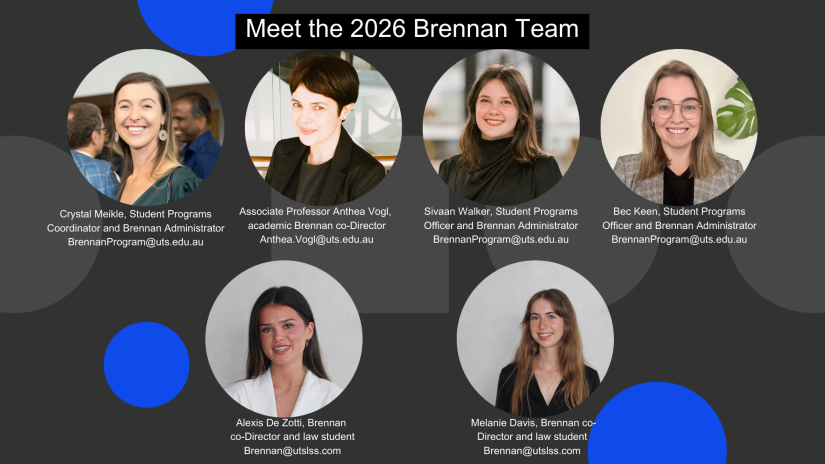
Six headshots of the Brennan Program Team members for 2026

"To see…future lawyers concerned about law and justice and leadership is an assurance that the future of the rule of law in this country is in good hands. I congratulate the Law Students’ Society and the UTS Faculty of Law on their initiative in creating this program. Sir Gerard Brennan, AC, KBE (speaking at the Program Launch, 17 March 2011)"

Keen to sign up? 

Join Now

Contact us

If you've got questions about the program, please don't hesitate to reach out to the program administrators or Brennan co-Directors.

Faculty of Law Brennan administrator
BrennanProgram@uts.edu.au

UTS Law Students' Society
Brennan@utslss.com