


- Posted on 29 Jun 2021
- 3-minute read
The debate surrounding the Future of Work, often so fraught with anxiety, can make it difficult to imagine alternative outlooks when surrounded by the ‘doom and gloom’ scenarios of ‘robots coming to take jobs’.
In the Envisioning Futures subject, BCII Fourth Year students from the UTS TD School were tasked with designing and showcasing an audience encounter around the ‘Future of Work’.
Thinking about the future is fundamentally important for dealing with the challenges of today and the exhibit aimed to provoke audiences to question the desirability of future work scenarios.
The subject integrates ‘Futures Thinking’ methods that project the hopes, problems and anxieties we face today into a wider context and future timeframe. The methods are used to stimulate strategic dialogue and inform decision-making.
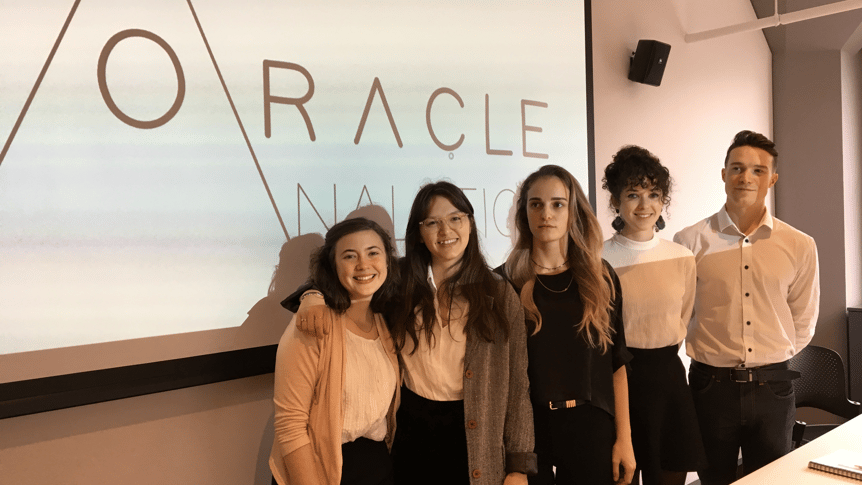
“In a rapidly changing super complex world, it is impossible to predict the future just by extrapolating past trends. There is a desperate need for imagination and creative approaches to thinking about futures that we all wish to live in,” said Giedre Kligyte, Envisioning Futures subject co-coordinator.
Students presented a-utopic experiential scenarios to industry and community members. The showcase delivered commentary and a creative slant on the debate, as well as ideas that could have rigour and application in the real world.
“Students’ responses to the brief exceeded our wildest expectations – from getting paid in social impact points, to a cognitive enhancement ‘rehab’ and planning flexible work hours to fit personal preferences,” said subject co-coordinator Susie Pratt.
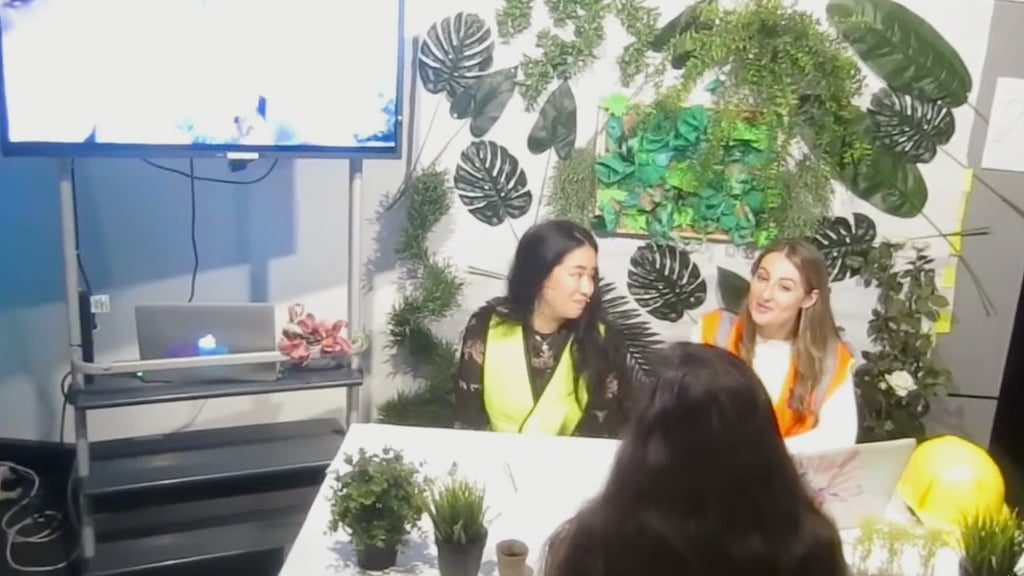
The team of students from Oracle Analytica, an AI lead tech company from the future, needed to recruit humans to meet a government-enforced ‘diversity’ mandate, where companies have a human employee quota of 49%. Stepping into a separate office, visitors had to prove their performative value to a panel of hiring ‘AIs’ in a mock job interview.
The AI dominant workforce represented current trends towards efficiency for the sake of economic growth and ‘progress’, while the ‘human quota’ represented a counter-trend to protect human agency.
In a rapidly changing super complex world, it is impossible to predict the future just by extrapolating past trends. There is a desperate need for imagination and creative approaches to thinking about futures that we all wish to live in.
“The scenario aimed to highlight the paradox between human fallibility, complexity and technological efficiency. A participant from the group interview said it was an unnerving experience. Because we stayed in character, people could really feel like they were only being considered for grunt work,” said group member Delayne Sternbeck-Rutter.
BCII Fourth Year student, Sammy Hurwitz who is working with industry partner, Breville to explore the future of the kitchen said, “It’s a situation of creating the future that you want. If you see where trends have emerged you can harness the positive attributes and redirect the negative ones, it’s a speculative space that is great to delve into”.
It is by thinking about the future in an open, experiential and collaborative way that helps expand our understanding of the type of world that we hope to live in.
“The BCII students have shown that the new generation of emerging transdisciplinary professionals are seeking positive societal change,” said Giedre Kligyte. “They want to play an active role in creating a more just and sustainable future for us all”.
Written by Emily Mundzic
Salmon farming disclosures
We examined climate-related disclosures for Tassal, Huon and Petuna and identified four key gaps between disclosures and existing climate science and other...
Building a research legacy inside elite sport
Since 2017, the University of Technology Sydney (UTS) and the Oklahoma City Thunder, of the NBA, have worked together to better understand what drives...

MekongELEVATE Research Partnership
MekongElevate is a four-year, multi-country initiative under the Mekong–Australia Partnership that seeks to strengthen the climate resilience of marginalised...

Bioengineering Protein Nanocages into Multi-target Vaccines for Alzheimer’s Disease
Alzheimer's disease (AD) is characterised by the clumping of abnormal proteins in the brain, which increases over time and leads to worsening cognitive...
Salmon farming disclosures
We examined climate-related disclosures for Tassal, Huon and Petuna and identified four key gaps between disclosures and existing climate science and other...
Building a research legacy inside elite sport
Since 2017, the University of Technology Sydney (UTS) and the Oklahoma City Thunder, of the NBA, have worked together to better understand what drives...
MekongELEVATE Research Partnership
MekongElevate is a four-year, multi-country initiative under the Mekong–Australia Partnership that seeks to strengthen the climate resilience of marginalised...
Bioengineering Protein Nanocages into Multi-target Vaccines for Alzheimer’s Disease
Alzheimer's disease (AD) is characterised by the clumping of abnormal proteins in the brain, which increases over time and leads to worsening cognitive...